2005-11-17

Israeli media on Tadić's visit

Thanks to friend of East Ethnia O.F. for bringing this to attention. Yossi Melman interviewed Boris Tadić for Haaretz and found out:

*He could not go swimming because he had a flu and was too busy

*The murder of Zoran Djindjić was like the murder of Yitzhak Rabin because "both were motivated by a desire to put an end to historical processes."

*He wants to commemmorate Serbian and Jewish victims in "a memorial center for the common tragedy of our two peoples, which will be built in Belgrade, where two concentration camps were located during the Nazi occupation."

*He sees a parallel between the sense of threat in both states, as (the reporter's words) "many Serbs feel close to and identify with Israel; they feel a common sense of victimization, justified or not. Israel is fighting Palestinian terrorism, and Serbia feels threatened by Albanian terrorism in the fight over Kosovo, most of whose residents are Muslims who want independence from Serbia."

All said, the interview is typical Tadić: a little bit of moderation, a little bit of opportunism, a little bit of playing to the extremes. It makes for an interesting set-piece on hybridity and the uses of victimisation.

Do animals harass people with lawsuits?

So it seems that the philosopher Milan Kangrga has won the case brought against him by the unusual person Tomislav Dragun on charges of "libelling Croatianity," noted earlier this month on this blog. Dragun had claimed that Kangrga had done him damage by claiming that animals were smarter than Croats. Kangrga denied having made any such claim (the conflict seems to have been over a satirical remark the philosopher had made on the question of whether people know what their interests are), and allowed that Dragun was smarter than an animal. There was no effort to specify what animal it was under discussion.

2005-11-16

Moral foreign policy?

The Times reports that the Uzbek interior minister, who is accused of directing the massacre of potesters in Andijon in May, is currently in Germany for cancer treatment. Colonel General Almatov is one of twelve Uzbeks affected by an EU travel ban announced Monday. EU officials explained that "medical emergencies" were exempt from the travel ban. There goes your leverage.

The Bush administration's contribution to the progress of civilisation, in five words

Torture. Secret prisons. Chemical warfare.

2005-11-15

Blog Against Racism Day, 1 December

This is the sort of blog action it is easy to support, and it could produce some useful results. Chris Clarke is asking people to make 1 December "Blog Against Racism Day." There is plenty going on worthy of comment and critique. On that day, put up whatever thoughts you have on the topic, and a good discussion ought to follow.

What's in a name?

The village of Smrdići (little stinkies) near Žitorađe (native town of Ceca Ražnatović), apparently got its name after a lot of horses died there. Now it has changed its name to Izvor (source), for some reason.

2005-11-14

Treatment for blogophobia

There was some concern this past summer when a pseudonymous "Ivan Tribble" published a couple of essays in the Chronicle of Higher Education on the perils of blogging. Considering that he chose a pseudonym for a column in a print publication too, he might as well have been warning about the perils of saying anything at all, anywhere. This week Rebecca Goetz has a response based on her own experience (and a small-scale survey), highlighting the positive contributions of blogging to many parts of the academic job. I would go further: to the extent that professors and other academics have anything valuable to say, they are not doing their job if they do not communicate it.

2005-11-13

Prediction: Something might happen, maybe

The interior ministry of RS is negotiating with somebody regarding a surrender to the ICTY, reports Nezavisne novine. It might be Ratko Mladić, but then again it might not be.

Confronting and understanding the extreme right

Today's papers have several reactions to the very public display of neo-Nazi groups in Serbia. Dnevnik's article cites a number of social scientists, including historian Zoran Janjetović who points out that the country does not have authentic fascist traditions and points to the appearance of extreme right groups as a sign of social crisis. The article also cites social psychologist Žarko Trebješanin who concurs that extreme movements appear as a result of social crisis, and also ties the appearance of these groups to the destruction of social values over the past several years. Sociologist Zagorka Golubović places the development in a global context, pointing out that similar developments are apparent elsewhere in the world, as a consequence of "great turbulence and confusion, and the impossibility of showing that there exists some different, new and more acceptable alternative to the dominant neoliberalism." Sociologist Neven Cvetićanin argues that people who see no future for themselves will tend to find solace in extremism.

A similar but more detailed perspective is outlined in sociologist Isidora Jarić's interview in Politika, where she details the results of a series of surveys on questions of hopelessness, inclination toward extreme perspectives, and the possibility of violence. B92's article concludes with a brief discussion of whether purely punitive approaches can address the problem.

Carnival of the Balkans #4!!!!

The fourth Carnival of the Balkans is up over at Science and Politics! This is the most exhaustive and diverse Balkan carnival ever, featuring Balkan blogs in many languages from around the world. Have a look and see what people are writing about, and what sorts of communications they are getting from their neighbors. Previous editions are archived at the Balkan carnival site.

2005-11-12

Study in Eastern Europe!

Apparently the degree will come much more cheaply than in other places, and the Bologna process is just as tasty.

A reunion in question

A group of veterans of the Honvéd, the Hungarian occupying forces in World War II in Yugoslavia, held a reunion in Subotica, which seems to have inspired differing reactions. The organisers of the meeting, a nongovernmental organisation called "Open perspectives," insist that in the context of the move to claim equivalency for Četnici and Partisans, the meeting should be taken as an effort to promote understanding rather than as a provocation. The meeting organiser Gabor Kudlik denies that most Honvédek were fascists, and that rather these were people who were forcibly mobilised, and that many of them could be considered victims themselves, particularly as many were sent to the Eastern front. Others, including most of those who have so far commented on the news item, see the event a revisionist provocation.

(For my part, I am not certain that "Honvéd" is a very specific term. It would seem to be more or less an equivalent of "domobran," and it appears in the names of many military institutions, as well as providing the name for a popular football club. Perhaps this is a bit of vojvođanski shorthand for something else?)

Update: A brief summary of what J. Tomasevich (War and Revolution in Yugoslavia, 1941-1945, pp. 168-174) has to say on the matter -- the Hungarian occupation concentrated most of its nastiness, especially the dispossession and deportation of civilians, to 1941. Otherwise, the German minority exercised far more real power. By late 1943, Germany had substituted its own power for that of the Horthy regime in every sense but the most formal, and did so in the formal sense by installing Ferenc Szálasi in October 1944. Germany evacuated many Volksdeutsche from Vojvodina when it was clear that territory would be lost, but not many people who were not Volksdeutsche.

2005-11-10

Little fascists

One group cut short a concert in Belgrade by the archival left-punkers The Exploited, by tossing tear gas into the audience of 1000 or so at the Student Cultural Center (SKC). Another group came in to verbally threaten participants in a discussion panel on the "fascist threat" in Novi Sad. Police reacted uselessly in both instances.

Odd as it may seem, appearing publicly as "fascists" is probably as far as these marginal and confused young people can get in terms of associating their behavior with something that people recognize. The tolerance of decent folks is probably the best treatment they will ever receive as well. If real fascists were ever to come to power thanks to their efforts, their "shock troops" would probably be among their earliest victims, as in the Night of the Long Knives.

Update: See the comments for the full text of the statement from the Independent Association of Journalists of Vojvodina (NDNV).

Update 2, 11 November: It looks like the police in Novi Sad are beginning to arrest members of the neo-Nazi group "Nacionalni stroj" after all. But they also want to file charges against the organisers of the meeting that was attacked for failing to file notice of a public meeting. Balance or something, what? But then the balance is upset again -- somebody is smashing the windows on shops owned by Chinese businesspeople in Valjevo.

Islamist Terror Strikes Again!

No, I'm not talking about the very real terror in Amman last night. I'm talking about the increasingly fantastic -- fantastically thin, that is -- case of the teenagers recently arrested in Denmark and Bosnia. The Copenhagen Post Online (whatever that may be) reported yesterday that they were linked to three suspects arrested in the UK:
Police fear that terror suspects arrested in Denmark are linked to a British plot to attack the US White House

A British police dragnet has raised suspicion that nine terrorist suspects arrested in Denmark and Bosnia are linked to a plan to attack the White House and other strategic targets in the United States.

British police became interested in one of the suspects after they arrested three men in London and found they had had email correspondence with a man living in Bosnia. The man living in Bosnia had been suspected of running a network that sought to draw alienated youths to the rebellion in Iraq.

Seven 16-20-year-olds are currently under arrest in Denmark along with two 18-year-old men in Sarajevo, one of Danish-Turkish heritage and the other from Sweden, in connection with the find of cache of weapons and explosives in Sarajevo.

Two days after the two were arrested in Sarajevo, British police arrested three people in Great Britain on suspicion of planning a terror attack on The White House.

The three men had apparently been in email correspondence with someone in Sarajevo who used the codename 'Maximus'.

I don't know where to start with this thing. First, it's totally unsourced. It says, "A British police dragnet has raised suspicion..." but doesn't tell us who is holding that suspicion. It says (in the hed, which probably wasn't written by the reporter) "Police fear..." but never tells us who told the reporter. But let's check the substance.

Police in Denmark and Bosnia arrest a bunch of people. Then the Brits arrest three more folks, apparently in an investigation that was at first unrelated. They find that the three new arrests had e-mail corrspondence with someone in Bosnia. That someone is "suspected" (but we don't know by whom) of running a network that "sought to draw alienated youths to the rebellion in Iraq." We are not told whether the network ever succeeded -- the term "seek" seems to indicate it didn't, and I wouldn't know what it means to "draw" someone "to the rebellion in Iraq" anyway.

The sole connection between the UK arrests and those in Denmark and Bosnia seems to be this 'Maximus' guy -- but the article doesn't even tell us whether those arrested in Denmark and Bosnia were ever in touch with him!

I'm not denying the very real danger of radicalism in Bosnia, or the potential for terrorism there. But the fact is that all of it is so far just speculation -- and I hope it'll remain that way.

Ustav ćemo vam

In the Guardian, Ian Traynor is reporting that "the Americans have written a new constitution transforming Bosnia into a centrally governed parliamentary democracy." The report indicates that some Bosnian politicians were consulted as well, but none are quoted in the report until the next to last paragraph, and this one does not seem too hot on the plan. While the new draft seeks to address one of the complaints about the Dayton agreement, that it imposed an unmanageable degree of decentralization, it does not address a more widely shared complaint, that it was imposed from outside.

2005-11-09

A baseball league is named after him

It was always certain that the Bush administration, a criminal aberration distinguished by dubious popular legitimacy, profit-taking under the rhetoric of patriotism, theocratic absolutism, incompetence in the face of disaster, illegal retaliation against intelligence agents, ill-conceived warfare, and torture, would go under. It is going under. With surveys showing that broad majorities disapprove of the job the president is doing and distrust him personally, his party entered the first major local elections since the national elections in 2004. They lost races for the governorships of both New Jersey and Virginia. In St Paul, Minnesota, a Democratic mayor who broke ranks to endorse Bush's reelection campaign has been defeated by a wide margin. Next year, the Republicans will lose their majorities in the two houses of Congress, in preparation for losing the presidency two years after that.

That is enough time for the Democrats to try to show that they can be anything other than pale and quivering imitations of their opponents, if they are able.

Update: In other election news, Maniac Shop's poll has chosen Belgrade's representatives to the final status talks on Kosovo.

2005-11-08

Your suggestions, please

Here is the deal: I will be heading off in December to the university in lovely Nishville (yes, I know! The home of Louis and Šaban Bajramović!), where I will have the job of helping the local sociologists improve their program in sociology of culture. The plans are ambitious: for creating a regional MA program in cultural studies (together with other universities in the region) concentrated on the Balkans to, more immediately, putting together a new textbook for sociology of culture. This is one of the results of isolation over the past several years: contacts need to be rebuilt, curricula are fifteen years out of date, and contemporary textbooks and readers need to be put together. It is not just Serbia -- there are no new culture textbooks in Croatia or BH either. Yes, this means I will be maintaining another blog silence for most of December.

This is where you come in. I have a budget from the foundation that is sponsoring our cooperation to bring them publications in sociology of culture that are essential for bringing the curriculum up to date, and portions of which might be excerpted and translated to be included in the textbook. What should I buy them? We are defining sociology of culture broadly -- for example, political sociology and sociology of religion are fair game, together with the usual topics. I have a sense that "border studies" might make for some good analogies, and our friend at Phronesisaical has given some good suggestions.

So, what would you like them to get? What texts do you think need to be in a new reader? The criteria are: 1) they should have been published between 1990 and the present, 2) they should be helpful in understanding the production, character and social life of culture, and 3) they should be, if not about the Balkans, about something for which comparisons and analogies will be useful in the Balkans. My finger is on the "order now! button.

2005-11-06

New frontiers in libel

The courts in Croatia should be keeping themselves mighty busy, but fortunately the Balkan scissors can be relied upon to cut to the chase. First the writer Predrag Matvejević was sentenced to a five month prison term for calling out a right-wing lesser writer. Now the philosopher Milan Kangrga is being charged for "libelling Croatianity" (is that a legal entity?) in a newspaper column. The Kangrga case has apparently been transferred from the Zagreb court to a rural district (a place which got a traffic signal earlier this month! And some road paving last month!), which could easily be interpreted as a strategic move to create a greater likelihood of conviction.

4eme Carnaval des Balcans


The Carnival of the Balkans is coming back. The Fourth Edition will be hosted at Science and Politics next week. Send your entries (or suggestions about other people's entries) to Coturnix1 AT aol DOT com by Saturday, November 12th at 8pm EST. The Carnival will go up on Sunday.

2005-11-04

I to ti je Amerika

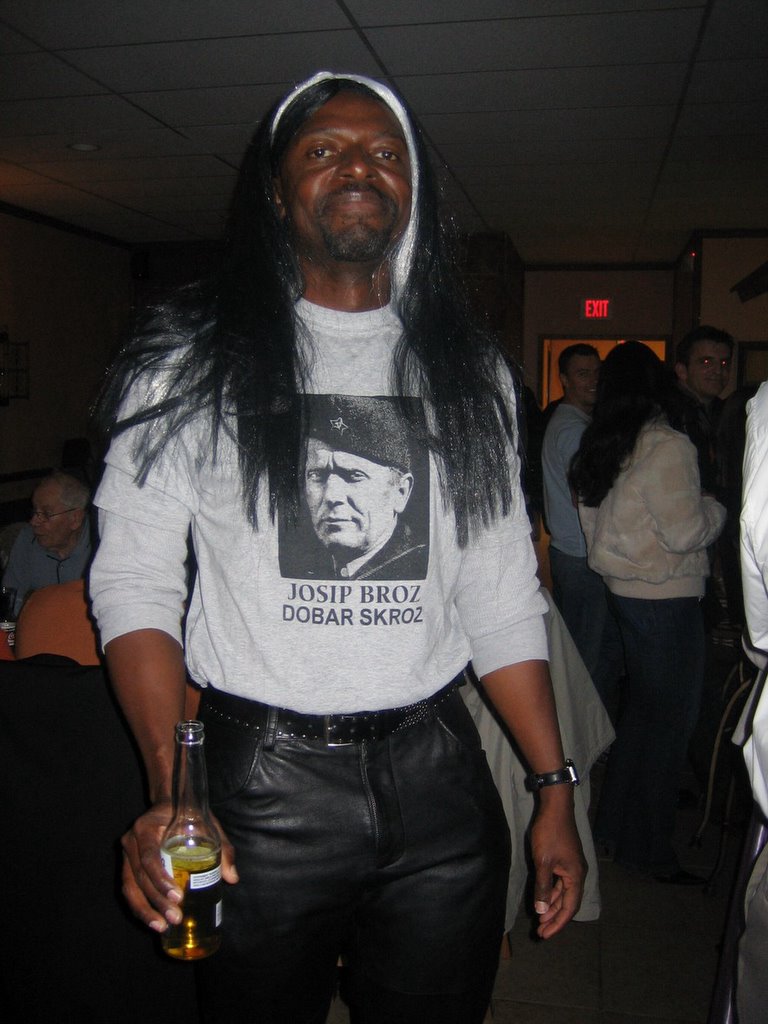
I do not know who the gentleman in the leather trousers is or where or when the photo was taken. It was sent to us by a friend in Njujork. But he has a nice t-shirt.

Of course, there are lots of other places where one can find signs of nostalgic remembrance of Tito.