2006-10-12

U-turn in Iraq?

Ever since it became clear that no WMDs would be found in Iraq, building democracy in Iraq has been the declared goal of the occupation, and its post facto justification. Is this about to change?

A bipartisan working group under former Secretary of State James Baker has been looking at the options. (Big surprise: none of them are good.) Baker has dropped hints, some less subtle than others, that this whole idea of democracy is just a distraction from stability in Iraq. According to a piece in today's Sun, the commission -- or at least Baker -- buys the canard that Iraq is essentially a sectarian conflict, a product of multi-ethnicity, which is of course the most popular "explanation" of what's happening there. The implications are clear: dictators are alright as long as they hail from majority groups (Bashar, move over).

On PBS's "Charlie Rose Show," Mr. Baker was careful to say he believed the jury was still out on whether Iraq was a success or a failure. But he also hastened to distinguish between a Middle East that was "democratic" and one that was merely "representative."

"If we are able to promote representative, representative government, not necessarily democracy, in a number of nations in the Middle East and bring more freedom to the people of that part of the world, it will have been a success," he said.

That distinction is crucial, according to one member of the expert working groups. "Baker wants to believe that Sunni dictators in Sunni majority states are representative," the group member, who requested anonymity, said.

100% Pamuk


Congratulations to the brilliant Orhan Pamuk, who has been awarded the Nobel prize for lterature.

Vic dana iz Danas-a

Gost u restoranu naručuje doručak:
- Želim dva kuvana jaja, jedno gotovo sirovo, a drugo tako tvrdo kuvano da se jedva može jesti, dve kriške tosta, jednu jedva malo pečenu, drugu prepečenu, jedan komadić maslaca da bude otopljen, a drugi ravno iz zamrzivača, šoljica kafe neka bude slaba i mlaka, a sok od narandže podgrejan.
- Ali, gospodine, to je vrlo komplikovana narudžba. Biće je teško ispuniti.
- Ne bi trebalo da vam bude teško, to ste mi juče servirali.

Maznuto od Danas-a, 12. oktobar 2006

2006-10-10

A dal se to pita na slavi?

Repeatedly asked by reporters to clarify the status of the ministers from the G17+ party who have resigned their positions but continue to occupy them, prime minister Vojislav Koštunica replied:
"All these questions you are asking, I will gladly answer them some other time. Allow me, the question we are discussing today at the Academy is much, much more meaningful, regardless of any type of journalistic curiosity, than the questions you are asking. That question is absolutely secondary both in its essence and formally, compared to the fact that Serbia has finally received a new, democratic Europan constitution and that afterward democratic elections will be called. That is the only thing that matters."
"Four legs good," continued the prime minister, "two legs bad."

2006-10-07

Great post-election moments, RS edition

Milorad Dodik, who runs the one-party statelet inside Bosnia known as Republika Srpska and who is the only Bosnian politician to have both a vision for the country and the mandate to implement it, was asked on the BHTV show Javna tajna Thursday whether he would wish to become Bosnian prime minister. He replied, according to BBC Monitoring,

Sarajevo, well, what you still have there is an unconsolidated political climate, which absolutely does not leave much room for creative people--and I believe I am one of those--to show [their potential]. I want to tidy up and organize the Serb Republic in order to make it the incontestably more developed part of Bosnia-Hercegovina in the future.


Creative people would be wasted on Bosnia's central institutions, in other words. Is that why he said in the same interview that he might send Nikola Spiric there?

Great moments in devotional orthography

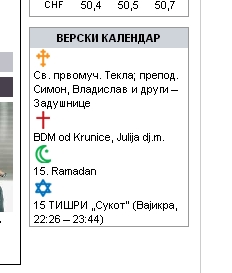
Not to pile on Politika (which I increasingly enjoy reading, especially on Sunday) or anything, but friend of East Ethnia Mirko sends in this tidbit I had never noticed from the bottom of the web page. As near as I can tell, aside from the occasional ad and the symbol for Swiss francs (which would look silly as цхф), the only Latin script that appears on the page is in part of the daily religious calendar. The Lord prints in mysterious ways.

2006-10-06

Great moments in translation

One of the interesting phenomena I was able to observe on my visit involves the long march of Politika back to respectability and its historic position as the premier newspaper in the area. Last Monday, they initiated a strategy of reputation-by-association, running a special additional section (in English) of articles selected from Sunday's New York Times. It's a nice section, and undoubtedly useful both to people who want a glimpse at international media and to people wanting to keep their English language skills in shape. In the interest of achieving that second goal, the section contains a box at the bottom of the second page, prepared by the Institut za strane jezike, with translations of some rare or new English expressions. A very nice idea altogether. The first item in their little glossary was:
butt brushes -- sudaranje kupaca u suviše uskom prostoru

I never knew this! Nor did my students. But I like it.

He's baaack

Why no posts for a week, you may or may not ask? Your humble correspondent was globetrotting to glamorous destinations. Beograd, Niš ....

The trip to Belgrade was for a conference (sponsored by the Association for the Study of Nationalities and the Forum za etničke odnose) organized by distinguished Ethnian (and according to Slobodna Evropa, "britanski ekspert") Florian Bieber. Simply fantastic stuff, and many perfectly charming people. In the meantime, there were the interesting elections in BH on which TK has been leading debate here (imagine! politics in an election!), and Serbia got a constitution written overnight and approved by a Parliament whose members had not had the time to read it, to be followed at the end of this month by a referendum which could easily go either way. In response, the courageous leaders of G17 resigned their positions but did not leave them.

It is always a pleasure to go to Niš, to which the buses get more luxurious each time I go. This was a short visit, but I think our project (about which more when there is concrete news) is really moving forward. It is surprising that more people do not go to Niš. I am not saying that everybody needs to visit, just everybody who loves peppers.

So now I am back, and between home and work I will be resuming my normal syncopated rhythm of posting. Thanks for your patience. It looks like the United States was a complete disaster while I was gone. Lunatics shooting schoolchildren? Congressmen schtupping teenage boys? What on earth?

2006-10-02

All for democracy, as long as I get elected

Voters in Bosnia's general election yesterday (October 1st) pushed the system to its absurd--but logical--extreme: it looks increasingly likely that Željko Komšić from the non-nationalist SDP might be elected Croat member of Bosnia's three-member presidency, with a substantial chunk of his vote coming from ethnic Bosniaks. The reason is simple: while the three co-presidents are representatives of Bosnia's three constituent peoples (Serbs, Croats, and Bosniaks), voting is organized by entity. Residents of RS vote for the Serb member while residents of the Croat-Bosniak Federation vote for the Croat and Bosniak members. The SDP recognized that it stood no chance of winning against either incumbent Sulejman Tihić nor indeed Haris Silajdžić, whose victory last night was unexpectedly convincing, so they presented a candidate for the Croat member. Incumbent Ivo Miro Jović, who made a scene at the TV studio and insulted journalists there, announced that "Ivo Miro Jović will be the Croat member of the B-H Presidency or the Presidency will cease to exist," in a remarkable display of his understanding of how democracy works.

Expect preliminary results for the parliamentary elections (both at entity and central level)sometime tonight local time (press conference announced for 9pm).

2006-09-26

Montengrans and other ans

If Serbia is RS, then the inhabitants of Montenegro are "Montenegrans". Well, at least this is to whom Rumsfeld talked to: Rumsfeld holds talks with Montenegrans after that trip, he is going to talk to Serbans, Croatans and Bosans. Luckily, he is not visiting the Republic of Sata.

It's RS after all

ISO has reconsidered and accepted the initial proposal of the Serbian government, which is a lot better than the earlier compromise solution of SS.

2006-09-25

Kandidat za Oskar

This year's entry from Serbia into the Oscars competition will be Sutra ujutru, directed by Oleg Novković from a screenplay by Milena Marković. The original songs for the film were written and composed by Miroslav Mitrašinović, the optimistic miner from the documentary Rudarska opera, produced by the same couple. The film tells the story of a returnee from Canada who comes home, and meets his old friends and problems in a big way. It is, in my humble opinion, one of the more distinguished pieces of contemporary dramatic film from the area (Full disclosure: I had a very tiny role in the production of the film -- revising the translation -- and Ivana and I have translated a couple of other projects for Milena and Oleg, who are our pals. But we do not have any influence over film juries.).

A ko vas traži?

Is EU accession going to lead to a huge migration of labor from Romania and Bulgaria to the UK? The UK Home Office seems to be planning for the eventuality, and probably has plans to try to limit what they (may) anticipate to be an inflow of 60K to 140K workers. Gallup's survey in Bulgaria suggest otherwise: they find about 46K people saying that they intend to seek employment abroad, and Britain is not their first choice. Most would prefer to go to Spain, Germany, Italy or Greece. Alan Travis is listing for The Guardian a number of research studies showing that, for a variety of reasons, the UK is not all that attractive a destination for employment migration from SEE. A government that is declaring its hostility in advance is probably not enhancing the attraction. If there is unfounded anticipation in Britain, it may be because people are expecting the influx of workers from Poland to be repeated. If so, there is a crucial difference being overlooked: there was already an established Polish community and network in the UK, and there is nothing approaching that level of ready-to-use connections from Romania or Bulgaria.

In a similar pattern, there are some signs that the direction of the India-UK "brain drain" might be starting to move in reverse, as people become attracted to an environment that is dynamic and where they are less likely to encounter growing forms of "profiling." These are probably not the same reasons why a large number of people already in Britain express a desire to leave.

2006-09-22

Defending Magyarity

For the electronic world, there is a new Hungarian cuisine blog. For Worcesterians (but also worth a trip from such distant spots as Boston), there is the recently sampled and very fine indeed Anna's Kitchen.

Immodest revision of obscene proposal

This is truly appalling. It is a "compromise" that codifies violations of the Geneva Conventions and gives them the appearance of law. Read the analysis by Marty Lederman, who also provides the proposed text. Then vote against any member of the US Senate who favors this monstrosity, and if you have any cash to spare, donate it to their opponents. Did you ever believe that you would see the day on which torture was legalized?

2006-09-21

Identity

The lawyer Kemal Kerincsiz has filed over 40 cases against writers who have considered the Armenian genocide in their work, accusing them under Article 301 of the Turkish criminal code of insulting "Turkishness" ("Turkianity"? "Turkitude"?). Today he lost one more case, against the novelist Elif Shafak. The value of Article 301 aside, the frequent repetition of cases like this would seem to raise the question of why Mr Kerincsiz believes that he is defending a culture by incessantly attacking the people who contribute to it.

The last plane to Moskva

Today's arrest of Marko Lugonja, one of the people accused in the conspiracy to harbor Ratko Mladić (a "jatak," which is of course different from a "hohštapler"), took place at the Belgrade airport, on a plane which was getting ready to depart for Moscow. This might be interpreted as a sign of desperation on the side of the fugitive wannabe, who wanted to get out any way he could. Or it might be interpreted as a sign of supreme confidence, taking a regular flight with a ticket and all.

2006-09-19

Detaillessness

Okay, so Gyurcsány Ferenc is a liar. But he does not seem to be too upset about this. And nobody seems to be bothered by his Hugh Grant penchant. But people are angry, or at least desirous of television equipment. As may be expected, Erik D'Amato is ready with a constitutional solution.

2006-09-17

Zlatko Brzina

In other film-related news, Richard Gere is in Sarajevo, where he seems not to have impressed folks much.

2006-09-14

Fate-less-ness

Imre Kertész’s novel Fatelessness is a unique piece of work, and it impressed me. In contrast with his other works like Kaddish for an unborn child, which is self-reflective to the point of claustrophobia, this one is told in the voice of a teenage boy who is, sometimes shockingly, not reflective at all. And in contrast to the overwhelming majority of works in (what I guess has to be called) “Holocaust literature,” it proudly and aggressively refuses both melodrama and moralism. In that respect the work is paralleled by the work of only a couple of other writers who treat the period – Tadeusz Borowski, and perhaps to a lesser extent Primo Levi.

Kertész explained some of the motivations for this approach in his Nobel lecture in 2002. He was confronted both by his own ambivalent memory and by the demonstrative nature of much of the existing literature:

“The experience was about solitude, a more difficult life, and the things I have already mentioned - the need to step out of the mesmerizing crowd, out of History, which renders you faceless and fateless. To my horror, I realized that ten years after I had returned from the Nazi concentration camps, and halfway still under the awful spell of Stalinist terror, all that remained of the whole experience were a few muddled impressions, a few anecdotes. Like it didn't even happen to me, as people are wont to say.”

[....]

“In the free marketplace of books and ideas, I, too, might have wanted to produce a showier fiction. For example, I might have tried to break up time in my novel, and narrate only the most powerful scenes. But the hero of my novel does not live his own time in the concentration camps, for neither his time nor his language, not even his own person, is really his. He doesn't remember; he exists. So he has to languish, poor boy, in the dreary trap of linearity, and cannot shake off the painful details. Instead of a spectacular series of great and tragic moments, he has to live through everything, which is oppressive and offers little variety, like life itself.”

One of the elements in the book that makes the strongest impression is the way in which the main character, before his deportation a detached and ironic lad, but in all instances a model of orderliness and obedience, accepts so many of his experiences as reasonable and tries to adapt. A good deal of the book’s tension comes from the contast between what the lead character does not know and the reader does. This acceptance weakens as he weakens in the camps, but does not really collapse until he returns home to Budapest. There the varieties of misunderstanding he encounters leads him to realize (as Kertész put it to the Swedish Academy in 2001) that he has been in exile from a homeland that has never existed”.

This leads to the conclusion, as shocking as it is gentle, in which the narrator expresses what sounds like nostalgia for the horror he has experienced: Yes, the next time I am asked, I ought to speak about that, the happiness of the concentration camps. If indeed I am asked. And provided I myself don't forget.” If the image of "happiness" in such circumstances still shocks, that was the author's intention. "I took the word out of its everyday context and made it seem scandalous," says Kertész. "It was an act of rebellion against the role of victim which society had assigned me. It was a way of assuming responsibility, of defining my own fate."

I am not certain that all of those factors which made the novel so unique and impressive come through in Lajos Koltai’s film of the novel, its title shortened to Fateless. The film is shot (very much in the style of István Szabó, with whom Koltai collaborated as a cinematographer before this directorial debut) in nostalgic sepia tones, the story told slowly and aestheticized. Some scenes which I interpreted as crucially important are left out or shortened – for example, the conclusion of the main character’s conversation with a well-meaning liberal journalist on his return to Budapest. One sequence is added, though it is not clear what it adds – after the liberation of the camps, an American sergeant tries to persuade the main character not to return home. All this is additionally puzzling, since nobody can accuse the screenwriter of messing with a badly understood text: Kertész wrote his own adaptation. But there is something odd about seeing the work of an author who defined Spielberg’s Schindler’s list as “kitsch” presented in a style that seems just the littlest bit Spielbergesque.

This is not to say that I don’t recommend the film. It is interesting on in own level, and has some well considered beauty. I would recommend it (like a lot of adaptations) more as a supplement to the book than as a substitute for it.

Cinema 320 is showing the film at Clark University this week. After the last projection (3:40 PM on Sunday in the Jefferson Academic Center, room 320), I will be leading a discussion for anyone who is interested. If you are around, come on down.