2007-01-24

Curiouser


A loyal reader writes in to point out: if you go (sometime in the very near future, before the spot changes) to the popular website of the Mideast historian Juan Cole, and look at the right side of the page, you will find this lovely ad. It shows Vojislav Koštunica in front of a wall with an icon and a flag, fingering a ballot box with a come-hither expression on his face. The ad is right above another one promoting the candidacy of Barack Obama, and it features the following text:
The New Serbia
A young democracy, rich in tradition, with religious and press freedom.
A democratic Serbia is the key to stability in the Balkans, an inspiration to all in the region.
The New Serbia
An investment in democracy that's working
Read more

There are links in the text, but they all lead to the same not so exciting site: the place where the government puts out its English-language press releases (among the news items: 3,334 votes means that "31.5% of diaspora casts ballot"--that is rather a smaller diaspora than other folks, some of whom might know what the government is saying, claim). If Professor Cole's source code is to be believed (and why should it not?) this ad was purchased through Blogads for the modest price of $100, and the buyer was promised that it would be seen by 193,732 people, of the type targeted by the "Liberal Blog Advertising Network." It's interesting company for a government which is led, for another few weeks anyway, by a party which releases statements claiming that visits by European diplomats before an election "are impermissible and damage the normal life of the country."

Technorati:

CNN rewriting Bosnian geography


Tonight's main news show on Bosnia's national broadcaster was all excited about CNN's weather site. BHTV had a story couple nights ago about CNN putting Sarajevo under "Yugoslavia," a country that no longer exists. In the meantime, CNN has fixed the site. The result is to the left.

2007-01-23

On the uses of SRS

My post-election wrapup has now been posted at Open Democracy. A little polemics, a little prediction, plenty to disagree with.

Last-chance exit

In June last year, the consortium of interested parties overseeing the international peace mission in Bosnia, the Peace Implementation Council (PIC), decided that the Office of the High Representative should close in June 2007. It was entirely clear back then that the OHR under Christian Schwarz-Schilling would spend most of the remaining time dealing with its own phase-out rather than with the pressing issues confronting Bosnia (including police and public broadcasting reform, constitutional amendments, and the blocked process of inching closer to the EU).

Now, even the PIC seems to have recognized that its decision was premature; when its Steering Board meets in Brussels at the end of February, it is very likely to extend the OHR's mandate. (The decision had always been subject to review in February.) Another piece of news: according to today's Dnevni avaz, Schwarz-Schilling will be replaced, presumably by someone who's actually interested in using his office to achieve concrete results. For this situation, however, the PIC deserves as much blame as Schwarz-Schilling, whose views on the extensive powers of the OHR were after all well-known even before his appointment. (Avaz is not known for meticulous fact-checking, but I've now heard the same from more credible sources.)

Rumor has it that Schwarz-Schilling is about to make a statement to the effect that he would not serve beyond June.

The whole episode is embarrassing because it suggests that the PIC hadn't done its homework before appointing Schwarz-Schilling, or before taking the decision to phase out in June. It is also a blow to the idea, already rather thin intellectually, that the pull of European integration would on its own be strong enough for Bosnia's elites to bring their irreconcilable visions for the future closer together. Thanks to the PIC, Schwarz-Schilling's term in office has been a complete waste of time.

2007-01-22

The number of the beast?


Somebody in the Ukraine is the 66,666th visitor to East Ethnia. For you, a picture of the Beast.

Technorati:

SRS 81, DS 65, DSS 47, G17 19, SPS 1, LDP 15, SVM 3, LZS 2, URS 1, RP 1

We drove, she voted, we enjoyed. This was our first experience with consular voting. It turns out that the Serbian consulate is in a fairly spare seventh-floor office on East 45th Street in New York. They use a Verizon address for electronic correspondence. No big crowds, but there were people coming and going the entire time, and no big security, but one NYC cop lounging by the desk. Then the commission with the list (they had an incorrect address for Mrs Ethnia) and a young volunteer with that stuff they put on people's fingers. The contribution made to the survival of democracy, we proceeded to enjoy our weekend in New York.

The result, as it turned out, was probably about as good as could be expected, neither the best nor the worst. Open Democracy asked for my response, so I'll have a link to that when it comes out. One blogger who could always be counted on to disagree with me (in a good way, and accompanied by the sounds of Balkan hip hop) seems to be hanging up his blogging skates, but we can hope that turns out to be temporary. Meanwhile, Viktor might need some help drinking all the beer he will be getting.

2007-01-19

Izborna tišina

I had been thinking of giving you a play-by-play of Sunday's elections, but instead the invitation to vote at the consulate that Mrs Ethnia got in the mail persuaded us to use the event as a (hardly necessary) excuse to spend the weekend in New York. I'll be back with analysis as quickly as I can, though.

2007-01-17

Bajbuk


Biologist Bora Coturnix has been edutaining the world for a while with his blogging on science, politics, and the relations between the two. Now he is coming out with a new book he has edited, The Open Laboratory: The Best Writing on Science Blogs 2006. And he is collecting nominations for the 2007 edition. In the meantime, you can buy the book.

2007-01-15

Quotation of the day

From B92 news:

Analitičar Milan Nikolić kaže da političarima ne treba zamerati zbog ljubljenja beba. "To je dokaz da političari pokušavaju da se prikažu kao obična ljudska bića, što u suštini nisu", kaže on.

2007-01-14

A week to election day

In anticipation of the parliamentary elections in Serbia a week from today, an assessment and some hesitant predictions. Making predictions is usually a foolish enterprise (if it is not obvious in advance what the result will be, then the only way a prediction can be correct is by chance), but why should that stop me?

As much as I am not fond of Mr Koštunica and his DSS, and even less of his coalition partners, they deserve credit for what has got to be the most skillful effort to transcend political conflicts and issues in a political campaign. Everything from the campaign slogans "Živela Srbija" (živela!) and "Narod najbolje zna" to the new year concert which appeared to bring together opposed social forces, in this case Ceca and a random selection of rokeri, succeeded in being both memorable and content-free. Although they will probably end up with a third or fourth place finish next week (there! a prediction!), they have given the media impression of being a party of power about which other parties talk. It is easy to agree with the assessment by Dragoljub Žarković that Mr Koštunica has assured his success by outperforming the very low expectations which people had of him.

For the most part the opposite has to be said about the party that stands to gain the most from the election, DS. They act like a party of power which runs in terror from the risk of saying anything that prevents them from being all things to all people, and to top it off is not in power. The move of naming their candidate for PM, former finance minister Božidar Đelić, might help them, in the sense that he is a figure who is respected by many, despised by few, and comes forward with a clear program that he has recently published. The announcement may have come too late to help them much, but DS has calculated, probably correctly, that their best hopes are fuelled by inertia and dissatisfaction with the current government.

A few of the parties are in the race mostly to save themselves from oblivion. A few of them (like G17) may succeed in this, and some (like SPO, SPS, and a few curiosities) will more likely fail. But the most interesting reemergence from oblivion has got to be the campaign of the Čedomir Jovanović vehicle LDP. Shut out of his previous party for his radicalism and overreaching and because of a reputation (whether it is deserved or not) for corruption, Mr Jovanović will most likely come out of this election at the head of a parliamentary delegation, and will certainly come out with recognition as a force to be reckoned with. A sign of his power was observable during my visit last month, when LDP posters were the most obvious and frequent targets of anticampaigners and vandals -- there is probably something to the principle that whoever is being attacked most is probably threatening somebody who ought to be threatened. Another sign was apparent last night at the new year celebration/election rally hosted by DSS, at which a discredited former pop idol in a hat he borrowed from Branimir Štulić dedicated an insulting song to the party leader. If the best attack is an accusation of being a drug addict coming from a drug addict, this is pretty close to a sign of having achieved untouchable status.

The biggest open question of the election, of course, is with how much power SRS will emerge. It remains popular for government officials and NGO types to use the threat that the extreme right may come to power in order to extract money and support from the internationals. This is still happening. But the SRS campaign has been strangely quiet. It may be that they are running low on resources and that their original campaign plan to capitalize on the suicide of the party leader was scuttled by Mr Šešelj's failure to comply. On the other hand, the greatest advances by SRS tend to take place under the radar. It is a matter for research whether what happens under the radar is the mobilization of dissatisfaction or the engagement of clandestine services. But I will go out on a limb here -- the only time SRS has been close to ruling has been when there was a dictator willing to put them into that position. Their supporters will turn out, as they always do, and provide them with enough representation to assure that they have access to the publicity for scandalmaking well into the future. But they will underperform expectations, and will never be close to forming a government by legal means just as they never have been before.

What does this all amount to? Probably not much, which is either a disappointment or an achievement in itself, depending on how you look at it. I am guessing that the next government will be an everyone-but-SRS coalition, and that DS will be slightly more influential and DSS slightly less influential.

Lawyers and torture

I received this essay from a mailing list I subscribe to today. Apparently it is the transcript of a lecture by P. Sabin Willett, "My worst moment as a lawyer." It goes over justifications for torture, the way prisoners are produced, and a defendant who decided to give up.

2007-01-13

Homily

Thanks to the loyal and dedicated reader who drew my attention to this inspiring story, which shows how the love of baked goods is stronger than the hatred of some ethnicity or another, regardless of whether people agree as to how the object of the hatred should be labelled, and what all this has to do with real estate.

2007-01-09

... a pivo voli nas

How to strike up a conversation with Europeans in the US: join in the complaints about top-loading washing machines and American beer. On the washing machines, point granted. The old saw that American beer is bad applies pretty much to the mass-marketed national brands, which are uniformly watery, flavorless, and pretty much only good for marinating beef (even then, a proper beer would be better). People with longer or tastier experience in the Statiunitima know that there are a lot of very fine small-production and local brews. Personally, I'm a fan of the products of the Ommegang brewery in Cooperstown, NY. Americans are moving away from the stereotypical product as well: domestic sales are stagnant, while imports are growing rapidly.

The most representative of the domestic mass-market bunch, and object of innumerable jokes (one of them involves canoes, but that is as far as I am going), is the flagship product of the brewery giant Anheuser-Busch, Budweiser (introduced in 1876). For over a hundred years, Anheuser-Busch has been in a trademark conflict with the Czech Budweiser Budvar brewery, which has marketed a far superior product under the same name since 1895. A-B claims exclusive rights to the Budweiser name, which kept the Czech product out of US markets for a very long time and may cause some easily resolved confusion in Europe.

Now Anheuser-Busch and Budejovicky Budvar have reached an agreement, whereby A-B (which already has marketing agreements with several international producers, including the Belgian giant InBev), agrees to market and distribute the Czech product in the US. It will continue to be sold under the deeply unsatisfying compromise name Czechvar.

It is one small step.

2007-01-08

Where was the previous Provence?

Travel and Leisure magazine declares that Istra is "the next Provence," whatever that may mean. This may well be the case, althugh it remains unclear just what this may mean for the present Provence or for any of the Provences which may have come after it. Before the next Provence pops up, though, they note the construction of some new sites for mass elite tourism and the intrduction of cheap air routes from the UK. My advice would be to avoid the better-known "beaches," which "sparkle as brightly as those of the better-known coast to the south" (why would you want a beach to sparkle?) and head inland.

2007-01-04

A good year, after all


East Ethnia joins the Republic of Greece in declaring
2007 to be the year of Maria Callas.

2007-01-03

Intelligence dump

There may or may not be something of interest in the documents released by the National Intelligence Council, representing some of the intelligence estimates on Yugoslavia prepared for US agencies between 1948 and 1990. What may be most interesting of all is the introductory essay to the collection by Marten H.A. van Heuven, attempting to assess just where intelligence succeeded and failed, and noting the strong and perhaps excessive emphasis placed on trying to understand Yugoslavia through the lens of the Soviet Union.

Related?: The CIA's role in the publication of Dr Zhivago?

The future of education?

I have the same mixed feelings as most of the folks who teach at private universities about the increasingly consumerist nature of the whole enterprise. We old folks often complain that paying students are encouraged to feel entitled to any number of things -- our time, a grade, a degree -- while the financial constraints often mean that we serve a fairly narrow social group (although like at most costly institutions, a minority of the people there pay full tuition). Interestingly, in discussing teaching with my colleagues from "the former countries of real socialism" (anyone remember that phrase?), many of them have the sense that high tuitions mean that the people paying them are more likely to be highly motivated than just passing through. For people in the teaching field, it often seems as though the goal is something not entirely realistic, providing knowledge and insight to people who really want it but do not really need it. I render this with a little bit of irony, but still hold to the belief that the best students will usually be the ones who have chosen what they are doing, for reasons of which they are aware.

For those reasons and a bunch of others, the Toronto-basedAnarchist U(niversity, no?) project looks very intriguing. It is not entirely new, having operated since Fall 2003. And it is not so big, with just three courses this term and not much more than five or so in other terms. Courses are free (there may be a charge for books and copies) and non-credit, and most of them are on political and social themes. Although it seems that course development and enrollment are e-mail and wiki-based, the classes themselves are nonvirtual, with people gathering in rooms at particular times.

Probably this sort of model is not likely to substitute for the kinds of institutions where most instructors and students find themselves now. But it looks like a mighty good way of making it possible for both teachers and students (broadly, rather than professionally, defined) to do a bit more of the stuff that attracted them to the world of knowledge in the first place.

A test post

This post is a test. I am trying out a new (to me) blog posting program called Bleezer.

Okay, it seems to work. What I like about it so far is that it circumvents the Blogger interface, and that it makes adding tags easy. No complaints yet.

You'll also find some fancy new links on the link list.

Technorati:

2007-01-01

Particularly chalga

Aside from continuing to synthesize fear of immigration, UK media are also welcoming Romania and Bulgaria to the EU by showcasing their pop culture. Apparently Bulgarian chalga artists run the gamut from "at least Bulgarian" to "not particularly Bulgarian." Thanks to Mirko for the tip.

2006-12-31

Because I cannot help myself

Vanessa Paradis performing "This will be our year"


What was I going to put up? LDP's new year TV spot?

Oh my, Francesco has a new year song as well.

Sretna nova godina

The remainder of the day, and hence the year, will be divided between grading papers (down to the deadline, again!) and cooking. Our menu for this evening:
  • Mushroom soup in the style of the Hungarians, if they were Japanese
  • Lentil salad (this is supposed to bring good luck)
  • Ruska salata
  • Stinco di vitello al vino
  • A bunch of fruit and cheese
The goal this new year, as it is every new year, is to cook so inefficiently and make a meal so engaging that midnight will come and go without any of the guests noticing.

However and whomever with you are celebrating, a happy new year to you and yours.

Srđan Vrcan (1922-2006)


Sad news to end the year. This text arrived last night from Christophe, friend of East Ethnia. The text of the obituary is by Srđan Dvornik:

Srđan Vrcan was professor of sociology at the University of Split, Croatia. Born in 1922, he was the head of the Chair of Sociology at the Law School of the Split University from 1961 to his retirement in 1990. In 2003 he was awarded the title of Professor Emeritus. He also taught at graduate and post-graduate studies in Zadar, Zagreb, Ljubljana, Belgrade, Sarajevo, Vienna, Rome, Pecs, Berkeley, Sacramento. For many years he was a co-leader, together with the German professor Rudolph Siebert, of the seminar "The Future of Religion" at the Inter-University Centre for post-graduate studies in Dubrovnik. He presented the results of his scientific researches at conferences and symposia in Rome, Florence, Bergen, Dresden, Moscow, Berlin, Paris etc.

He was the Chairman of the Croatian Sociological Society. Through three consecutive terms he served on the Executive Board of the International Conference for Sociology of Religion in Lille/Paris. For many years he was on the Editorial Board of the journal for sociology of religion Social Compass, first published by the Catholic University of Leuven (Belgium), later by the Sage Publications (London). He was among the founders of the journal for social issues Pogledi (Views), which was published in Split from 1969 to 1990. He was also on the Editorial Boards of journals Sociologija (Sociology, the journal of the Yugoslav Sociological Association) and Revija za sociologiju (Review of Sociology, the journal of the Croatian Sociological Society).

The main field of Vrcan's scholarly interest was sociology of religion. On that subject he published the books Raspeto kršćanstvo (Christianity Crucified, 1980, co-authored by Boris Vušković); Od krize religije do religije krize (From the Crisis of Religion to the Religion of Crisis, 1986); Faith in the Swirls of Transition (Vjera u vrtlozima tranzicije, 2001). He studied social inequality (Social Inequalities and the Modern Society – Društvene nejednakosti i moderno društvo – 1974); the relationship between sport and violence (Sport and Violence Here Today – Sport i nasilje danas u nas, 1990; Sport, Violence, and Politics – Sport, nasilje i politika – 2003); as a co-author, he participated in two studies of voting behaviour (A Raid on Voters – Pohod na glasače, 1995; Packaging Power – Pakiranje vlásti, 1999); he was also a co-author of a study of youth (Position, Awareness, and Behaviour of the Young Generation of Yugoslavia – Položaj, svest i ponašanje mlade generacije Jugoslavije, 1986). He also published hundreds of scientific and review articles, articles in newspapers and interviews, which makes him one of the most productive Croatian sociologists.

Vrcan's particular merit is establishing and development of the particular sociological disciplines such as sociology of religion, of sport, of politics, of the youth, and of elections and electoral systems.

Srđan Vrcan actively supported democratic civic initiatives; thus, he was among the founders of the Association for Yugoslav Democratic Initiative, the first political civic initiative in the communist Yugoslavia (established in early 1989). He participated in many civic education activities, such as summer schools for democracy and human rights, and spoke at many public panel hearings on relevant political issues.

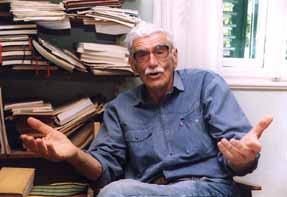
The photo is from an interview with Rade Dragojević in Zarez, in which Vrcan discusses his research on football fans and politics.

2006-12-30

Revenge served clammy

It is not necessary to have any sympathy for Saddam Hussein -- who was a revolting thug -- to see the futility of his rushed and widely publicized execution. Alive, the only people to whom he presented a danger were those who might be mentioned in the evidence he could give in trials that will now not be conducted. Dead, he is a monument to his failed trial and the fictional government that has now taken its useless revenge on him. Some people will now try to turn him in a martyr, which can only further increase the level of violence in the world. As far as deterrent effect, his killing ought to prevent the survival of the sort of political movement he developed about as much as the hanging of Mussolini did.

2006-12-29

Ford passing on the right

How surprising to see Gerald Ford dominating the news. He lived a long time, and during his brief, accidental presidency, he showed himself to be not an especially capable politician. His pardon of Richard Nixon set a precedent for impunity that has been called upon several times, and won him the undying gratitude of the handful of people who circulate between high positions in Washington. He plucked Donald Rumsfeld and Dick Cheney out of obscurity and set their bizarre mix of sadism and ressentiment on the world. It is a wonder that he is remembered at all.

He did, however, have a sense of humor.

2006-12-27

Some preelection music

Discipline kičme, "Političari virusi"

Povratnik


I'm back from my brief Balkan sojourn, partly unpacked with gifts properly distributed to their intended recipients. While there are many good things about being back at home, one that stands out is the ability to shower for longer than five minutes, without being confronted by the dilemma of whether to shower or shave today. Regular blogging to resume as soon as the inspiration strikes me.

Photo: Eric takes a moment for discussion with the youth of Niš.

2006-12-18

Great moments in tailoring

Hrvoje Petrač led the search for innovative uses of religion at the moment of his sentencing for kidnapping. Despite repeated instant messages, God could not be reached for comment.

Update: Loyal reader AR drops a note to point out that the text which Mr Petrač cited a bit selectively does not promise so many good things for him.

Election slogans

A few of the election slogans I have seen around (not all parties have begun media campaigns yet), with cheeky commentary:

DSS-NSS-Palma -- Živela Srbija ("Long live Serbia!," or alternatively, "Serbia lived!")
Jes da je živela određeno vreme, a vi se možda time ponosite, a?

G17+ -- Stručnost ispred politike (Expertise before politics)
It is not clear to me why any party would want to highlight its inability to do politics. The slogan might seem to call to mind some other things that G17 has put ahead of politics, which would not be so beneficial for the party.

DS -- Život ne može da čeka (Life cannot wait)
Is this a slogan for a political party or for a cosmetic product?

LDP i ostali -- Od nas zavisi (It depends on us)
Who thought that it would be a good idea to bring up the image of dependency in a slogan?

The phantom PSS -- Srbija ima snage (Serbia has energy)
I always thought that this slogan, the same one they used in the last election before the party leader hightailed it to Russia to avoid prosecution, should be "Srbija ima snaje." True and appealing, at the same time.

Noted at the bus station while waiting for my luxurious ride to Niš: the buses that claim to go to Sarajevo but in fact go to Lukavica no longer have a little sign in front saying "S. Sarajevo" ("Srpsko Sarajevo"). Now the sign says "I. Sarajevo" ("Istočno Sarajevo").

Pozdrav iz Beograda

(written Friday; posted when I found an internet connection)

I arrived on Thursday, after a more or less okay trip. Belgrade looks much the same, at least what can be seen of it through the fog. It looks like posting will be intermittent for a while -- we thought that we had resolved the question of internet connection in our palatial vračarska garsonjera, but in the meantime the building changed cable providers, which means we are back to step one. There are promises that this can be quickly and easily resolved.

From the first moment I began to encounter the things I like about Belgrade, which include:
Friends and family: Here they are. As it turns out, though, some of them have jobs for me to do.
Burek: This week about 93% of the people in Serbia will celebrate sv. Nikole, which is a "posna" slava (not a good thing), but as a side effect the bakeries have burek with mushrooms (a fantastically good thing).
Beogradski rokenrol: over the next two days at SKC, we have Partibrejkersi, Disciplina kičme, Obojeni program and much much more.
Beogradski radio: Every station, including the ones I don't like, has its individual character. Here is an idea for a društvena igra: look at the face of a taxi driver and try to guess what station is playing in the cab. Your guess is certain to be wrong.
People on the streets: There they are.
Of course, in addition to the things that I like, there are also other things. The first major success of the special prosecutor for war crimes, last year's Ovčara conviction, has been reversed by the Constitutional court. Last summer, when it seemed as though the far right might be returning to power, this sort of thing looked like a strategy of stretching out the cases until everybody could be pardoned; now that it seems like the upcoming elections will probably just bring a reshuffle of the balance of power between DSS and DS, it is less clear what the judges are trying to do (or prevent from happening). Maybe they would like the trials to last forever?

Politika announced today that it has placed on the web site of the Narodna biblioteka its issues from 1903 to 1941. Just 65 more years of digitizing, and it will be possible to read recent articles from the paper online as well, which every other major paper in the country offers.

On Sunday it is off to Niš. The fog, I might add, is gorgeous. I woke up this morning and looked out the window, and thought maybe someone had come in and closed the shades while I was sleeping.

2006-12-13

Svuda prođi

I'm travelling today, back at you from the sunny Balkans, if I find an internet connection.

2006-12-12

Demokratski blok

Does anyone remember the parliamentary speeches by Dragan Marković - Palma, parliamentary candidate on the DSS list, when he was a member of parliament on the list of the Stranka srpskog jedinstva? That must be because they have not been well documented.

2006-12-10

Stipe u raljama života

Follow Index and Neretva River for the developing brouhaha over stupid remarks Stipe Mesić may or may not have made in 1991, and a set of responses ranging from the inadequate to the self-incriminating, none of which makes any of the people involved look too good at all.

Update: All the same, Catherine has found grounds for pomirenje. Between Mesić and the ubiquitous Mr Thompson.

A gdje bješe taj CK?

Nikola Kavaja could have been a pioneer in terrorism in 1979, if he had known where the building he wanted to smack a plane into was located (hint: it is the only building in a huge expanse of grass). Or so he claims. He claims a lot of other stuff too, in a fascinating interview with Christopher Stewart. Some of the stuff he claims might even be true, however it sounds. But the old fellow can tell a story, he can.

2006-12-08

Two criminal cases


Vojislav Šešelj began his diet on 11 November, and ended it today. So he stuck with it just under a month, longer than I usually manage such things. Of course, he and I have in common that hunger is a choice for us, which distinguishes us both from the people who were forced into poverty when Šešelj was in power.

In other news, a mere seven years after his murder, prosecutors seem ready to bring to an investigative judge the case of the killing of Slavko Ćuruvija. Says the special prosecutor, "all indications are that it was a political killing."

Photo: Vojislav Šešelj is welcomed back to the ranks of the gluttonous by the members of Midnight Oil and ZZ Top.

Some survey results

Here is one from Danas, on the basis of a survey of 1700 potential voters by the "Scan" agency, as reported by the funnysurnamed director of the agency, Milka Puzigaća:
DS: 20%
SRS: 18%
DSS-NS: 17%
LDP-GSS-SDU-LSV: 9%
G17+: 5%
SPS: 4%
SPO: 3%
Matters change when the results are calculated on the basis of respondents who say that they are certain that they will actually vote in the election. Then it looks like this:
SRS: 28%
DS: 25%
DSS-NS: 17%
LDP-GSS-SDU-LSV: 9%
G17+: 5%
SPS: 4%
SPO: 3%
So the main difference in comparing all respondents with likely voters applies to the results for DS and SRS. This is because the highest percentage of SRS supporters (75%) declare an intention to vote, fewer supporters of DS and the LDP-based coalition say so (60%), while only half (50%) of SPS and SPO supporters declare they will vote. The reporter for Danas, R.B., did not give figures for DSS supporters -- R.B., are you reading this?

I say 1) it's too early to make predictions, and 2) the track record of preelection surveys in Serbia does not give much reason to treat results of this type as anything other than a curiosity, good for half a beer's worth of conversation. At the same time, it hardly offers a reason for headlines like the one accompanying the article by Radovan Borović (hey, wait a minute--R.B:?) in RFE-RL, "Šešeljev štrajk povećao popularnost Radikala." No it hasn't, and the higher of the potential results is still lower than their most recent result.

2006-12-06

International cooperation

Did the "Zemun clan" plan to assassinate former Croatian PM Ivica Račan as a way of returning the favor of assistance from Croatian criminal groups in the assassination of Serbian PM Zoran Đinđić? Novi list reports that they did, and Račan says that he received similar information.

Background on the news item of the day

For anybody who is interested, here is the report of the tzv. "Iraq study group" which was released today. And the cartoon version is here.

2006-12-05

More on the Dutchbat medal

The award of medals to the Dutchbat 3 soldiers who abandoned the civilians they were obligated to protect has certainly got a response! Participation in the “Aferim!” campaign (linked in the previous post) promoted by the student radio station of Sarajevo has been worldwide in scale, and there have also been press responses. This modest site has not been immune from it, either, since I posted an item on the issue yesterday. Usually East Ethnia gets somewhere between 100 and 150 visits a day. So far today there have been over 1500 visitors (and it is not yet noon here!), nearly all of them from the Netherlands, with a wide variety of responses being left in the comments. Some people are expressing agreement, some offer a different perspective, and some disagree quite vehemently. Of the ones who disagree, there seem to be a few who are under the mistaken impression that the whole issue involves somebody’s mother – I am not quite sure where this association comes from. Leaving those remarks aside, the comments offered in defence of the soldiers of Dutchbat would seem to call for me to define a position more precise than simply outrage at the awarding of medals for abject failure.

First of all, in what does the responsibility of Dutchbat consist? At bottom, in dereliction of duty. Their job was to protect the civilian population, and when the moment of decision came, they decided to protect their own personnel instead. Some of the arguments in defence of Dutchbat come down to pointing out that an effort to protect civilians would have put the soldiers at risk. This can only be persuasive if one fails to distinguish between soldiers, who take on risk as a condition of their employment, and civilians, who do not.

This is of course not the whole story, and a whole variety of other failures (as well as factors contributing to those failures) are detailed in the NIOD report, as well as in other places. In addition to political and military failures and misunderstandings, there were cultural ones, many of them detailed by Guido Snel in a very interesting reflection.

A more persuasive objection has to do with the unenviable situation in which the Dutchbat forces found themselves. The elements of this are summarized in the announcement of the NIOD report. In essence, the unit had poor instruction, poor information and communication, and inadequate support. Some of this was the result of vagueness in the conception of the UN “peacekeeping” mission in Bosnia-Hercegovina, and some of it was the result of decisions made by military commanders from Dutchbat and from forces commanded by the military of other countries.

Some of the problems have to do with problems endemic in the activity of “peacekeeping” itself. In situations in which there is no peace to keep, the activity can – and does – easily devolve into auxiliary support for the warring parties, and peacekeeping forces can easily be used as a secondary strategic resource. Many of the problems have to do with a lack of political will on the part of the UN and the most influential international political actors to take any action that went beyond giving the appearance of concern. That is to say, some of the responsibility for Dutchbat’s dereliction of duty can plausibly be transferred to other actors. This does not diminish the obligation of the commanders to act in accordance with international law and in the interest of the people they are bound to protect. How well this obligation was carried out is illustrated in the photo in the post below, showing colonel Kerremans raising a glass with Ratko Maldić. Živeli, a potom više nisu.

Probably it is the case that minister Kamp saw the distribution of medals as a gesture of reintegration of the soldiers, some of whom must have been traumatized by the obvious failure of their mission, and some of whom were deterred by their commanders from doing what a soldier is obligated to do. This sort of situation may call for therapy, certainly calls for action against the commanders and review of procedures. But a medal on the chest of an accomplice is a slap in the face to the people who trusted and depended on the forces that failed them.

2006-12-04

Valour


While the troops commanded by Ratko Mladić (price: 600 million Euros) carried out the massive killings in Srebrenica, the Dutch peacekeeping troops who were there to protect the victims did nothing. Today the members of that infamous Dutch battalion were presented with medals by their defence minister. Minister Henk Kamp says that in trading thousands of civilians under their protection, for summary execution in exchange for fourteen Dutch officers, Colonel Thom Kerremans and the rest of Dutchbat III "did their utmost." As Mr Kamp is doing, no doubt. Here is a site at which you can send a postcard of congratulations to the Government of The Netherlands, the Embassy of the Netherlands in Sarajevo, the brave soldiers of Dutchbat 3, and the Netherlands Ministry of Defence. Bravery is as bravery does, after all.

Sevdah on my mind


A friend of a friend of East Ethnia is a friend of a friend of mine, and Damir Imamović is a friend of music as well. The page linked in the last sentence is nicely designed but still awaiting its content. However, there is another page at Myspace where you can see who the musicians are, find out about upcoming performances, and download three examples of "fusion sevdah." About those upcoming performances, one of them is 12 December at the Terazijsko kazalište (two days before I arrive in town, na svoju veliku žalost). There is hope for all those people unfortunate enough not to be in Belgrade that day: they can buy the group's album for a mere nine and one half Euros, less than the price of your average published work in the social sciences.

2006-12-03

New (to me) in the blogosfera

Obviously I will have to be updating the link list. I haven't done it in ages and hope to do it soon. In the meantime, you will probably enjoy the culinary and musical explorations at Dumneazu.

In other news that will force me to deal with my aging link list fairly soon, the Serbian Mess blog has a new name and location, or so one hears anegdotally.

Being of sound mind and body

The Serbian Radical Party gave a public presentation of the political testament of Vojislav Šešelj. The fact that he is not dead only presents a problem to those for whom the distinction between the living and the dead is meaningful. Dakle, not for SRS.

2006-12-01

Spectres and their terrorist aspirations

In a dramatic warning reported by the BBC, "The US government has warned of an al-Qaeda call to attack US online stock market and banking services." The warning "was said to be in revenge for the continued detention of suspects at the US prison camp in Guantanamo Bay." But wait: said by whom? And why would al-Qaeda take revenge for detention of suspects when if there were any evidence that these suspects had anything to do with al-Qaeda, charges would have been filed against them?

It turns out that the guilt of the suspects is not the only thing for which there is a lack of evidence: "A spokesman for the Department of Homeland Security, Russ Knocke, said there was no evidence to corroborate the threat."

Now, I thought I had heard one of the most foolish phrases of my life at a recent conference I attended where somebody proposed something he called "spectral terrorism," which he defined as the consequence of terrorism in an environment where there is no terrorism. Yes, you read that correctly -- it is a fancy way of admitting that you are giving an entire presentation about something which does not exist at all, while at the same time demonstrating no shame for wasting everybody's time by talking about nothing. But here is a new one from the same Department of Homeland Security spokesman: "aspirational threat." Now, you all know what an aspirational threat is: it is a bichon frise growling at a lion, a threat that is not a threat at all, in fact, it is nothing.

Says the Department of Homeland Security spokesman, the warning was issued out of "an abundance of caution." Or possibly, an abundance of something else.

2006-11-30

Academia goes to the movies

This just came in the old e-mail. I doubt that I will get myself organised in time to respond, but maybe one of you will, yes?
From Slavic Review: Call for Papers: Borat: Eurasia, American Culture, and Slavic Studies

Few recent works of literature or film have made Eurasia as central and, perhaps, as flagrantly irrelevant to the American experience as Sacha Baron Cohen's hit film, Borat. In many respects this movie touches on key aspects of our discipline and expertise, and it also marks the distance that "Eurasia" has traveled in the American mentality since the appearance of other epoch-defining films (From Russia With Love, Doctor Zhivago, The Manchurian Candidate). Slavic Review invites its readers to submit contributions for a cluster of scholarly essays on Borat. Contributions may use the methodologies of any discipline so long as they relate in some substantial way to Borat and to interaction between Eurasia and the West.
Length should not exceed 5000 words. Contributions will be peer reviewed and must be received by the end of March 2007. If you have questions, please contact the editor, Mark Steinberg, at slavrev@uiuc.edu.

2006-11-29

Partnership for what?

The wire services are reporting from the NATO summit in Riga that Serbia, Montenegro, and Bosnia-Herzegovina have been invited to the Partnership for Peace, a sort of ante-chamber for eventual full membership. The NATO statement pointed to the "importance of long-term stability in the Western Balkans" and acknowledged the progress made so far by Bosnia and Heregovina, Montenegro and Serbia." It called on Bosnia and Serbia to honor their commitment towards the Hague war crimes court and announced it would monitor progress on the matter.

After turning a blind eye to Karadžić and Mladić for over a decade, NATO didn't have much credibility left to lose in the Balkans -- but it has somehow, inexplicably, managed to gamble away even that little bit.

2006-11-27

Delić istine

Just follow the links .... From today's report from AFP (no link, sorry) on the response of the Serbian Radical Party to the opening of their leader's trial in the Hague comes this sentence:
"While Vojislav Seselj is practically dying in The Hague, the trial was opened as if nothing is happening," said Bozidar Delic of the Serbian Radical Party (SRS).
Božidar Delić, now, that is a name known to TV fans everywhere as the retired general who found a hobby in his golden years of appearing repeatedly as a defence witness for Slobodan Milošević. Is he representing SRS now? I am not certain, but came across this account of a meeting in March, which was attended both by representatives of SRS and by the former TV personality Mr Delić. The sponsors are listed as the "International anti-NATO Movement," together with something called the "Serbian neo-Gaullists."

But follow the links, and one gets to the "National-European Communitarian Party." Their newsletter features a portrait of Ernesto Guevara, no neo-Gaullist himself, on the masthead. But perhaps El Che was a part of their "National-Bolshevik current." The party also has a link to "the situation in Serbia," which leads to a placeholder noting that the page no longer exists. Then this page autotransports the browser to a site listing a variety of activities of the group, including a heartwarming essay finally telling us the truth about Stalin. Oh, and also to the Serbian intifada. From Vladivostok to Reykjavik, preko Milvokija, bre.

But where is Waldo? I mean, Boža.

Not so much

Later than most, we finally watched the Borat film over the weekend. Our expectations were mixed, no doubt. On the one hand, we expected a lot of puerile humor and exploitation of naive subjects (but were mostly unworried about any possible sullying of the reputation of Kazakhstan). On the other hand, we were primed by a variety of media accounts presenting the oft-disguised Mr Cohen as a guerrilla comic who exposes the dark side of American life by appearing to be foolish enough to share the prejudices of his interlocutors. At the same time, saddled by disappointing experience, we arrived with the awareness that efforts to inflate characters developed for sketch comedy to the scale of the large screen usually fail.

The end result, comparing the actual viewing experience to our expectations, is that the film has a little of all that and not enough of any of it. What is disgusting is often amusing, if you like that sort of thing, but not overwhelmingly or hilariously so. What is exploitative is apparent, but not mean enough that anybody seeing it would actually care. As for the biting political satire, well, Borat unearths the surprising fact that racism exists, but there is nothing there that anybody did not already know. He has a couple of interviews with minor ex-politicians, but uses only a few seconds of footage from each; these interviews must not have gone well. In sum, what comes across on film is a bit smarter than, say, Candid Camera, but neither as revealing nor as feeling as Tito po drugi put među Srbima. There are a few moments that stand out from the howling pack of moments: most of these involve people indulging Borat for reasons unknown, but the rapidly shifting response of a rodeo audience to his rants is truly scary, and a group of drunken fratboys is distressingly recognizable.

We left the screening thinking of ways in which somebody with a similar idea might produce a truly impressive film. It would probably not be a popular hit, then. If the producers made a "making-of" documentary parallel with the film, though, that might be really fascinating. As it turned out, I walked into the theatre thinking I would disagree with Darko, but walked out agreeing.

Montenegro as it... might be?

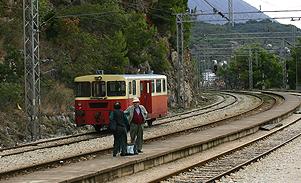
Real trains...

For those who have not been to Montenegro, but have watched the latest James Bond, this might be a bit of a dissapointment. The high-speed train from Switzerland to somewhere in Montenegro bears little resemblence to the Montenegrin railways today and would lose its attraction somewhere along the line of the 30 hours long journey. And the hotel is also not quite the Hotel Crna Gora... But it seems that Montenegrin tourism will profit and Casino Royal is already invoked in Montenegro's advertisment . Sorry, just no evil lair there (except maybe Radovan Karadzic's).


Fake Hotels...


...and real ones

Dont fear the reaper

The trial of Vojislav Šešelj began today, with the accused represented by David Hooper as his own remaining energy, constrained by a melodramatic attempt to demonstrate that hunger strikes are available even to the morbidly obese, is being spent in the effort to think up evocative names for the tribunal judges and prosecutors which he has not already used. The way things are going, he remains well behind his colleague Branimir Glavaš in the effort to transform the putrefaction of the flesh into publicity.

Meanwhile, the preelection season has been marked by one protected witness offering selective testimony against a few of the people with whom he communicated when he was a conspirator, and by the police demonstrating that on instruction, they can produce a limited number of fugitives.

2006-11-19

Rentacops gone wild

This video was taken by a student at the UCLA library. It shows campus police repeatedly using tasers against a student. An officer threatened to use the weapon against another student who requested a name and badge number. What is a taser? The name is an acronym for Thomas A. Swift Electric Rifle, and it is designed to stun a person by discharging an electric current into the body. Its intended use is to allow law enforcement officers to stop a highly violent individual without a high risk of causing death. It is on these grounds that such taser advocates as the company that makes them (duh) and several police agencies that use them (the RCMP, for example) defend their use. Controversies over their use have to do with their ability to cause death when they are used against people with certain medical conditions, such as heart conditions, and with incidents like this one at UCLA, in which they are used solely for intimidation against people who clearly and obviously present no danger at all. That is why organizations like Amnesty International highlight concerns about abuse of this weapon, and advocate that their use be suspended.

UCLA has done pretty much nothing to address the incident, other than repeatedly administering electric shocks to acting chancellor Norman Abrams until he issued a weaselly statement blaming the student for being attacked.

I am a graduate of the University of California, having got two degrees at the Berkeley campus. During my years there I provided them with a lot of free and below-market labor. It is a system with a good deal to be proud of, a fantastic faculty, outstanding library collections, an often okay record in dealing with a hostile state government. The administration when I was there did not generally contribute to the quality or reputation of the institution, and now that condition seems to have reached metastasis. As much as I believe in public education, this system is not getting one penny from me, ever.

Update: Was it enough for Norman Abrams to demonstrate that he is not capable of carrying out the job he holds? Apparently not, assistant UCLA police chief Jeff Young also had to show his complete lack of familiarity with the appropriate use of force. Does the Taser Corporation recommend using their device as a "pain compliance technique"? What kind of compliance is expected from a person who has been immobilised by pain? Here is the LA Times showing why the officers involved, their commanders, and Norman Abrams, who have already disgraced themselves and the institution that they represent for no apparent reason, should be fired and prosecuted:
Several local police agencies — including the LAPD and Los Angeles County Sheriff's Department — allow officers to use Tasers only if a suspect poses a physical threat or is acting combatively.

The sheriff's policies expressly say deputies can't use Tasers simply to move someone.

"We look for assaultive conduct," said Bill McSweeney, chief of the sheriff's leadership and training division "We generally don't use the Taser on passive resisters except when an individual indicates explosive action to follow, such as a verbal threat."

But UCLA police are allowed to use Tasers on passive resisters as "a pain compliance technique," Assistant Chief Jeff Young said in an interview Friday.

See the comments to this post on the highly charged atmosphere in Houston and Slovenia.

Another update: Does the UCLA police force screen its employees at all? Then perhaps they might have known why officer Terrence Duren was fired from the Long Beach Police Department. Or they could have used the evidence that was immediately available to them based on incidents at UCLA when he choked a student with his nightstick, and when he shot a homeless man. Or is a long history of complaints considered a positive recommendation?

Low-end imperial tourism

I do believe that this video is the most tasteless thing to which I have yet linked from this blog, at least in the video category. Not that I haven't tried. "Sonne, strand and šljivovic," apparently.

2006-11-16

History in the Making

In case you did not already have the urge to spend your holidays in Kosovo, the Department of Tourism of the Ministry of Trade and Industry launched a nice website. Better than "Discover Wild Beauty" or "The Mediterrenean as it once was", the slogan is "History in the Making"... Not that wrong, but usually tourists are just not very enthusiastic to witness history in the making. Other suggestion might be "Where status really matters" or "Travel to Kosovo: Standards and Status" or "When you want to leave your holidays from a different country you go to: Kosovo"

2006-11-15

Zar je zločin citirati ludake?

Testifying for the defence of Milan Martić at ICTY, Smilja Avramov said .... actually, who cares what Smilja Avramov said?

Democratic values and procedures

Certainly no democratic party is ideal. Still, I am not quite sure what my distinguished colleague was thinking. Even if I am a little bit charmed by his relativisation of the instrumentality of epic poesy.

Musical interlude

I'm off today to Washington to attend a conference and distribute quarters to the unemployed Republicans thronging the sidewalks. In the meantime, enjoy Rambo Amadeus and Kal, "Dikh tu kava" (featuring the vocal of Dragan Ristić).

2006-11-14

Clueless in the Balkans, fall 2006 edition

When I was an intern at the Open Society Institute in 1997-98, my boss, Arthur Helton, had me draft letters to Bob Gelbard, the Dayton czar of the Clinton administration. They often started, "Dear Ambassador Gelbard, Bosnia is at a crossroads." Today, Bosnia really is at a crossroads. The best indication for that is that even the EU has noticed.

Yesterday, EU defense ministers met to discuss troop reductions in peacekeeping missions (read: Congo and Bosnia, with customary good timing).
"A decision to reduce troop strength is under consideration," EU foreign policy chief Javier Solana told the meeting. "The situation in Bosnia-Herzegovina allows this."
Source: AP, Concern over Kosovo delays EU decision on cutting Bosnia force, International Herald Tribune, November 13, 2006

But then he went on to say that a decision should not be taken before next month, and actual withdrawal not begin before February.

If the situation in Bosnia "allows" troop reductions now, why wait till February? Because the UN has just postponed its imposition of a Kosovo status until after the Serbian elections, to be held at the end of January. Solana's people must have forgotten to brief the current EU presidency on these things, though:
Finnish Foreign Minister Erkki Tuomioja, who chaired separate EU foreign ministers talks with Ahtisaari, said the U.N. envoy's decision to delay would not harm efforts to bring lasting stability to the Balkans.

"We are not afraid it will destabilize the situation," he told reporters.

In other, related news, Bosnia's High Representative Christian Schwarz-Schilling, a man who spent his entire period in office trying to undo as much as possible the legacy of robust international action in Bosnia, is now calling on his overseers in the "Peace Implementation Council" to think twice before confirming the decision, taken last June, to close down his office by June next year. (The PIC meets in February for that purpose; many observers thought it would just rubber stamp the closure without much debate.) The OHR is scared that its entire exit strategy of having an association deal with the EU signed soon is about to collapse since the Serb Republic is reneging on its part of and agreement on police reform. Next step: the EU will define down the "non-negotiable" principles of the reform (which had already been agreed last year) to make a "deal" possible. The first to suggest that option? None other than the High Representative, who -- with a straight face -- told a press conference last month that he had never heard of the idea that police regions should cross the entity boundaries except around Sarajevo.

Watch this space for more weaseling from the OHR and the EU.

Special fantastic thing for our friends in London

This comment came in, I think, to an earlier post about TF, though I don't know which one:
Turbo folk, in my opinion, has killed the real values of our region. One of those values is Sevdah music (in its original shape and form).

This is why I am putting my best efforts into resurrecting this and promoting it around London and the rest of the world as much as possible.

Let me know what you think of our project.

www.londonsevdah.com
londonsevdah.blogspot.com
Check out the sites! The first has general information about the group, its schedule, its performances and goals. The second reports on their nastupi in and around London. Next time I am in the city of night and fog, I hope to catch them. Are they visible from Gazette Tower?

Thank you, Mirza!

2006-11-13

On the universality of declarations

The European Court of Human Rights will have to decide whether European military forces are bound to respect the human rights of people in places where they are involved in international operations. The British government says it is not. At issue is a case by brought by the family of two boys, Gadaf and Bekir Behrami, one of whom was injured and another killed when they happened upon cluster bombs left by NATO forces.

2006-11-11

Apsolutna vlast apsolutno goji

Let history record that on this day, Vojislav Šešelj went on a diet.

2006-11-10

Gish Jen in Beograd

This just in from a friend of East Ethnia, Gish Jen's experience at the Belgrade Book fair:
I have seen crowds before, but I was taken aback by the Belgrade book fair, where some 15,000 people attended my opening address. A few days later, too, at the airport lost and found, I watched an officious frown break suddenly into a smile. "You're a writer!" the woman behind the counter exclaimed and, as others watched enviously, produced my bag. The power of writing! During the fair, a reporter asked whether writers in the United States were like writers in Eastern Europe and, when I said I didn't know, volunteered, "Here, writers are gods." Well, that's a difference, I said...
The rest hides behind a registration screen at TNR, the patient are welcome to sample on.

2006-11-09

Možeš i da gubiš snagu kao kada gubiš glavu


Now that the unindicted Donald Rumsfeld is being replaced the just barely unindicted Robert Gates, the next head to roll is that of John Bolton, who has been impersonating an ambassador to the United Nations.

Update: Did I say unindicted? Too soon.

Continuity

When there is trouble in the village, count on Josip Broz to help.

2006-11-08

Slanina


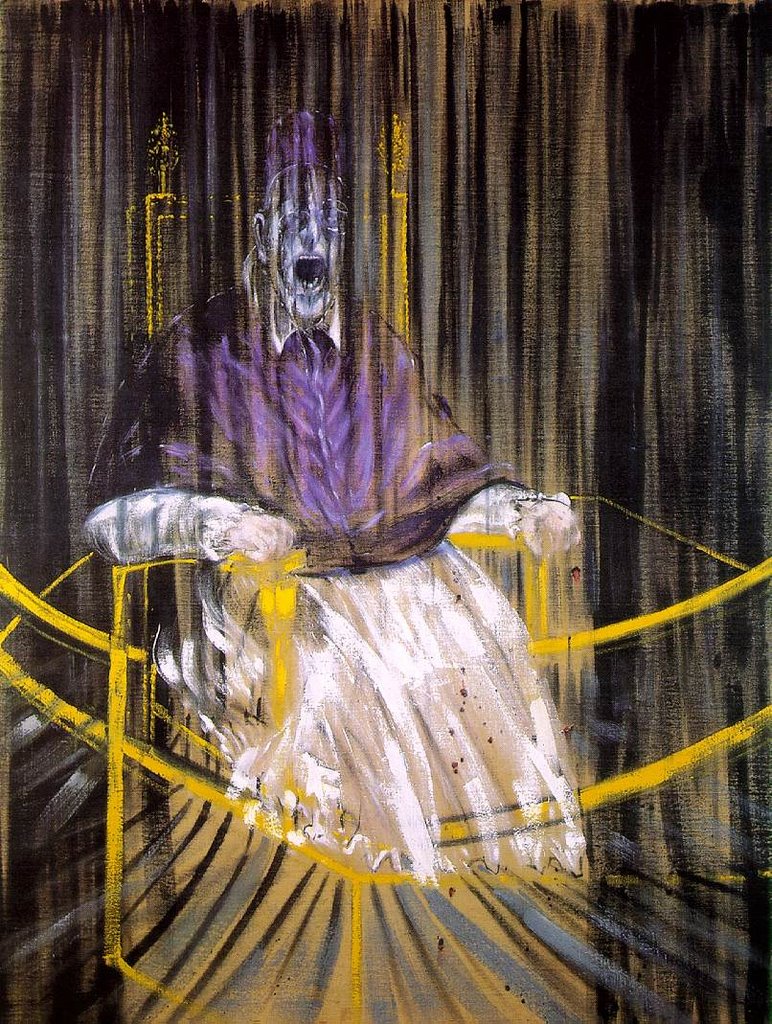
Who knew that the first head to roll after the midterm elections would be one from a Francis Bacon painting?

(Image courtesy of WebMuseum)

A good day for democracy

Yesterday, George Bush's America died. Voters pushed members of his party out of state offices, pushed them out of the majority in the House of Representatives, and depending on the results of two very close races in Virginia and Montana, may also have pushed them out of the majority in the Senate. There are still two years left in his term, but the capacity he once had to operate as if he were in a one-party state is gone.

I would have to be a lot taller to get proper historic perspective, but let's hope that this administration is the bizarre aberration it appears to be, one horrifying detour from this society's path to democracy, an aggressive and ultimately failed effort at restoration by a residual clique of hardliners on its way out.

2006-11-06

Nikolic's visions

Nikolic outlined the other day just on how he envisages his "Greater Serbia" to be in an interview (see also here) with the good old Kurir. In response to Agim Ceku's visit to Montenegro he argued that Serbia should impose sanctions (and visas...). When asked about how this would be for Serbs in Montenegro, he noted that they would come to Serbia, just like Serbs from Croatia and Kosovo...

I vi biste ostavili na cedilu Srbe u Crnoj Gori prekinuvši sve odnose a predstavljate se kao njihovi zaštitnici?
- Svi koji su Srbi, pobeći će u Srbiju. Svi treba da dođu ovde.

I to je vaše radikalno rešenje?
- Zašto da ne? Pobegli su i oni iz Hrvatske i sa Kosova i Metohije. Sve će to Srbija da izdrži. Majka mora da prihvati svoju decu. Oni neće da njima vladaju Albanci

Pixels, justice and mediascape

Gavin Simpson and Sameer Padania have a question:
GV Eastern Europe editor Veronica Khokhlova has pointed to debates about video footage of atrocities in the past. However, in the realm of Balkan blogs, many of which are cross-linked on sites like East Ethnia, there seems to be something of a dearth of examples of vlogging or other home-grown initiatives dedicated to reconciliation.

How might video be used in this or other situations? As training or education materials? As evidence? To promote reconciliation? What role can citizen journalism play?

I know there are a lot of people reading who are a lot more involved in the media and exchange scene than I am. What do you think? Video za pomirenje? Any interesting projects out there that you know of?

Chronicle of a death sentence foretold

I am guessing that I may not be the only person who is underwhelmed by the verdict against Saddam Hussein, which was timed to be announced just before the midterm elections in the United States.

Not to confuse the matter: he is undoubtedly guilty, not only of the crimes with which he was charged, but of a lot else as well. But the character of the process and the conditions under which it was carried out leave a lot to be desired. And the sentence of death by hanging calls up both bizarre images of ritual sadism and a despotic tradition of offing the people who occupied power previously – both images which do more to revive the character of Saddam Hussein’s rule than to point toward any sort of vision of a democratic or just future. This kind of a punishment is the act of an insecure regime.

One way of thinking about transitional justice is as a performance: a new regime demonstrates its capacity, in contrast with its predecessor, to apply the rule of law and settle the controversies surrounding its arrival to power in the process. By providing a fair trial, they embody the distinction between an old despotism which exercised summary justice and a new legal state which does not fear its opponents’ evidence and arguments. By providing a public trial, they create the opportunity for a forum on the legacy of the past in the process which Mark Osiel calls “making public memory, publicly.” To the degree that they (in the words of Nuremberg prosecutor Robert Jackson) “stay the hand of vengeance,” they demonstrate their commitment to be constrained by legal rules.

The Saddam Hussein trial failed on all these points. The charges were selective, standing in the way of producing a comprehensive account of the character and actions of the old regime (not all of which would have reflected well on the occupying power or the current paragovernment). The court and government manifestly failed to control the proceedings, maintaining neither the loyalty nor the security even of the officers of the court. The fear of what might come out in the course of the proceedings was such that the trial was broadcast – but with a twenty minute delay, to allow for the editing out of inconvenient moments.

As for the rule of law, there is no such thing in Iraq to be represented in a trial, a fact of which the occupying powers who are obligated by international law to maintain public services and public order are no doubt aware, regardless of what their representatives say to the press.

There are probably not many people in the world more deserving of severe punishment than Saddam Hussein. It is only in the context of a misbegotten fiasco like the occupation of Iraq that his conviction on charges of which he is guilty could be made to appear like another desperate and empty act of revenge.

2006-11-03

Šetnja da divljoj strani

I have been fairly quiet, I know, since trying to follow the returns on the constitutional referendum in Serbia this past weekend. Of course, here in the United States we are having elections as well, and they are the first ones I have been optimistic about for a long time. Here in Massachusetts, it looks certain that we will reverse the curse that has given us a series of Republican governors (three out of four of them embarrassing disasters) since 1990, electing instead the first really inspiring figure to emerge from outside of the machine in ages. The House of Representatives is pretty well certainly moving out of the hands of Bush's party, and it looks like there is at least a fighting chance of getting a majority in the Senate as well. These are midterm elections, which means that the same malicious dolt will occupy the presidency for another two years, but he will be considerably weakened in his ability to take revenge on the country that despises him and is about to hand him a large-scale repudiation.

As a part the anticipatory celebration, and thanks to Jane at the blog Jezero vatrenog kera (or is that Jezero kera koji je dobio otkaz?), Lou Reed has a gift for us: the anti-Iraq war remix of Walk on the wild side.

2006-11-01

Smrt

Today Clifford Geertz, a great thinker and researcher, passed away. Coincidentally, some nasty racist also died on the same day. East Ethnia cares about one of them.

2006-10-29

Constimatution

Both RIK and CeSID are projecting that the final result will show that the referendum has succeeded, based on their random samples of returns. Meanwhile, RIK claims that there were no major irregularities. CeSID claims otherwise, and the pro-boycott party LDP has been collecting evidence of irregularities, one piece of which was posted by Viktor Marković. More detail at Bojkot.

50%, ipak


CeSID is now estimating that turnout was 50% one hour before the official poll closing time. If the competing figures follow the pattern set so far, RIK's numbers will be higher. For the referendum to pass, a majority of registered voters must have voted yes, which means that the overwhelming majority of votes will have to be in favor.

Image: Turnout at 7 PM, according to CeSID.

Update: B92 is reporting (only by audio now, no text to link) that CeSID's estimate is that the referendum has succeeded, based an analysis of a random sample of polling places.

Marginally related to referendum; more important news

One of the nice things about following ongoing news is the possibility of a surprise. Today I have had B92 running all day, and since today is Sunday that means listening to one of my favorite music programs on the planet, Žikica Simić's Dole na uglu. Today he is featuring the work of an artist I have never heard of before, Howe Gelb. This is wonderful stuff! Apparently he is playing a concert in Belgrade next week, at Dom omladine. Lucky Belgrade.

Referendifying


As the second day of the referendum on the constitution continues, CeSID is reporting turnout at 33.1% at 2 PM. The comparative figures may be more interesting, since they show the highest turnout in Kosovo (unsurprisingly, since the huge gap between the number of residents and the number of registered voters generally produces distorted election results) and in Belgrade (also unsurprisingly, since the proposed text continues the centralization of resources and political power in Belgrade). Unless there is unusually high turnout in the last hours of the afternoon and early evening, this makes it look likely that turnout will not reach the 50% + 1 threshold. If this turns out to be the case, it might be understood as supporting the following theses:
1. Serbia does indeed new a new constitution, but citizens are not so excited about about approving one that was prepared in a hurry and without a wide-ranging process of consultation.
2. There is resistance to proposals which do not involve some decentralization of power.
3. The effort to cast a political question as a question of patriotism (with the famous clause on Kosovo) has not succeeded, and it is possible that the currency of patriotism has been overdrawn.
4. Types of consultation matter; some of the anti-referendum sentiment may derive from the fact that the text was designed to satisfy the leaders of the major political parties, not the citizens.
What happens in the event that the referendum does fail? First, this probably means that the government fails as well, which would force the calling of new elections. But this only changes the situation marginally, since the plan was for elections to be called anyway, probably in December. Second, the process of generating a new constitution has to continue. Law professor and former high judge Zoran Ivošević sees two ways in which this can be done: either renewed voting on the same text, or the calling of a constitutional convention. The second option is probably more promising than the first.

Views: Estavisti favors the referendum, read his reasons why. Serbian Mess does not, and also has reasons.

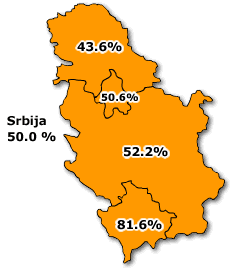
Image: Turnout by region at 5 PM on Sunday, according to CeSID.

Update: The Republic Electoral Commission (RIK) has bigger numbers than CeSID. They estimate that turnout at 6 PM is over 47%, and also announced that they have decided (suddenly?) that rather than closing polling places at 8 PM as planned, they would keep them open as long there are people near them. Meanwhile, CeSID is beginning to give information about irregularities in voting. Could a last-minute change in the rules turn out to be one of them?

2006-10-28

Reconstitution

It is true I have had nothing so far to say about Serbia's new constitution, on which a referendum is being held today and tomorrow. The text itself has been discussed elsewhere, and I agree with the people who point out that 1) it has some good elements and a lot more bad elements, and 2) the procedure by which it was adopted leaves a great deal to be desired. All in all, it is a fairly amateurish legal document, produced in a hurry and very much influenced by the parties of the Milošević regime, SPS and SRS, without whose support it could not pass.

The procedure adopted for the conduct of the referendum is also a bit odd, and there has been ongoing controversy both over the lists of voters and over the fact that voting has been scheduled over two days. A few oddities in the voting have been reported, but if there are to be any huge objections they are more likely to come tomorrow, as the two-day time frame opens a lot of space for various types of manipulation. If there is to be any stuffing of ballot boxes, this will probably happen overnight.

Right now it looks like the referendum will more likely pass than not, but we can be certain about the result probably sometime tomorrow night. Although there have been some high passions both for and against the draft, I have not taken a strong position. The letter of the law matters only when situations encourage somebody to insist on it, and the practice in the country has often been either to ignore laws or to use and interpret them very creatively. A lot more will depend on the habits and orientation of the government that will be elected after the referendum, probably in December, than on legal constraints which will bind the members of the government only formally.

Update: That prediction at the beginning of the last paragraph may well be wrong. Not only Milić, but also Milić reports turnout at 19:00 at 17%. This would make it unlikely that more than 20% would have turned out on the first day, though who knows what will happen on the second day (if something similar happens, the referendum fails). Their report also lists irregularities reported by LDP, as does Index. Surely LDP is not the only available source?

Update2: CeSiD is reporting the first day's turnout as 17.5%. This is the lead story on the Bojkot site, and it is followed by cautions from both Marko Blagojević and Srba Branković to keep in mind the obvious point that there is no precedent for the two-day voting schedule, and that what happens tomorrow may be different from what happens today.

Darko Rundek, "Ruke"

With thanks to whoever put this on JuTube.

2006-10-25

Professional courtesy

Thanks to friend of East Ethnia AR for sending along this item. Much has been made of the failure of US forces to participate in apprehending fugitives indicted for war crimes and other violations of international humanitarian law in Bosnia-Hercegovina. Could that be because those forces have been violating international humanitarian law in Bosnia-Hercegovina themselves, at the Eagle base in Tuzla?

I would comment on the item, but anything I could say seems sort of beside the point. Which is perfectly clear.

Old wine in new bottles

Are you one of the millions of readers who has been desperately searching for the Belgrade blog but not finding it? That is because it has a spiffy new location.

2006-10-24

Welcoming a new Balkan blog

I once tried swimming in the Neretva River. My goodness, it was cold.

2006-10-23

Trendsetter Montenegro

By abandoning the tricolore two years ago, Montenegro might have become a trendsetter. Replacing the boring red, blue and white with some more inspiring creatures has apparanetly given some in my home country of Luxembourg an idea. Rather than an eagle, an MP in Luxembourg has suggested to change the flag and introduce the historical lion to the flag.
I would suggest that all countries should get rid of the tricolore and replace it with nice pre-French revolution flags. My requirement would be one animal per flag minimum (Montenegro again outdid it, two!)