According to the latest survey by CeSID the referendum on the new constitution in Serbia might actually succeed--some 57% of voters said they'll surely go to vote for the constitution and another 24 % probably will. The primary motivation for voters appears to be a sense of civic duty (I guess the voters in France and the Netherlands last year are much worse at understanding their civic duties when they voted against the EU constititution). Considering the content of the next Serbian constitution, this is better news than the motivation being enthusiasum for substance. And, only one in ten supporters in the survey do so because of Kosovo.
For a good blog calling for a boycott see http://www.bojkot.info/
2006-10-21


2006-10-20
2006-10-19
Hodzic & Zelja vs. the Vegitarian threat
Some might have been following Richard Gere's adventures in the Balkans recently, trying to caputre Mladic etc. Now he has been the victim of the most foul kind:
As Fonet reports, "Gere becomes ill from the smell of cevapi" so what is done? The cevabdzinicas of Bascarsija had to be close for Richard Gere. Let's hope this is not a precedent and after smoking bans, there will be cevapi grilling bans haunting the Balkans.
As Fonet reports, "Gere becomes ill from the smell of cevapi" so what is done? The cevabdzinicas of Bascarsija had to be close for Richard Gere. Let's hope this is not a precedent and after smoking bans, there will be cevapi grilling bans haunting the Balkans.
2006-10-18
Now that torture is legal
Excuse me, the rule is now to call it "harsh interrogation." In any case, there may now be people wanting to join the U.S. Torture Corps.
Possibly of interest to anybody who regards the use of violence against suspects in an interrogation as necessary: I have recently been rereading an old favorite, Criminal Interrogation and Confessions, by Fred E. Inbau, John E. Reid and Joseph P. Buckley (3rd ed, Williams and Wilkins, 1986). This book is more or less the standard one used in the training of police detectives, and interesting in its own right mostly for its semi-hard boiled style (a little Nathaniel West, a little Erving Goffman, some Quentin Tarantino, simmer without stirring...). Inbau, Reid and Buckley are openly in favor of all kinds of deception and psychological tricks, and ofer a wide variety of suggestions for achieving them effectively -- peruse a file with nothing in it, pay attention to the distance between chairs, that sort of thing. They draw the line at two places, though. First, at the use of techniques that "would cause an innocent person to confess" (how well they achieve this is a matter of intense debate, and there is some good evidence that the techniques they suggest are more likely to produce coerced-internalized false confessions than they think). Second, they absolutely draw the line at the use of force or the "third degree," including threats and promises, both on the practical grounds that these techniques are likely to produce false information and on the legal grounds that confessions which are not voluntary are more likely than not to be rejected by courts.
Possibly of interest to anybody who regards the use of violence against suspects in an interrogation as necessary: I have recently been rereading an old favorite, Criminal Interrogation and Confessions, by Fred E. Inbau, John E. Reid and Joseph P. Buckley (3rd ed, Williams and Wilkins, 1986). This book is more or less the standard one used in the training of police detectives, and interesting in its own right mostly for its semi-hard boiled style (a little Nathaniel West, a little Erving Goffman, some Quentin Tarantino, simmer without stirring...). Inbau, Reid and Buckley are openly in favor of all kinds of deception and psychological tricks, and ofer a wide variety of suggestions for achieving them effectively -- peruse a file with nothing in it, pay attention to the distance between chairs, that sort of thing. They draw the line at two places, though. First, at the use of techniques that "would cause an innocent person to confess" (how well they achieve this is a matter of intense debate, and there is some good evidence that the techniques they suggest are more likely to produce coerced-internalized false confessions than they think). Second, they absolutely draw the line at the use of force or the "third degree," including threats and promises, both on the practical grounds that these techniques are likely to produce false information and on the legal grounds that confessions which are not voluntary are more likely than not to be rejected by courts.
Volver con la frente marchita
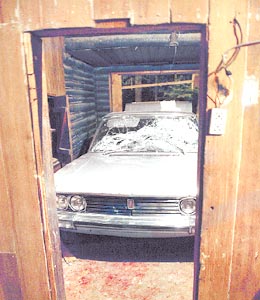
Juan Perón had a hard time with landings. When he returned from exile in 1973, his reception at the airport had to be held up while the different factions of his supporters continued their gunfights. His reburial in a new place has not gone well either. In the street battles that accompanied the event, in addition to dozens of people being injured (there is dispute over how many by bullets, how many by other means), the general's stylish old Fiat also bit the dust (photo). Why was the old fellow being buried again anyway, after a rest of 32 years with only three interruptions? It was to meet the demands of a woman who claims to be his daughter. Although el primer trabajador had no children with his two wives, he was involved with many people, some of whom were of childbearing age, so who knows.
2006-10-17
This is just messed up
I don't know what to make of this. But my first response is: whacked out racist fantasy heavily influenced by the original Willie Wonka film (the one with Gene Wilder, not the one with Johnny Depp doing Michael Jackson-as-Wonka).
2006-10-15
Borat se vraća kući
I'll admit that as much as I enjoy an occasional dose of the character, I have not rushed off to see the film, since I figure one joke can only be stretched out for so long (case in point: the Bush administration). But now I may be changing my mind, since it seems to offer the opportunity to celebrate the return of Kazakhstan to its glorious Balkan kolijevka. Catherine explains how....
PS: Curious to hear some Kazakh music? Imagine finding it in a gulag.
PS: Curious to hear some Kazakh music? Imagine finding it in a gulag.
2006-10-12
U-turn in Iraq?
Ever since it became clear that no WMDs would be found in Iraq, building democracy in Iraq has been the declared goal of the occupation, and its post facto justification. Is this about to change?
A bipartisan working group under former Secretary of State James Baker has been looking at the options. (Big surprise: none of them are good.) Baker has dropped hints, some less subtle than others, that this whole idea of democracy is just a distraction from stability in Iraq. According to a piece in today's Sun, the commission -- or at least Baker -- buys the canard that Iraq is essentially a sectarian conflict, a product of multi-ethnicity, which is of course the most popular "explanation" of what's happening there. The implications are clear: dictators are alright as long as they hail from majority groups (Bashar, move over).
A bipartisan working group under former Secretary of State James Baker has been looking at the options. (Big surprise: none of them are good.) Baker has dropped hints, some less subtle than others, that this whole idea of democracy is just a distraction from stability in Iraq. According to a piece in today's Sun, the commission -- or at least Baker -- buys the canard that Iraq is essentially a sectarian conflict, a product of multi-ethnicity, which is of course the most popular "explanation" of what's happening there. The implications are clear: dictators are alright as long as they hail from majority groups (Bashar, move over).
On PBS's "Charlie Rose Show," Mr. Baker was careful to say he believed the jury was still out on whether Iraq was a success or a failure. But he also hastened to distinguish between a Middle East that was "democratic" and one that was merely "representative."
"If we are able to promote representative, representative government, not necessarily democracy, in a number of nations in the Middle East and bring more freedom to the people of that part of the world, it will have been a success," he said.
That distinction is crucial, according to one member of the expert working groups. "Baker wants to believe that Sunni dictators in Sunni majority states are representative," the group member, who requested anonymity, said.

Vic dana iz Danas-a
Gost u restoranu naručuje doručak:
- Želim dva kuvana jaja, jedno gotovo sirovo, a drugo tako tvrdo kuvano da se jedva može jesti, dve kriške tosta, jednu jedva malo pečenu, drugu prepečenu, jedan komadić maslaca da bude otopljen, a drugi ravno iz zamrzivača, šoljica kafe neka bude slaba i mlaka, a sok od narandže podgrejan.
- Ali, gospodine, to je vrlo komplikovana narudžba. Biće je teško ispuniti.
- Ne bi trebalo da vam bude teško, to ste mi juče servirali.
Maznuto od Danas-a, 12. oktobar 2006
- Želim dva kuvana jaja, jedno gotovo sirovo, a drugo tako tvrdo kuvano da se jedva može jesti, dve kriške tosta, jednu jedva malo pečenu, drugu prepečenu, jedan komadić maslaca da bude otopljen, a drugi ravno iz zamrzivača, šoljica kafe neka bude slaba i mlaka, a sok od narandže podgrejan.
- Ali, gospodine, to je vrlo komplikovana narudžba. Biće je teško ispuniti.
- Ne bi trebalo da vam bude teško, to ste mi juče servirali.
Maznuto od Danas-a, 12. oktobar 2006
2006-10-10
A dal se to pita na slavi?
Repeatedly asked by reporters to clarify the status of the ministers from the G17+ party who have resigned their positions but continue to occupy them, prime minister Vojislav Koštunica replied:
"All these questions you are asking, I will gladly answer them some other time. Allow me, the question we are discussing today at the Academy is much, much more meaningful, regardless of any type of journalistic curiosity, than the questions you are asking. That question is absolutely secondary both in its essence and formally, compared to the fact that Serbia has finally received a new, democratic Europan constitution and that afterward democratic elections will be called. That is the only thing that matters.""Four legs good," continued the prime minister, "two legs bad."
2006-10-07
Great post-election moments, RS edition
Milorad Dodik, who runs the one-party statelet inside Bosnia known as Republika Srpska and who is the only Bosnian politician to have both a vision for the country and the mandate to implement it, was asked on the BHTV show Javna tajna Thursday whether he would wish to become Bosnian prime minister. He replied, according to BBC Monitoring,
Creative people would be wasted on Bosnia's central institutions, in other words. Is that why he said in the same interview that he might send Nikola Spiric there?
Sarajevo, well, what you still have there is an unconsolidated political climate, which absolutely does not leave much room for creative people--and I believe I am one of those--to show [their potential]. I want to tidy up and organize the Serb Republic in order to make it the incontestably more developed part of Bosnia-Hercegovina in the future.
Creative people would be wasted on Bosnia's central institutions, in other words. Is that why he said in the same interview that he might send Nikola Spiric there?
Great moments in devotional orthography
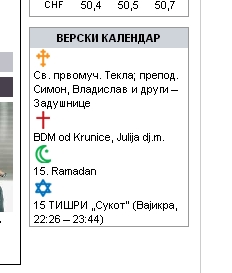 Not to pile on Politika (which I increasingly enjoy reading, especially on Sunday) or anything, but friend of East Ethnia Mirko sends in this tidbit I had never noticed from the bottom of the web page. As near as I can tell, aside from the occasional ad and the symbol for Swiss francs (which would look silly as цхф), the only Latin script that appears on the page is in part of the daily religious calendar. The Lord prints in mysterious ways.
2006-10-06
Great moments in translation
One of the interesting phenomena I was able to observe on my visit involves the long march of Politika back to respectability and its historic position as the premier newspaper in the area. Last Monday, they initiated a strategy of reputation-by-association, running a special additional section (in English) of articles selected from Sunday's New York Times. It's a nice section, and undoubtedly useful both to people who want a glimpse at international media and to people wanting to keep their English language skills in shape. In the interest of achieving that second goal, the section contains a box at the bottom of the second page, prepared by the Institut za strane jezike, with translations of some rare or new English expressions. A very nice idea altogether. The first item in their little glossary was:
I never knew this! Nor did my students. But I like it.
butt brushes -- sudaranje kupaca u suviše uskom prostoru
I never knew this! Nor did my students. But I like it.
He's baaack
Why no posts for a week, you may or may not ask? Your humble correspondent was globetrotting to glamorous destinations. Beograd, Niš ....
The trip to Belgrade was for a conference (sponsored by the Association for the Study of Nationalities and the Forum za etničke odnose) organized by distinguished Ethnian (and according to Slobodna Evropa, "britanski ekspert") Florian Bieber. Simply fantastic stuff, and many perfectly charming people. In the meantime, there were the interesting elections in BH on which TK has been leading debate here (imagine! politics in an election!), and Serbia got a constitution written overnight and approved by a Parliament whose members had not had the time to read it, to be followed at the end of this month by a referendum which could easily go either way. In response, the courageous leaders of G17 resigned their positions but did not leave them.
It is always a pleasure to go to Niš, to which the buses get more luxurious each time I go. This was a short visit, but I think our project (about which more when there is concrete news) is really moving forward. It is surprising that more people do not go to Niš. I am not saying that everybody needs to visit, just everybody who loves peppers.
So now I am back, and between home and work I will be resuming my normal syncopated rhythm of posting. Thanks for your patience. It looks like the United States was a complete disaster while I was gone. Lunatics shooting schoolchildren? Congressmen schtupping teenage boys? What on earth?
The trip to Belgrade was for a conference (sponsored by the Association for the Study of Nationalities and the Forum za etničke odnose) organized by distinguished Ethnian (and according to Slobodna Evropa, "britanski ekspert") Florian Bieber. Simply fantastic stuff, and many perfectly charming people. In the meantime, there were the interesting elections in BH on which TK has been leading debate here (imagine! politics in an election!), and Serbia got a constitution written overnight and approved by a Parliament whose members had not had the time to read it, to be followed at the end of this month by a referendum which could easily go either way. In response, the courageous leaders of G17 resigned their positions but did not leave them.
It is always a pleasure to go to Niš, to which the buses get more luxurious each time I go. This was a short visit, but I think our project (about which more when there is concrete news) is really moving forward. It is surprising that more people do not go to Niš. I am not saying that everybody needs to visit, just everybody who loves peppers.
So now I am back, and between home and work I will be resuming my normal syncopated rhythm of posting. Thanks for your patience. It looks like the United States was a complete disaster while I was gone. Lunatics shooting schoolchildren? Congressmen schtupping teenage boys? What on earth?
2006-10-02
All for democracy, as long as I get elected
Voters in Bosnia's general election yesterday (October 1st) pushed the system to its absurd--but logical--extreme: it looks increasingly likely that Željko Komšić from the non-nationalist SDP might be elected Croat member of Bosnia's three-member presidency, with a substantial chunk of his vote coming from ethnic Bosniaks. The reason is simple: while the three co-presidents are representatives of Bosnia's three constituent peoples (Serbs, Croats, and Bosniaks), voting is organized by entity. Residents of RS vote for the Serb member while residents of the Croat-Bosniak Federation vote for the Croat and Bosniak members. The SDP recognized that it stood no chance of winning against either incumbent Sulejman Tihić nor indeed Haris Silajdžić, whose victory last night was unexpectedly convincing, so they presented a candidate for the Croat member. Incumbent Ivo Miro Jović, who made a scene at the TV studio and insulted journalists there, announced that "Ivo Miro Jović will be the Croat member of the B-H Presidency or the Presidency will cease to exist," in a remarkable display of his understanding of how democracy works.
Expect preliminary results for the parliamentary elections (both at entity and central level)sometime tonight local time (press conference announced for 9pm).
Expect preliminary results for the parliamentary elections (both at entity and central level)sometime tonight local time (press conference announced for 9pm).
2006-09-26
Montengrans and other ans
If Serbia is RS, then the inhabitants of Montenegro are "Montenegrans". Well, at least this is to whom Rumsfeld talked to: Rumsfeld holds talks with Montenegrans after that trip, he is going to talk to Serbans, Croatans and Bosans. Luckily, he is not visiting the Republic of Sata.
It's RS after all
2006-09-25
Kandidat za Oskar
This year's entry from Serbia into the Oscars competition will be Sutra ujutru, directed by Oleg Novković from a screenplay by Milena Marković. The original songs for the film were written and composed by Miroslav Mitrašinović, the optimistic miner from the documentary Rudarska opera, produced by the same couple. The film tells the story of a returnee from Canada who comes home, and meets his old friends and problems in a big way. It is, in my humble opinion, one of the more distinguished pieces of contemporary dramatic film from the area (Full disclosure: I had a very tiny role in the production of the film -- revising the translation -- and Ivana and I have translated a couple of other projects for Milena and Oleg, who are our pals. But we do not have any influence over film juries.).
A ko vas traži?
Is EU accession going to lead to a huge migration of labor from Romania and Bulgaria to the UK? The UK Home Office seems to be planning for the eventuality, and probably has plans to try to limit what they (may) anticipate to be an inflow of 60K to 140K workers. Gallup's survey in Bulgaria suggest otherwise: they find about 46K people saying that they intend to seek employment abroad, and Britain is not their first choice. Most would prefer to go to Spain, Germany, Italy or Greece. Alan Travis is listing for The Guardian a number of research studies showing that, for a variety of reasons, the UK is not all that attractive a destination for employment migration from SEE. A government that is declaring its hostility in advance is probably not enhancing the attraction. If there is unfounded anticipation in Britain, it may be because people are expecting the influx of workers from Poland to be repeated. If so, there is a crucial difference being overlooked: there was already an established Polish community and network in the UK, and there is nothing approaching that level of ready-to-use connections from Romania or Bulgaria.
In a similar pattern, there are some signs that the direction of the India-UK "brain drain" might be starting to move in reverse, as people become attracted to an environment that is dynamic and where they are less likely to encounter growing forms of "profiling." These are probably not the same reasons why a large number of people already in Britain express a desire to leave.
In a similar pattern, there are some signs that the direction of the India-UK "brain drain" might be starting to move in reverse, as people become attracted to an environment that is dynamic and where they are less likely to encounter growing forms of "profiling." These are probably not the same reasons why a large number of people already in Britain express a desire to leave.
2006-09-22
Defending Magyarity
For the electronic world, there is a new Hungarian cuisine blog. For Worcesterians (but also worth a trip from such distant spots as Boston), there is the recently sampled and very fine indeed Anna's Kitchen.
Immodest revision of obscene proposal
This is truly appalling. It is a "compromise" that codifies violations of the Geneva Conventions and gives them the appearance of law. Read the analysis by Marty Lederman, who also provides the proposed text. Then vote against any member of the US Senate who favors this monstrosity, and if you have any cash to spare, donate it to their opponents. Did you ever believe that you would see the day on which torture was legalized?
2006-09-21
Identity
The lawyer Kemal Kerincsiz has filed over 40 cases against writers who have considered the Armenian genocide in their work, accusing them under Article 301 of the Turkish criminal code of insulting "Turkishness" ("Turkianity"? "Turkitude"?). Today he lost one more case, against the novelist Elif Shafak. The value of Article 301 aside, the frequent repetition of cases like this would seem to raise the question of why Mr Kerincsiz believes that he is defending a culture by incessantly attacking the people who contribute to it.
The last plane to Moskva
Today's arrest of Marko Lugonja, one of the people accused in the conspiracy to harbor Ratko Mladić (a "jatak," which is of course different from a "hohštapler"), took place at the Belgrade airport, on a plane which was getting ready to depart for Moscow. This might be interpreted as a sign of desperation on the side of the fugitive wannabe, who wanted to get out any way he could. Or it might be interpreted as a sign of supreme confidence, taking a regular flight with a ticket and all.
2006-09-19
Detaillessness
2006-09-17
Zlatko Brzina
In other film-related news, Richard Gere is in Sarajevo, where he seems not to have impressed folks much.
2006-09-14
Fate-less-ness
Imre Kertész’s novel Fatelessness is a unique piece of work, and it impressed me. In contrast with his other works like Kaddish for an unborn child, which is self-reflective to the point of claustrophobia, this one is told in the voice of a teenage boy who is, sometimes shockingly, not reflective at all. And in contrast to the overwhelming majority of works in (what I guess has to be called) “Holocaust literature,” it proudly and aggressively refuses both melodrama and moralism. In that respect the work is paralleled by the work of only a couple of other writers who treat the period – Tadeusz Borowski, and perhaps to a lesser extent Primo Levi.
Kertész explained some of the motivations for this approach in his Nobel lecture in 2002. He was confronted both by his own ambivalent memory and by the demonstrative nature of much of the existing literature:“The experience was about solitude, a more difficult life, and the things I have already mentioned - the need to step out of the mesmerizing crowd, out of History, which renders you faceless and fateless. To my horror, I realized that ten years after I had returned from the Nazi concentration camps, and halfway still under the awful spell of Stalinist terror, all that remained of the whole experience were a few muddled impressions, a few anecdotes. Like it didn't even happen to me, as people are wont to say.”
[....]
“In the free marketplace of books and ideas, I, too, might have wanted to produce a showier fiction. For example, I might have tried to break up time in my novel, and narrate only the most powerful scenes. But the hero of my novel does not live his own time in the concentration camps, for neither his time nor his language, not even his own person, is really his. He doesn't remember; he exists. So he has to languish, poor boy, in the dreary trap of linearity, and cannot shake off the painful details. Instead of a spectacular series of great and tragic moments, he has to live through everything, which is oppressive and offers little variety, like life itself.”
One of the elements in the book that makes the strongest impression is the way in which the main character, before his deportation a detached and ironic lad, but in all instances a model of orderliness and obedience, accepts so many of his experiences as reasonable and tries to adapt. A good deal of the book’s tension comes from the contast between what the lead character does not know and the reader does. This acceptance weakens as he weakens in the camps, but does not really collapse until he returns home to Budapest. There the varieties of misunderstanding he encounters leads him to realize (as Kertész put it to the Swedish Academy in 2001) that he has been “in exile from a homeland that has never existed”.
This leads to the conclusion, as shocking as it is gentle, in which the narrator expresses what sounds like nostalgia for the horror he has experienced: “Yes, the next time I am asked, I ought to speak about that, the happiness of the concentration camps. If indeed I am asked. And provided I myself don't forget.” If the image of "happiness" in such circumstances still shocks, that was the author's intention. "I took the word out of its everyday context and made it seem scandalous," says Kertész. "It was an act of rebellion against the role of victim which society had assigned me. It was a way of assuming responsibility, of defining my own fate."
I am not certain that all of those factors which made the novel so unique and impressive come through in Lajos Koltai’s film of the novel, its title shortened to Fateless. The film is shot (very much in the style of István Szabó, with whom Koltai collaborated as a cinematographer before this directorial debut) in nostalgic sepia tones, the story told slowly and aestheticized. Some scenes which I interpreted as crucially important are left out or shortened – for example, the conclusion of the main character’s conversation with a well-meaning liberal journalist on his return to Budapest. One sequence is added, though it is not clear what it adds – after the liberation of the camps, an American sergeant tries to persuade the main character not to return home. All this is additionally puzzling, since nobody can accuse the screenwriter of messing with a badly understood text: Kertész wrote his own adaptation. But there is something odd about seeing the work of an author who defined Spielberg’s Schindler’s list as “kitsch” presented in a style that seems just the littlest bit Spielbergesque.
This is not to say that I don’t recommend the film. It is interesting on in own level, and has some well considered beauty. I would recommend it (like a lot of adaptations) more as a supplement to the book than as a substitute for it.
Cinema 320 is showing the film at Clark University this week. After the last projection (3:40 PM on Sunday in the Jefferson Academic Center, room 320), I will be leading a discussion for anyone who is interested. If you are around, come on down.
2006-09-12
Kurta
Picking up where the Serbian Radical Party left off, Kurir is running a defamation campaign against deputy prime minister Ivana Dulić-Marković. On Monday it was with a story claiming that her father (Kurir says his name is or was Antun, she says they got the name wrong, I don't have any information) had hid Ustaše on his farm, and that her mother had been a founder of the (fabulously succesful!) HDZ in Vojvodina. The hiding business is supposed to have taken place between 1948 and 1951, for which the only source (and who are you, reporter R.K.?) is an individual who the article says was put to death in 1957. For the curious, Ivana Dulić-Marković was born in 1961.
Today the campaign continues with a story that Dulić-Marković has "sold Vojvodina to the Croats" (a heck of an accomplishment if she could do it). The story relies on the claims by -- of all people -- Milan Paroški, the marginal paramilitarist from the Sloba era who survived and is only noticed as a marginal politician by the folks who write for Kurir. Actually he claims that the sale in question is of "nearly 30" businesses. Trouble is, he made the same claim to the same paper, clearly the only one that talks to him, in October of last year, at which time it was "28 businesses." She was not deputy PM at the time.
This is, of course, not the first time that people have attacked Ivana Dulić-Marković by trying to draw associations between her family and freaky movements from a long time ago. The last two times it was done by SRS. Which must have something in common with Kurir, no?
2006-09-10
No details yet
I still do not know anything about the murder of a candidate for the local council in Novi Pazar, except that it happened at the polling place.
Update: Two attackers have been arrested, police are seeking a third. The two main regional political parties are accusing one another.
Update: Two attackers have been arrested, police are seeking a third. The two main regional political parties are accusing one another.
2006-09-08
Symbolism

So, obviously it is time to retire the old YU symbol, since it no longer refers to anything that exists. SCG (fine for graphic resolutions, not so easy to pronounce in a pleasant way) is also gone. So it's off to the International Standards Organisation. For a three-letter symbol, Serbia had the choice of SER or SRB -- no big deal there, the choice seems to have been SRB, fine. But then, there was the choice of a two-letter symbol. ISO rejected the proposal that the new symbol be RS ("Republika Srbija," but their rules do not allow the form of government to be a part of the symbol, they say, which ought to call CH and UK into question, no?). They proposed as alternatives SP, SQ, SS, SW i SX. Not any one of these is especially appealing, but the Ministry of Foreign Affairs chose from among the options the symbol SS.
Is there any point at all in even beginning to set out the reasons why this was a bad decision?
2006-09-07
Transcendence
Stable democratic orders depend, above all, on a perceived community of interest. For example: the Serbian Radical Party could not survive without financing from the state budget and the opportuity to provide its leading figures with parliamentary immunity. And the Serbian government could not survive without the not especially well hidden support of the Serbian Radical Party. Which is why when Dragan Todorović, who resigned a seat in the current parliament from which the law prevents him from returning, wanted to return, his wish was granted. If he were not a member of parliament, he may have to face prosecution for massive expropriation of funds from the state budget during the time (bet you can't guess the period) when he was minister of transport and telecommunications. Explaining this instance of creative violation of the law in defence of prior violations of the law, SRS leader Tomislav Nikolić pointed out that Radicals are "above the organs of the state." The evidence would appear to suggest that Mr Nikolić is right.
2006-09-06
Seal

Thanks to Darko, I have found this timewaster called the Official seal generator. Which I used to make the above.
But really the reason to make this post was to try out this new (for me) blog posting program thingie called Qumana. It seems clever. There are still some bits of it I need to figure out.
2006-09-05
Epic poetry
A poem in honor of the recent congress of the Srpska radikalna stranka in Sava centar:
In Karlobag
the gentle breeze
stoked megalomaniacal
fantasies
Perchance to march
our souls in tune
with rhythm kept by
rusty spoons
The further away
the louder the din
all the way to Ogulin
Or backward, it seems
with no stops for pizza
The last stop was
in Batajnica
Komparativne studije
Thanks to the Belgrade blog for the link. Down Virginia way, a local Yugo takes up the task of comparing his experience to the famous list of stereotypes "You know you're a Serb when ..." Down Niš way, I once heard a political scientist use this list as a framework for a lecture on politics of identity. If I remember well, though, the list was originally prepared for the amusement of the Austalian diaspora (this version seems to come from LA, all the same).
2006-09-04
Impression of the week
Following up on the preceding unclear story, another unclear story. The activist Nataša Kandić was waiting for a taxi after appearing as a guest on the popular TV program Utisak nedelje, on the sidewalk outside the B92 studio. Three explosions were heard. The chief of B92, Veran Matić, claims that the explosions are part of an effort to intimidate some public figures. The police say that some fireworks went off in the area, and it is no big deal. The police version seems to be supported by the host of the show, Olja Bećković, who was seeing off Kandić and another guest, the former philosopher and full-time unusual person Svetozar Stojanović. Bećković says that Kandić had already got into the taxi when the explosions were heard, and that she and Stojanović more or less paid them no mind. So, maybe a tempest in a teapot, and maybe not.
What adds (or maybe does not add) another dimension to the story is an item in the provocative tabloid Kurir (which I have not found -- feel free to have some fun in their archive), in which the blaster from the past Siniša Vučinić claims that there is a plan to murder three prominent human rights activists. As much as this sort of thing leads to all types of responses, there are few conclusions to be drawn. Although Kurir hardly falls in the "reliable source" category, it is a popular place to plant stories. And although Vučinić is known for his tendency to threaten violence, he is also known for being something less than sincere in his statements. So there are a lot of reasons to raise suggestions about last night's incident, if there was one, but not a lot of reasons to draw conclusions.
Except for one conclusion: there is a genuine atmosphere of intimidation, which makes all sorts of interpretations, even ones that might turn out not to be warranted, seem plausible. Most interesting of all may be the statement by police that they station plainclothes officers around the studios where programs are filmed that involve "exceptional risk," a category into which publicly discussing issues of general concern would seem to fall.
What adds (or maybe does not add) another dimension to the story is an item in the provocative tabloid Kurir (which I have not found -- feel free to have some fun in their archive), in which the blaster from the past Siniša Vučinić claims that there is a plan to murder three prominent human rights activists. As much as this sort of thing leads to all types of responses, there are few conclusions to be drawn. Although Kurir hardly falls in the "reliable source" category, it is a popular place to plant stories. And although Vučinić is known for his tendency to threaten violence, he is also known for being something less than sincere in his statements. So there are a lot of reasons to raise suggestions about last night's incident, if there was one, but not a lot of reasons to draw conclusions.
Except for one conclusion: there is a genuine atmosphere of intimidation, which makes all sorts of interpretations, even ones that might turn out not to be warranted, seem plausible. Most interesting of all may be the statement by police that they station plainclothes officers around the studios where programs are filmed that involve "exceptional risk," a category into which publicly discussing issues of general concern would seem to fall.
2006-08-29
A midsummer night's skinhead attack
A friend of East Ethnia sent along this little item about a recent violent attack by skinheads in Belgrade. I won’t go into the details here, you can read about them if you care to. While the violence and racism are predictable enough, it might be most interesting to note the complete failure of the police to prevent the attack or respond in any way. This is perhaps not so surprising either, considering a number of recent incidents that are well known. These would include the utter failure of prosecutors to respond to invitations to ethnic hatred on the part of a large political party which is only formally in the opposition, and would also include the participation of police in the same spirit as rioters in violent clashes at sporting events.
Some of the details of these incident might seem baffling to normal people: chanting “Auschwitz” at Jewish people, repeatedly addressing people of Croatian ethnicity as “Ustaše,” maybe bizarrest of all, throwing matches between police and sport hooligans involving urine-filled condoms. Some of these seem too vulgarly stupid to be true, like snippets of a compulsive belcher’s works of science fiction.
There is certainly something to be observed in the atmosphere of Belgrade which might be thought of as contributing to these sorts of incidents. Anybody could reply well, there are violent racist idiots everywhere, which would of course be true. There may be something telling about the most recent crop of global racist idiocy: when planes can be diverted and escorted by fighter plane because somebody on there thinks that another person is “acting strange,” or is dressed wrong, or is of a certain regional origin, then it looks like a certain licence is being renewed. All those people who were compelled by politeness or the fear of social isolation to keep their racist thoughts quiet can suddenly express them all they like, and fighter pilots will be ordered to supply the punctuation. This is observable over the course of a couple of weeks, when panic takes hold, order breaks down, and “security” types crawl out of their moleholes.
I doubt very much that people in Belgrade are any stupider or more filled with hate than anybody else on the planet. What makes the situation there unique is the degree to which the society and its values have been destroyed, leaving it with precious little to position against the skinheads. Watch any of the television talk shows and listen to the shouting and cheering. The only thing they have got that the skinheads do not is hair.
It is easy to dismiss the occasional outbursts of violence by violent racists as coming from the margins, the lumpish lumping of lumpen youth. Like the image of terrorists coming from the ranks of the most oppressed, this is not generally the case. The Boston youth who received a comically handwringing sentence for beating two young women is the son of the director of one of the city’s major arts centers; the “9/11” hijackers were educated sons of prominent families; the intellectual leaders of the Serbian skinheads are writers, artists, critics.
Like every other political fact, racism is about power – especially, about the fear of losing power. That is why groups of young violent people will be most active when they believe that what they are doing is supported, even if silently, by the more respectable members of their community. That is why seemingly unrelated parts of the atmosphere, like the media presence of extremists, the use of the Parliament for invitations to violence, the support of war criminals, and the general worthlessness of the police, contribute to the frequency of this type of event. If people in positions of authority begin to speak out, who will believe them?
Update: Two attackers have been arrested, after voluntarily going to police. One of them is "Predrag M," whose lawyer appears to have been told to acknowledge the facts of the case but not the motivation of the attackers. The other is an unnamed US citizen, who is for some reason being protected by the US Embassy. The police, who failed to respond, have spent the day denying that they failed to respond.
Update: Friend of East Ethnia AR points us to an article in today's Blic (no direct link to the article until it gets into the archive, majke im) from which we learn: 1) how the attackers identified their victims (by asking them), 2) the names and major fields of study of the attackers, and 3) the tonsorial similarities linking skinheads and their victims.
Some of the details of these incident might seem baffling to normal people: chanting “Auschwitz” at Jewish people, repeatedly addressing people of Croatian ethnicity as “Ustaše,” maybe bizarrest of all, throwing matches between police and sport hooligans involving urine-filled condoms. Some of these seem too vulgarly stupid to be true, like snippets of a compulsive belcher’s works of science fiction.
There is certainly something to be observed in the atmosphere of Belgrade which might be thought of as contributing to these sorts of incidents. Anybody could reply well, there are violent racist idiots everywhere, which would of course be true. There may be something telling about the most recent crop of global racist idiocy: when planes can be diverted and escorted by fighter plane because somebody on there thinks that another person is “acting strange,” or is dressed wrong, or is of a certain regional origin, then it looks like a certain licence is being renewed. All those people who were compelled by politeness or the fear of social isolation to keep their racist thoughts quiet can suddenly express them all they like, and fighter pilots will be ordered to supply the punctuation. This is observable over the course of a couple of weeks, when panic takes hold, order breaks down, and “security” types crawl out of their moleholes.
I doubt very much that people in Belgrade are any stupider or more filled with hate than anybody else on the planet. What makes the situation there unique is the degree to which the society and its values have been destroyed, leaving it with precious little to position against the skinheads. Watch any of the television talk shows and listen to the shouting and cheering. The only thing they have got that the skinheads do not is hair.
It is easy to dismiss the occasional outbursts of violence by violent racists as coming from the margins, the lumpish lumping of lumpen youth. Like the image of terrorists coming from the ranks of the most oppressed, this is not generally the case. The Boston youth who received a comically handwringing sentence for beating two young women is the son of the director of one of the city’s major arts centers; the “9/11” hijackers were educated sons of prominent families; the intellectual leaders of the Serbian skinheads are writers, artists, critics.
Like every other political fact, racism is about power – especially, about the fear of losing power. That is why groups of young violent people will be most active when they believe that what they are doing is supported, even if silently, by the more respectable members of their community. That is why seemingly unrelated parts of the atmosphere, like the media presence of extremists, the use of the Parliament for invitations to violence, the support of war criminals, and the general worthlessness of the police, contribute to the frequency of this type of event. If people in positions of authority begin to speak out, who will believe them?
Update: Two attackers have been arrested, after voluntarily going to police. One of them is "Predrag M," whose lawyer appears to have been told to acknowledge the facts of the case but not the motivation of the attackers. The other is an unnamed US citizen, who is for some reason being protected by the US Embassy. The police, who failed to respond, have spent the day denying that they failed to respond.
Update: Friend of East Ethnia AR points us to an article in today's Blic (no direct link to the article until it gets into the archive, majke im) from which we learn: 1) how the attackers identified their victims (by asking them), 2) the names and major fields of study of the attackers, and 3) the tonsorial similarities linking skinheads and their victims.
The judge and the general
AP is reporting comments made by Wolfgang Schomburg, a judge at the ICTY, in which he suggested that the EU's linkage between Serbia's association talks and the war-crimes question could be counterproductive. "It can certainly become counterproductive if a country perceives itself taken hostage because of one or two wanted people," he said in an interview. He also said that the Tribunal was there to judge individuals, not states.
These comments are so wrong at so many levels it's tough to decide where to start. At the most basic level, of course, it's entirely up to the EU to make this linkage (which is a tried and tested approach, not something new they just came up with) and frankly none of the ICTY's business. It's also highly tendentious to imply, as his reported statements seem to do, that the linkage somehow means that the ICTY is now running the risk of judging states not persons. (I'm open to the suggestion that this apparent implication is an artifact of the way the interview, which was made by Austria Press Agency, was reported by AP.) And if Serbia "perceives itself" taken hostage, that's, frankly, Serbia's problem -- perhaps it then shouldn't have applied for association with the EU, or indeed signed up at Dayton to the obligation of catching war criminals (sorry, "persons indicted for war crimes").
But perhaps the judge wasn't just airing his personal views? Perhaps his comments have to be seen in the context of recent statements by unnamed "sources close to EU diplomats" (whatever those may be -- waiters? Cleaning ladies?) reported by Politika to the effect that it was "not unrealistic" to expect a stabilization agreement to be concluded even with Mladic at large? Wouldn't be the first time that the EU went wobbly on Serbia. We shall know more in September.
These comments are so wrong at so many levels it's tough to decide where to start. At the most basic level, of course, it's entirely up to the EU to make this linkage (which is a tried and tested approach, not something new they just came up with) and frankly none of the ICTY's business. It's also highly tendentious to imply, as his reported statements seem to do, that the linkage somehow means that the ICTY is now running the risk of judging states not persons. (I'm open to the suggestion that this apparent implication is an artifact of the way the interview, which was made by Austria Press Agency, was reported by AP.) And if Serbia "perceives itself" taken hostage, that's, frankly, Serbia's problem -- perhaps it then shouldn't have applied for association with the EU, or indeed signed up at Dayton to the obligation of catching war criminals (sorry, "persons indicted for war crimes").
But perhaps the judge wasn't just airing his personal views? Perhaps his comments have to be seen in the context of recent statements by unnamed "sources close to EU diplomats" (whatever those may be -- waiters? Cleaning ladies?) reported by Politika to the effect that it was "not unrealistic" to expect a stabilization agreement to be concluded even with Mladic at large? Wouldn't be the first time that the EU went wobbly on Serbia. We shall know more in September.
2006-08-25
Vuk slova menja
Line from a news item on B92 regarding the decision by Apple computers to recall the Sony batteries on its iBook and PowerBook computers:
Now, with all respect to Vuk and the formulation everybody knows, which commands "Пиши као што говориш и читај како је написано" (apparently, it is not original to him), I still say: "Epl?" "Ajbuk?"
"Baterije su povučene iz Eplovih računara Ajbuk G4 i Pauer buk G4."
Now, with all respect to Vuk and the formulation everybody knows, which commands "Пиши као што говориш и читај како је написано" (apparently, it is not original to him), I still say: "Epl?" "Ajbuk?"
2006-08-24
Music and Society
The Ups! festival in Zadar might have been a pretty good event. The program included The Beat Fleet, Let 3, Damir Urban... But then all three of them cancelled their appearances after discovering that among the sponsors of the festival was the "Society for truth about the Homeland war" (Zaklada za istinu o domovinskom ratu), which was planning to use the festival to continue their marketing of Ante Gotovina t-shirts.
Saša Antić of The Beat Fleet explained the band's decision: "The Society for truth abouth the Homeland war accepts the ideology of hatred and of racial, religious and national discrimination. That is not the way to achieve world peace, which we as a band try to advance."
The question arises as to what the Society thought they were doing in the festival in the first place. Among the mystified is Davor Fadić from the Zadar youth organization ZVUK – Zadarska vizija urbane kulture: "On the one hand, if you look at the texts and messages of the bands, and on the other hand the work and vision of the Society it is clear that these are two completely different things. The bands confirmed this with their boycott." At the request of the organizers, the Society has withdrawn its sponsorship. The damage is done all the same.
Saša Antić of The Beat Fleet explained the band's decision: "The Society for truth abouth the Homeland war accepts the ideology of hatred and of racial, religious and national discrimination. That is not the way to achieve world peace, which we as a band try to advance."
The question arises as to what the Society thought they were doing in the festival in the first place. Among the mystified is Davor Fadić from the Zadar youth organization ZVUK – Zadarska vizija urbane kulture: "On the one hand, if you look at the texts and messages of the bands, and on the other hand the work and vision of the Society it is clear that these are two completely different things. The bands confirmed this with their boycott." At the request of the organizers, the Society has withdrawn its sponsorship. The damage is done all the same.
2006-08-22
Šeki is on the road again
If it were not for Vojislav Šešelj, we may never know how easy it is to make the move from left-wing Stalinism to right-wing Stalinism. No wait, that would be obvious without him too. In any case, he has now had counsel imposed on him. Hard not believe that he wanted that all along, considering his colorful correspondence with the trial chamber.
Update: Oh, but necronostalgia is all over the place today. Mirjana Marković gave an interview to the dependable Večernje novosti. Upon which I will not comment.
Update2: It would be interesting to see what would happen if anybody tried to engage children involuntarily in these festivals of necrophilia. Oh, but that is already happening.
Update: Oh, but necronostalgia is all over the place today. Mirjana Marković gave an interview to the dependable Večernje novosti. Upon which I will not comment.
Update2: It would be interesting to see what would happen if anybody tried to engage children involuntarily in these festivals of necrophilia. Oh, but that is already happening.
2006-08-21
Musical notes from both sides of the wall
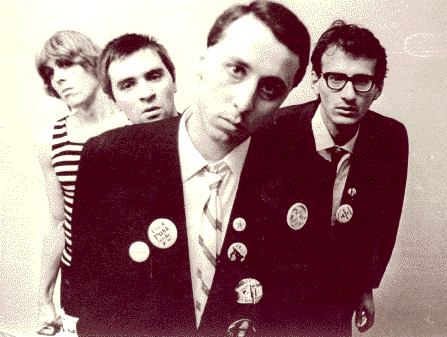
In Blic, Simonida Stanković offers a lyrical chronicle of the high-decadent period of turbo folk, with biseri from Aca Lukas, Tina Ivanović, Seka Aleksić, Keba and a pleiad of TF idols. Prize for couplet of the year goes no contest to Goga Sekulić: "devojka za jedno veče, misli, briga me, al’ kod tebe su još uvek moje gaćice." Right up there with "Zar nije lepše vekovat' u te, Santa Maria della Salute?"
In better news, Igor Burić has an interview in Dnevnik with Mr Nebojša Čonkić of Toronto, known to his millions of fans around the world as Čonta of the fondly recalled group Pekinška Patka. The group has just released a CD with remastered versions of pretty much everything the group ever put out, back in the day. It will be my first purchase when I return to Belgrade next time.
Back to unhappy musical news: police in Split decided that a public concert by the French group "Imperial Kikiristan" -- I have never heard of them, but if Jurica Pavičić's desription is any good, they must be hugely entertaining -- amounted to an "offence against order and peace" (the people nearby seemed to disagree, and so intervention units were called in). So the musicians spent the following night and morning in prison.
2006-08-19
Good work if you can get it
A Croatian company has put out an advertisement seeking 400 translators from Serbian to Montenegrin.
2006-08-17
If we crawl at two
Anybody who may have believed that my hope of arriving as scheduled back in Boston on Friday was sorely misplaced is undoubtedly right. Probably if I had not thought that there was a chance of arriving in time for my meeting (it was paid work ...) I would have simply changed the ticket to avoid going through London, although JAT was maintaining the level of responsiveness which continues to make it wholly dependent on its monopoly.
On Friday morning, JAT is pretending to operate as normal: they take luggage, print boarding cards, check passports. Departures are announced as on time. Then the “on time” time passes, and the departure is announced as delayed thirty minutes. After sixty minutes, they add another thirty minutes to the announced departure time. No reliable information is available, no indication of whether the flight is taking off or not, and it becomes clear that the staff of JAT and Belgrade airport have, in fact, no idea what is happening. Three hours after the originally announced departure time, a gate number is posted. Thirty minutes after this, the gate is opened. But wait: JAT has taken on the duty of applying the Heathrow security regulations, no carry-on baggage, no liquid, no electronics. Except their staff is not clear either as to what these regulations are or how to apply them. Ninety minutes after the gate is opened, all of the resilient passengers are on the plane.
Arriving in mid-evening at Heathrow, it is clear that every person on the plane who had hoped to make a connection in London has missed their flight. Not to worry: a good half or more of flights have been cancelled anyway, and those that do fly do so without many of their passengers, because the airport operator BAA has not figured out a way to enforce their security regulations and get passengers to the terminal in less than two and a half hours in any case. No problem: JAT will certainly schedule another flight and provide a hotel, no doubt. The first challenge is to find the JAT service desk, which is off in a corner autonomous from the service desks of the other airlines. The JAT service desk is lovely: a spacious segment of clean formica, computers and telephones on the counter, a little room behind where the light is on, and coats are hung. The only thing it lacks is a person staffing the desk. It is clear that at some point one or more (there are two coats hanging in the back room) persons must have shown up to do their job behind that desk. But there is no direct sign of this for ten minutes, fifteen, thirty. There is, however, a solution: Alitalia remains the international agent for JAT. Alitalia does everything JAT does not: they swiftly provide a taxi, a hotel room, meal vouchers, and a reservation (standby, unfortunately) for the following day. Little do I know that this is the best service I will receive on the journey.
A quick jaunt to a shop where I buy toothpaste, a toothbrush and deodorant, and a quick visit to the hotel reception desk, and I am set to rest up for the next day's challenge. Nothing special here, the hotel is identical to every airport hotel on the planet. There is one distinction – it is in Hounslow, the neighborhood made famous to the world as the home of the Hounslow Harriers in Gurinder Chadha's delightful film Bend it like Beckham. Strolling about, I believe that I recognize the row of houses where Parminder Nagra's character lives. It is one of my daughter's favorite films, and I recall the excellent performances: Keira Knightley's sly pro aspirant, Anupam Kher's honest and tormented father, the casual comic turns by Ameet Chana and Frank Harper. But there is not much time for cinematic tourism. The toiletries get left in the hotel room (they cannot be taken to the airport anyhow) and it is off to see whether my standby reservation will get me to Boston.
One would imagine that Virgin Atlantic, with its public face constructed by the mildly interesting exhibitionist Richard Branson on the one hand, and by its sister record label's oh-so-safe catalog on the other, would have the situation in hand. In fact, what distinguishes Virgin from JAT is primarily the stylishness of its graphic resolutions. There is a standby desk, where after a while it becomes clear that there is no line. One reaches the desk by maneuvering through the crowd of people seated at a depth of ten meters in front. Then one quickly realizes that there was no point in reaching the desk, because the person who stands behind knows nothing and will do nothing, other than to instruct you to come back at another time, at which point the person will still know nothing. There is always the option of trying to find a certain reservation at Virgin's ticket desk, where the unfriendly agent will tell you that the fact that you have purchased a ticket confers no obligation on the airline to assure that you reach your destination. By way of explanation, an agent who has not purchased a ticket and who has slept the previous night in her own home, and who knows with assurance at what time she is coming to the airport and at what time she is leaving, declares “we are all in the same situation.”
Four hours after reporting to the standby desk, and one half hour after the plane is scheduled to leave, the standby agent begins to distribute tickets. Announcements on the loudspeaker instruct people not to get into the line for security inspections until one hour before the departure of their flight. Since it is already after the only announced departure for my flight, I get into the security line. The line snakes through the entire upper floor of the terminal, blocking all of the takeout counters, bookshops and gift outlets. This is just as well, since anything that a person purchases at one of the shops would have to be handed over to the security inspectors. They are taking books away! Getting to the front of the security line takes two and one half hours. The inspectors have been ordered to hand search 100% of passengers, a task for which they do not have the staff, space or time. The strict 100% search regime continues for five days, and must have been tremendously effective: while treating every passenger as a terrorist, they did not turn up a single one (they did, however, let through a passenger carrying a banned cell phone, which caused a flight to turn back, and a minor who had no ticket or passport. No offending books, though).
Passengers are instructed that they can buy books to read on the plane once they have passed into the area after the security inspection (by the end of the day, everybody has learned that airport operators call this section, for reasons that must not be aesthetic, “airside”). It turns out that this information is false, and as I am relieved of my half-read copy of A history of tractors in Ukrainian – nothing special as a novel, but a bother to have interrupted all the same – everybody begins to wonder what kind of mayhem the security services expect people to wreak with their mass market paperbacks. Nonetheless, the weary and irritated Boston-bound travellers breathe a sigh of relief when, around 9:00, their 2:30 flight is called. For the lucky ones at the front of the line, this means that they get to experience the pleasure of one more 100% hand search, for people who have just gone through a 100% hand search. The ones at the end of the line have to pass on the pleasure, because before the plane fills up the flight is cancelled.
After the second cancellation in two days, all of the travellers have questions. Will there be another flight to take us to Boston? Will we get our luggage back? Will the airline provide a place to sleep? Nobody, however, has answers to these questions. In fact, it turns out that Virgin has no staff in positions of responsibility at all, at least ones that would be visible to their passengers. Quickly it begins to appear that the entire corporation is run by uninformed teenagers, who are sent out from time to time to give contradictory information (no, there are no hotels; yes, there are; no, it is not possible to get luggage; yes, hurry to get your luggage right away; yes, there will be another flight; no, fend for yourselves). It becomes increasingly clear that not only are none of the people whose faces appear endowed with the authority to make a decision, but also that none of them are of sufficient rank to be told what is happening. In the end, we head to the luggage area to get our bags (one more security inspection), are deposited at 3 AM a subprime downtown hotel, and are given a printed sheet with a phone number to call in the morning to try to get onto some other flight.
By this point, I am not about to spend another 24 hours at Heathrow, where all systems have broken down and post-Fordist rationality is exposing its translucent center, trying to get onto a flight which will in all likelihood be cancelled. I call the Virgin reservations line, accept a seat for Tuesday, and set about to ask my friends in London whether they would like a surprise visit. By Tuesday, the either the level of chaos will have been reduced or the people responsible for managing it (the government security agencies, the airport operator BAA,and the airlines) will have figured out how to cope.
Not likely. Police are close-lipped about their investigation into what they have publicly stated is a massive terror conspiracy. At one point, they declare that in their sweep of the country, they have turned up one rifle and one handgun. Tony Blair remains on vacation: unselfconscious, he frolics in flowered swimming trunks and hangs his own laundry out to dry. The Home Secretary makes use of the general mood of panic, fantasizing publicly about the security inspections regime becoming permanent and the government having another go at lengthening the period of time that people can be held in custody without charges being filed against them. Meanwhile I enjoy an unplanned London vacation: visiting friends, sampling the fantastic Indian cuisine that is available everywhere, wondering who got the idea of deep-frying skate wings in batter. By Monday night, hopeful announcements are being made that perhaps fewer than a third of flights will be cancelled at Heathrow the next day, and that security agents may stop taking people's books away. And broadcast media faithfully relay the message that passengers should plan to come to the airport early.
In fact, coming to the airport early is an entirely useless gesture. The technique that is being used to relieve crowding inside the airport is to create it outside. Thousand of people are assembled on the sidewalks with their luggage, straining to hear the airline employees who occasionally emerge to announce for which flights passengers may have the privilege of entering the building and waiting two hours to reach a check-in desk. Nonetheless, somebody has been thoughtful: tents have been put up on the sidewalk in case of rain, and there are tables with (free!) coffee, sandwiches and mineral water. And today it looks like flights are likely to leave. At the security checkpoints, they are only handsearching 50% of passengers, and there is no line to speak of at all.
The new semifunctionality of Heathrow is illusory, of course. Once past security, it seems as though there are only a few minutes to peruse newspaper headlines about the collapse of the transport system turning into a national embarrassment, or about how the sudden evaporation of revenue from duty free sales (apparently all those last-minute perfume and whiskey purchases amount to 24% of Heathrow's income, which is used principally to subsidize airlines, who mysteriously do not translate their windfall into improved service) will force the air transport industry to restructure. Immediately, they claim that the plane is boarding, and on time at that! But of course it is not. Instead people are being asked (but not informed of this) to leave the kobajagi comfort of the waiting lounges in order to be crowd the hallways and wait for one more 100% search, a special pleasure reserved for people foolhardy enough to want to fly to the United States. Just ninety minutes after the announced departure time, which is never changed, we have a plane full of tired, angry, humiliated people ready to take off, in the event that a takeoff is cleared.
In my case, the whole experience was not so bad. I got home four days later than planned, spent some money on hotels and meals that I certainly would not have spent otherwise and lost some income from missing a meeting that I certainly would not have missed otherwise. But I am fortunate to be in a position that allows me to absorb a small loss of money, and very fortunate to have friends in London, a city I have always been happy to visit up until now (and may still be happy to visit, if I can come by boat, train, Vespa, or mule). At the same time, I understand completely people like Catherine Mayo, for whom the sustained mistreatment by airport and airline staff triggered a nervous reaction inflight. The fact that instead of getting assistance, she got an F-15 escort, a long delay, and criminal charges is symptomatic – not of her condition, though, but of someone else's.
Update: We did not meet, but it seems this person was on the same flight. Interesting detail -- the flight that we were removed from on Saturday went off after all, empty (!), to Boston to pick up passengers bound for London.
2006-08-10
This summer's atrocity film festival
In these last few days of my stay in Belgrade, I haven't had the time or energy to post what I have been thinking about the latest atrocity videos, showing crimes against the civilian population during the course of the "Oluja" operation in 1995. But I did have a chat on the subject today with Dragan Štavljanin of RFE/RL.
This will be my last post for a few days. I am supposed to return to Boston (through London, thanks to my brilliant planning) tomorrow, and then I'll be off for a few days, after which I hope to be back with a shiny new computer.
This will be my last post for a few days. I am supposed to return to Boston (through London, thanks to my brilliant planning) tomorrow, and then I'll be off for a few days, after which I hope to be back with a shiny new computer.
2006-08-08
Summer reading: The East Ethnia mini book review
At the end of the week it is goodbye to Belgrade once again, and back to work. I will have a brief period of computerlessness, and so no posting (ha! see if you notice the difference!). But my charming employer has agreed to replace my rahmetli laptop, so this should be just a matter of time, the shorter the better.
In the meantime, a selection of a few of the more interesting books I have acquired and read during my glamorous summer vacation.
In the meantime, a selection of a few of the more interesting books I have acquired and read during my glamorous summer vacation.
There are a few other titles in my bag that I have not got to reading yet. Of the ones I have, some are good and some are not so good. For the most part, I am surprised at the thin selection of new titles in bookshops. Maybe publishing is weaker than it used to be, or maybe distribution is as weak as ever.
- Slobodan Antonić, Nacija u strujama prošlosti -- This is a fellow who gets a lot of publicity, partly because at one point he did some interesting research, and partly because local media need an intellectual who is sympathetic to the right wing of DSS for the sake of "balance." But sorry, this book is just a compilation of polemical magazine columns.
- Jovan Bajford, Teorija zavere -- The author marks the spring of 1999 as the time when all sorts of otherworldly discourses from the margins of the church, the military, and the hangers-on from the distant past became respectable enough to get wide play in big-circulation media. Foteljaši say the darnedest things.
- Aleksandar Bošković, Etnologija skakodnevnog života -- Not really an ethnology of everyday life, more a series of essays written over a period of several years for magazines and newspapers. Some of them are interesting.
- Boris Dežulović, Jebo sad hiljadu dinara -- Quickly reached the top of my list of favorite antiwar comic novels. A Muslim unit disguised as a Croatian unit for a "special mission" reaches a standoff with a Croatian unit disguised as a Muslim unit for a "special mission."
- Jens/Martin Eriksen and Frederik Stjernfelt, Anatomija mržnje -- A couple of Danish journalists take a trip and do several interviews. Some of them are good. They also do some analysis, some of which is good.
- Todor Kuljić, Kultura sećanja -- A good theoretical and historical overview of problems associated with the politics of public memory. If the book were as strong on empirical detail as it is on quotations from Nietzsche, it would be a great study.
- Nebojša Popović and Kosta Nikolić. Vojislav Koštunica, jedna karijera -- This is a bit of a hatchet job by two historians who have taken the effort to dig up every compromising thing Mr Koštunica has ever done or said. Maybe good as a primary reference source, for someone who wants to sift the wheat from the chaff. Highlight: The essay by Danica Drašković on how Voja is not a proper ravnogorac.
- Marko Vidojković, Kandže -- This novel about the student protests of 1996-1997 came highly recommended to me by several people. After reading it, I cannot figure out why. A random mixture of objectless cynicism and adolescent male fantasy.
- Helena Zdravković, Politika žrtve na Kosovu -- Go straight to the empirical material, which begins about two thirds of the way into the book, and you will find some interesting interviews and discourse analysis on ways in which Serbs and Albanians in Kosovo perceive one another.
2006-08-01
 When people roll out maps, you know you are in trouble... here is a perfect example not only of that but also of the intellectual brilliance of such an idea. A recent article of the Armed Forces Journal called "Blood borders. How a better Middle East would look" proposed a new map for the Middle East (no, I am not a regular reader o fthe Armed Forces Journal, I came accross it thanks to Carl Bildt's Blog).
This map (the article discloses the mind-set of the author: 'Oh, and one other dirty little secret from 5,000 years of history: Ethnic cleansing works'.).
has such great ideas such as Greater Lebanon (in fact todays Lebanon is already Greater Lebanon), Greater Jordan (making a functional state even more functional), Saudi Homelands Independent Territories (the term homeland is particularly well chosen).
There is really only one map in recent years which has proposed some decent borders, and is based on more serious research than the above:

Things I will not miss from Belgrade
Mostly Belgrade is a perfectly pleasant place to live in and the down-sides are made up by the up-sides. Here is one of the down-sides to most other places: Indicted war criminals. It just does not really make my day, as just a few days ago, when I parked the car and had to see Nikola Sajnovic going to church (my fault for parking next to Sveti Save one could argue). Good news, he had to go back to the Hague the next day. A few years ago I had my lunch at the otherwise wonderful Grmec ruined by the company of Aleksandar Pavkovic. Unfortunately, I have not yet seen any of the war criminals for which I could get 5 mio. $ and retire.
2006-07-28
Rising up and falling down
A lot of attention is going to acting SRS leader Tomislav Nikolić today for his comments last night in an interview on RTS. In his remarks he restated his position (one shared by most parties in Serbia) that independence for Kosovo would not be acceptable, but also went a step further: he declared his advocacy of "armed defense" (of what?) to prevent independence, and promised to bring SRS followers out in opposition to the president and prime minister following any agreement to independence.
In fact, there is nothing new in the statement by Mr Nikolić. Both the invitations to new wars and the threats against elected governments are longtime SRS rhetorical standbys. Sometimes, usually around election time, they are brought out among smaller circles and a little more quietly. At rally-the-supporters times, or when SRS has the security of a partner in power, they are louder and frequenter. During a couple of periods over the last couple of years, there were quiet moments, and these led to all sorts of speculation: is SRS adapting to democratic politics? are there fundamental differences between Mr Nikolić and his more bombastic predecessor? is SRS reorienting itself to become, eventually, an attractive coalition partner to some ideologically similar party which is less discredited than its previous coalition partners? Then SRS returns to its established bag of tricks and confirms what was known all along, that the answer to all those questions is no.
It might be the case that by turning up the heat, SRS is putting down the blinds. Last month, a survey by the Medium agency for Gallup raised fears when it showed SRS as the most popular political party in Serbia at 36%, potentially able to form a government, perhaps in coalition and perhaps on its own. This month's survey by the same agency shows SRS falling to 30%, and SPS from 6.3% to 4.6%, with gains by DS, DSS, NS, and G17+ (and also, interestingly, by the populist party out of Jagodina, Jedinstvena Srbija). This would leave SRS as the most popular single party, but probably out of reach of power -- but at the same time, it would show once again that there is no possibility of a government by the "democratic bloc" without one more very broad and probably fragile coalition. The question keeps coming up as to whether DSS wants to be a part of the "democratic bloc" or not.
Medium agency director Srbobran Branković (as quoted in Blic) might or might not be right in attributing the weakened position of SRS to their "return to the old image and the noticable rebellion which has occurred in democratic public opinion because of this." Or it may be that both the June and July results are blips, considering the continuing instability of the political scene, the high rate of abstention, and the fact that it is not an election season. In either case, the results would seem to confirm again that while support for SRS is certainly not rising and may be falling, the power and influence of this party continues to depend most of all on high rates of abstention and the lack of faith in "democratic" leadership. In the meantime, the statements of the acting president of the party, while they may not help SRS, are probably doing some damage to the country over which it once exercised power.
In fact, there is nothing new in the statement by Mr Nikolić. Both the invitations to new wars and the threats against elected governments are longtime SRS rhetorical standbys. Sometimes, usually around election time, they are brought out among smaller circles and a little more quietly. At rally-the-supporters times, or when SRS has the security of a partner in power, they are louder and frequenter. During a couple of periods over the last couple of years, there were quiet moments, and these led to all sorts of speculation: is SRS adapting to democratic politics? are there fundamental differences between Mr Nikolić and his more bombastic predecessor? is SRS reorienting itself to become, eventually, an attractive coalition partner to some ideologically similar party which is less discredited than its previous coalition partners? Then SRS returns to its established bag of tricks and confirms what was known all along, that the answer to all those questions is no.
It might be the case that by turning up the heat, SRS is putting down the blinds. Last month, a survey by the Medium agency for Gallup raised fears when it showed SRS as the most popular political party in Serbia at 36%, potentially able to form a government, perhaps in coalition and perhaps on its own. This month's survey by the same agency shows SRS falling to 30%, and SPS from 6.3% to 4.6%, with gains by DS, DSS, NS, and G17+ (and also, interestingly, by the populist party out of Jagodina, Jedinstvena Srbija). This would leave SRS as the most popular single party, but probably out of reach of power -- but at the same time, it would show once again that there is no possibility of a government by the "democratic bloc" without one more very broad and probably fragile coalition. The question keeps coming up as to whether DSS wants to be a part of the "democratic bloc" or not.
Medium agency director Srbobran Branković (as quoted in Blic) might or might not be right in attributing the weakened position of SRS to their "return to the old image and the noticable rebellion which has occurred in democratic public opinion because of this." Or it may be that both the June and July results are blips, considering the continuing instability of the political scene, the high rate of abstention, and the fact that it is not an election season. In either case, the results would seem to confirm again that while support for SRS is certainly not rising and may be falling, the power and influence of this party continues to depend most of all on high rates of abstention and the lack of faith in "democratic" leadership. In the meantime, the statements of the acting president of the party, while they may not help SRS, are probably doing some damage to the country over which it once exercised power.
2006-07-26
Bad Metaphor of the Day: Serbia has it's own Dalai Lama!
Well, in fact it is the 'Serb Republic of Krajina', as Politika's article on the Dalai Lama in Zemun so aptly calls the government in exile of the state which never really was. However, don't expect spirutal enlightment for the prime minister Miloran Buha of the 'government in exile' the RSK, incidentally also an MP for the Serb Radical Party.
Well, in fact it is the 'Serb Republic of Krajina', as Politika's article on the Dalai Lama in Zemun so aptly calls the government in exile of the state which never really was. However, don't expect spirutal enlightment for the prime minister Miloran Buha of the 'government in exile' the RSK, incidentally also an MP for the Serb Radical Party.
2006-07-24


The timing of Ceca has been impeccable in her more than 18 year long career as the star of the Serbian pop scene. From gangster bride to heroic widow and Serbian J-Lo, she demonstrated a better sense of where
Within a few days of Ceca releasing her new album “Ideally Bad” (Idealno loša) and singing its tunes to the biggest crowd ever gathered for a concert in the Balkans, more than 100,000 people saw her live at Ušće, the confluence of the Sava and Danube in Belgrade, on June 17 (the same place one of the biggest demonstrations took place to praise another idol, Slobodan Milošević in 1988), prime minister Vojislav Koštunica harshly criticized the EU for its treatment of Serbia and called it “deeply wrong” in his “ideally bad” interview for the news agency Fonet.
With both Ceca and Koštunica being ideally bad, one might ask is this just a coincidence. The text below suggests that the popular folk-star, cum widow of indicted war criminal Arkan, cum self-styled icon of
Notes to Koštunica (unknown origin, crumbled up piece of paper, found in trash can near government building):
You might say to yourself:
“This world is for smarter ones,
this is the path for more courageous ones…
my heart is a chick, rained on, yellow and small”.
You might get cold feet before the meeting and say to yourself:
“Already I am panicking a little,
still nobody has invited me anywhere.
I will go by myself, what else. …
Everything annoys me here.”
But find your courage and tell Oli Rehn:
“Once the ground cracked beneath our feet…
You were the one I could call when the whole world forgot about
me.”
“But now, it is only will you leave or stay,
now everything between us is, do you want to or don’t you.”
“I offered myself to you, I offered but you rejected me.“
“Never, never, with you never again”
“In my room there, everything is crap and broken,
just as everywhere else in my city.
If you don’t know with whom you want to be, where you want to be, and why,
then for you this
is ideally bad.”
After you have told him, you might think to yourself:
“You don’t know anybody, but know them all,
that’s how it is when you’re alone,
as if it all happened to you before.”
(The text is taken from songs: “Čulo bola”, “Koža pamti”, “Ponuđen ko počašćen”, “Viski”, “Lepi grome moj”, “Idealno loša” and “Pile” on the new Album of Ceca Svetlana Ražnatović, Idealna loša)
Another connection
Was there a connection between the Serbian government and the self-declared military forces and paramilitary formations that operated in Croatia and Bosnia-Hercegovina? The Supreme Court of Serbia says yes. It has confirmed an earlier decision ordering the state to pay damages to seven (out of an estimated 10.000) refugees who were arrested by the military in 1995, then delivered under military security for "training" at a camp of the "Serbian Volunteer Guard" (Srpska dobrovoljačka garda) in Erdut, after which they were forcibly mobilised into units of the "VRSK" in Croatia and the "VRS" in Bosnia-Hercegovina.
2006-07-22
Worrying developments in Bosnia
[Updated version with links]
Last week I edited the draft of a report in which the author had written of "deteriorating political trends" in Bosnia. The donor wanted to have this changed to "worrying political trends." Whichever it is, it's for real. Until recently, for example, I'd have been inclined to dismiss calls for a referendum on independence for RS -- the miserable statelet ("entity") the Serbs carved out of Bosnia by killing, raping, looting, and shelling -- as mere campaigning. (Bosnians will vote for central and entity parliaments on 1 October.) The SNSD, a nominally moderate party with good links to the RS business community and a history of antagonism towards the RS' "natural" government party, the SDS of Dr. Radovan Karadzic, wanted to prop up its nationalist credentials, on this reading, and that's certainly part of the story -- but not all of it. RS prime minister and SNSD leader Milorad Dodik is very close to certain circles in Belgrade -- the very same circles that pay a lot of money to Washington lobbying firms to place well-written and superficially reasonable op-ed pieces in U.S. papers, pieces that nonetheless are full of threats if one reads between the lines -- and it's obvious to assume that he's not doing this for purely opportunistic, or indeed domestic, reasons (unless one has a rather big house). Indeed, after spending years denying that what happens in Kosovo would resonate in Bosnia, Western diplomats are getting *really* worried at the precedents they're setting in Kosovo.
But it's not just the Kosovo repercussions. Police reform -- a key prerequisite to conclude the first association steps with the EU -- is stalled, with the Serbs very openly obstructing talks. The international proconsul has announced he'd close shop by end of June 2007, so all they need to do is sit him out. The Serbs are now also second-guessing the distribution key for fiscal revenue and are being difficult on a number of other fronts.
Perhaps there's really no point in trying to keep them inside Bosnia if they really don't want to be there, as folks like David Chandler and Robert Hayden have long argued? Aren't they just a millstone around the necks of those who want to build a *real* state in Bosnia, and not just a conglomerate of self-ruling ethnic territories?
Last week I edited the draft of a report in which the author had written of "deteriorating political trends" in Bosnia. The donor wanted to have this changed to "worrying political trends." Whichever it is, it's for real. Until recently, for example, I'd have been inclined to dismiss calls for a referendum on independence for RS -- the miserable statelet ("entity") the Serbs carved out of Bosnia by killing, raping, looting, and shelling -- as mere campaigning. (Bosnians will vote for central and entity parliaments on 1 October.) The SNSD, a nominally moderate party with good links to the RS business community and a history of antagonism towards the RS' "natural" government party, the SDS of Dr. Radovan Karadzic, wanted to prop up its nationalist credentials, on this reading, and that's certainly part of the story -- but not all of it. RS prime minister and SNSD leader Milorad Dodik is very close to certain circles in Belgrade -- the very same circles that pay a lot of money to Washington lobbying firms to place well-written and superficially reasonable op-ed pieces in U.S. papers, pieces that nonetheless are full of threats if one reads between the lines -- and it's obvious to assume that he's not doing this for purely opportunistic, or indeed domestic, reasons (unless one has a rather big house). Indeed, after spending years denying that what happens in Kosovo would resonate in Bosnia, Western diplomats are getting *really* worried at the precedents they're setting in Kosovo.
But it's not just the Kosovo repercussions. Police reform -- a key prerequisite to conclude the first association steps with the EU -- is stalled, with the Serbs very openly obstructing talks. The international proconsul has announced he'd close shop by end of June 2007, so all they need to do is sit him out. The Serbs are now also second-guessing the distribution key for fiscal revenue and are being difficult on a number of other fronts.
Perhaps there's really no point in trying to keep them inside Bosnia if they really don't want to be there, as folks like David Chandler and Robert Hayden have long argued? Aren't they just a millstone around the necks of those who want to build a *real* state in Bosnia, and not just a conglomerate of self-ruling ethnic territories?
2006-07-20
What dread hand? & What dread feet?
What mysterious force persuaded the basketball player and would-be businessguy Vlade Divac, once the court had cleared the way, to suddenly abandon his plan to become the first private operator of the resiliently state-controlled Večernje novosti?
Akcija planiranja
According to the indictment issued by prosecutors against some of the (less highly placed) people who aided in harboring the fugitive Ratko Mladić, he shifted hiding places several times between 2002 and the end of 2005, but was hanging out principally in a series of rented apartments in Novi Beograd. This was, naturally, entirely unknown to DB, the police, landlords, neighbours, and to the mother of one of the conspirators who was dragged over to cook for the genocide indictee, who no doubt had quite an appetite.
All this should change utterly now that the government has adopted something called an "Action Plan." Nobody seems to know quite what this is, but the most vocal members of the government appear to be quite happy about it. Apparently it amounts to an effort to reproduce the success that the Croatian government had not too long ago in overcoming political barriers to continuing negotiations with the EU without actually arresting Ante Gotovina. Except that there are a couple of key differences. One is that eventually, Gotovina was in fact arrested: there was a shift from "action plans" to action. By contrast, responsible figures like interior minister Dragan Jočić continue to deny that planning to engage in action involves any obligation to act at all. Another is that, at least according to some reports, one of the preconditions for "action" is restructuring the state security services, which provided the base for Mladić's power at one point, and which (despite the existence any indictments of people with no rank or official position) facilitated his flitting about thereafter. People who have tried to touch these structures of power since the regime that operated through them appeared to have left power in 2000 have found themselves the targets of aggression and violence.
But not to worry: anybody who stands in the way will have to face prosecution by the special prosecutors for organised crime. Except there will be a couple of difficulties here, as the court to which this prosecution office brings cases is about to be abolished, and the prosecutor seems to be getting rid of prosecutors who actually want to bring cases at impressive speed.
Update: Politika continues its series. How did Mladić come to be under the protection of the real estate traders of Novi Beograd? Delivered by an agent of the military security service in 2002, apparently. Politika's journalist Milorad Vesić stops just short of saying that the agent in question, who is not charged in the indictment, is Radomir Ćosić.
All this should change utterly now that the government has adopted something called an "Action Plan." Nobody seems to know quite what this is, but the most vocal members of the government appear to be quite happy about it. Apparently it amounts to an effort to reproduce the success that the Croatian government had not too long ago in overcoming political barriers to continuing negotiations with the EU without actually arresting Ante Gotovina. Except that there are a couple of key differences. One is that eventually, Gotovina was in fact arrested: there was a shift from "action plans" to action. By contrast, responsible figures like interior minister Dragan Jočić continue to deny that planning to engage in action involves any obligation to act at all. Another is that, at least according to some reports, one of the preconditions for "action" is restructuring the state security services, which provided the base for Mladić's power at one point, and which (despite the existence any indictments of people with no rank or official position) facilitated his flitting about thereafter. People who have tried to touch these structures of power since the regime that operated through them appeared to have left power in 2000 have found themselves the targets of aggression and violence.
But not to worry: anybody who stands in the way will have to face prosecution by the special prosecutors for organised crime. Except there will be a couple of difficulties here, as the court to which this prosecution office brings cases is about to be abolished, and the prosecutor seems to be getting rid of prosecutors who actually want to bring cases at impressive speed.
Update: Politika continues its series. How did Mladić come to be under the protection of the real estate traders of Novi Beograd? Delivered by an agent of the military security service in 2002, apparently. Politika's journalist Milorad Vesić stops just short of saying that the agent in question, who is not charged in the indictment, is Radomir Ćosić.
2006-07-18
Competition
So the story appears to be: the folk-pop figure personality Severina Vučković makes a guest appearance on a television station in Kragujevac, in the course of which she receives as a gift one of the legendary "Yugo" cars from the Zastava factory. This leads her commercial sponsor, the Croatian representative of Mercedes Benz (or Daimler Chrysler, I presume?) to announce a lawsuit against her. No doubt the competitive pressure is difficult for MBZ to bear. Leaving aside whatever differences in quality, comfort or reliabilty that may exist between the product from Stuttgart and the product from Kragujevac, there does not seem to be much question which company's directors have a better sense of what makes for good publicity.
Update: TV 9 in Kragujevac says it ain't so, that Severina did not ask for a car, the station did not contact the factory, and the factory did not provide one. They do, however, invite people to support a campaign to raise funds to buy a car for the use of the safe house for women and the center for children who are victims of violence in Kragujevac.
Update: TV 9 in Kragujevac says it ain't so, that Severina did not ask for a car, the station did not contact the factory, and the factory did not provide one. They do, however, invite people to support a campaign to raise funds to buy a car for the use of the safe house for women and the center for children who are victims of violence in Kragujevac.
An update on dining in Belgrade
Just some quick notes on places we have tried in the last couple of months:
Restoran Oskar: This was the discovery of the season for us, traditional dishes perfectly prepared, and a good selection of domestic wines. They made best sarme we have tasted, with Montenegrin hard cabbage. In Dorćol, ul. Braća Baruh below Dušanova.The classics have remained classic, and we have at least not encountered any places that used to be good which have turned bad. Though we have no doubt that they exist.
Restoran Čubura: I came here one day with my student and we were thrilled by the fanstasticity of it. A few days later Mrs Ethnia went with some friends and was disappointed. Go figure. On Vračar, gradić Pejton.
Restoran Porto: Good fresh fish, fine service. However, be warned that it is obscenely expensive. Go only if somebody else (preferably, somebody against whom you bear a grudge) is paying. ul. Francuska, way off in the industrial zone.
Kafana ?: Amazingly enough, this year is the first time that we tried the food at this landmark spot. They offer up good classic roštilj, and they have renovated the toilets probably for the first time since opening. ul. 7. jula, between the bankers and the theologians.
Čobanov odmor: It's a takeout place, but you can get sandwiches in a freshly baked lepinja, goatsies, sheepsies or piggies with kajmak. Darn good, even with the folk styling. At Crveni krst, ul. Žarka Zrenjanina.
Kafana Proleće: Hardly a discovery, but we have noted again that this low-priced standby is still pretty darn good. It may well be the only remaining normal place in the central part of town. Preko puta Instituta za sociološko i kriminalističko istraživanje.
Pietro dell'oro: Italian šminka, owned by some sports figure or another. The design is excellent, the food is okay, and the service is on the level of "you should be happy just to be here." Admire from afar. Vračar, ul. Save Kovačevića.
2006-07-14
Moderate progress, within the limits of the law
Recognition where it is due: there was a time, for eleven or twelve years there, when the only reason to read the once-mighty daily Politika was for a bit of ethnographic voyeurism, to see what parts of their fantasies the bizarre characters of the old regime imagined were respectable enough to put out into public. It was kind of like the early-nineties work of Madonna, only inclining more to the horrifying than to the entertaining. Since late 2000 it has changed a bit. Now reading Politika is a little bit like shopping at Filene's Basement -- it's not that there is nothing worthwhile to be found, but there is a lot of other stuff to plow through before you find it. More recently the paper has also massively improved its graphic design, I am told through the services of the mighty Mirko Ilić. Now Politika has introduced a new web site. It is an improvement on the old one, but the old one was a disaster. Before they offered fewer than ten articles a day and took them all down after three days, with no archive. Now they offer many more articles, giving at least an impressionistic overview of the major sections of the paper. The selection is a bit odd: today they lead off with a long-range weather prediction, for example. They still do not provide an archive; every other major Belgrade paper provides a complete online archive.
The new Politika web site is a bit like the new Politika. It is better than it was, but considering what it was, it would have been hard for it to be worse. Bit of a synecdoche, really.
The new Politika web site is a bit like the new Politika. It is better than it was, but considering what it was, it would have been hard for it to be worse. Bit of a synecdoche, really.
Understatement of the day from EU pillar in Kosovo ('Invest in Kosovo'). I am glad that in the section they did not dwell too much on the stabile political system part.
Subscribe to:
Posts (Atom)
