
Congratulations to the brilliant Orhan Pamuk, who has been awarded the Nobel prize for lterature.
"All these questions you are asking, I will gladly answer them some other time. Allow me, the question we are discussing today at the Academy is much, much more meaningful, regardless of any type of journalistic curiosity, than the questions you are asking. That question is absolutely secondary both in its essence and formally, compared to the fact that Serbia has finally received a new, democratic Europan constitution and that afterward democratic elections will be called. That is the only thing that matters.""Four legs good," continued the prime minister, "two legs bad."
Sarajevo, well, what you still have there is an unconsolidated political climate, which absolutely does not leave much room for creative people--and I believe I am one of those--to show [their potential]. I want to tidy up and organize the Serb Republic in order to make it the incontestably more developed part of Bosnia-Hercegovina in the future.
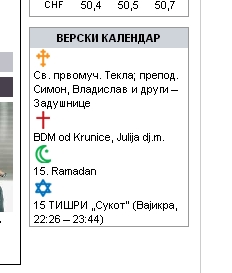 Not to pile on Politika (which I increasingly enjoy reading, especially on Sunday) or anything, but friend of East Ethnia Mirko sends in this tidbit I had never noticed from the bottom of the web page. As near as I can tell, aside from the occasional ad and the symbol for Swiss francs (which would look silly as цхф), the only Latin script that appears on the page is in part of the daily religious calendar. The Lord prints in mysterious ways.
butt brushes -- sudaranje kupaca u suviše uskom prostoru
Imre Kertész’s novel Fatelessness is a unique piece of work, and it impressed me. In contrast with his other works like Kaddish for an unborn child, which is self-reflective to the point of claustrophobia, this one is told in the voice of a teenage boy who is, sometimes shockingly, not reflective at all. And in contrast to the overwhelming majority of works in (what I guess has to be called) “Holocaust literature,” it proudly and aggressively refuses both melodrama and moralism. In that respect the work is paralleled by the work of only a couple of other writers who treat the period – Tadeusz Borowski, and perhaps to a lesser extent Primo Levi.
Kertész explained some of the motivations for this approach in his Nobel lecture in 2002. He was confronted both by his own ambivalent memory and by the demonstrative nature of much of the existing literature:“The experience was about solitude, a more difficult life, and the things I have already mentioned - the need to step out of the mesmerizing crowd, out of History, which renders you faceless and fateless. To my horror, I realized that ten years after I had returned from the Nazi concentration camps, and halfway still under the awful spell of Stalinist terror, all that remained of the whole experience were a few muddled impressions, a few anecdotes. Like it didn't even happen to me, as people are wont to say.”
[....]
“In the free marketplace of books and ideas, I, too, might have wanted to produce a showier fiction. For example, I might have tried to break up time in my novel, and narrate only the most powerful scenes. But the hero of my novel does not live his own time in the concentration camps, for neither his time nor his language, not even his own person, is really his. He doesn't remember; he exists. So he has to languish, poor boy, in the dreary trap of linearity, and cannot shake off the painful details. Instead of a spectacular series of great and tragic moments, he has to live through everything, which is oppressive and offers little variety, like life itself.”
One of the elements in the book that makes the strongest impression is the way in which the main character, before his deportation a detached and ironic lad, but in all instances a model of orderliness and obedience, accepts so many of his experiences as reasonable and tries to adapt. A good deal of the book’s tension comes from the contast between what the lead character does not know and the reader does. This acceptance weakens as he weakens in the camps, but does not really collapse until he returns home to Budapest. There the varieties of misunderstanding he encounters leads him to realize (as Kertész put it to the Swedish Academy in 2001) that he has been “in exile from a homeland that has never existed”.
This leads to the conclusion, as shocking as it is gentle, in which the narrator expresses what sounds like nostalgia for the horror he has experienced: “Yes, the next time I am asked, I ought to speak about that, the happiness of the concentration camps. If indeed I am asked. And provided I myself don't forget.” If the image of "happiness" in such circumstances still shocks, that was the author's intention. "I took the word out of its everyday context and made it seem scandalous," says Kertész. "It was an act of rebellion against the role of victim which society had assigned me. It was a way of assuming responsibility, of defining my own fate."
I am not certain that all of those factors which made the novel so unique and impressive come through in Lajos Koltai’s film of the novel, its title shortened to Fateless. The film is shot (very much in the style of István Szabó, with whom Koltai collaborated as a cinematographer before this directorial debut) in nostalgic sepia tones, the story told slowly and aestheticized. Some scenes which I interpreted as crucially important are left out or shortened – for example, the conclusion of the main character’s conversation with a well-meaning liberal journalist on his return to Budapest. One sequence is added, though it is not clear what it adds – after the liberation of the camps, an American sergeant tries to persuade the main character not to return home. All this is additionally puzzling, since nobody can accuse the screenwriter of messing with a badly understood text: Kertész wrote his own adaptation. But there is something odd about seeing the work of an author who defined Spielberg’s Schindler’s list as “kitsch” presented in a style that seems just the littlest bit Spielbergesque.
This is not to say that I don’t recommend the film. It is interesting on in own level, and has some well considered beauty. I would recommend it (like a lot of adaptations) more as a supplement to the book than as a substitute for it.
Cinema 320 is showing the film at Clark University this week. After the last projection (3:40 PM on Sunday in the Jefferson Academic Center, room 320), I will be leading a discussion for anyone who is interested. If you are around, come on down.
Picking up where the Serbian Radical Party left off, Kurir is running a defamation campaign against deputy prime minister Ivana Dulić-Marković. On Monday it was with a story claiming that her father (Kurir says his name is or was Antun, she says they got the name wrong, I don't have any information) had hid Ustaše on his farm, and that her mother had been a founder of the (fabulously succesful!) HDZ in Vojvodina. The hiding business is supposed to have taken place between 1948 and 1951, for which the only source (and who are you, reporter R.K.?) is an individual who the article says was put to death in 1957. For the curious, Ivana Dulić-Marković was born in 1961.
Today the campaign continues with a story that Dulić-Marković has "sold Vojvodina to the Croats" (a heck of an accomplishment if she could do it). The story relies on the claims by -- of all people -- Milan Paroški, the marginal paramilitarist from the Sloba era who survived and is only noticed as a marginal politician by the folks who write for Kurir. Actually he claims that the sale in question is of "nearly 30" businesses. Trouble is, he made the same claim to the same paper, clearly the only one that talks to him, in October of last year, at which time it was "28 businesses." She was not deputy PM at the time.
This is, of course, not the first time that people have attacked Ivana Dulić-Marković by trying to draw associations between her family and freaky movements from a long time ago. The last two times it was done by SRS. Which must have something in common with Kurir, no?


