The trial of Vojislav Šešelj began today, with the accused represented by David Hooper as his own remaining energy, constrained by a melodramatic attempt to demonstrate that hunger strikes are available even to the morbidly obese, is being spent in the effort to think up evocative names for the tribunal judges and prosecutors which he has not already used. The way things are going, he remains well behind his colleague Branimir Glavaš in the effort to transform the putrefaction of the flesh into publicity.
Meanwhile, the preelection season has been marked by one protected witness offering selective testimony against a few of the people with whom he communicated when he was a conspirator, and by the police demonstrating that on instruction, they can produce a limited number of fugitives.
2006-11-27


2006-11-21
2006-11-19
Rentacops gone wild
This video was taken by a student at the UCLA library. It shows campus police repeatedly using tasers against a student. An officer threatened to use the weapon against another student who requested a name and badge number. What is a taser? The name is an acronym for Thomas A. Swift Electric Rifle, and it is designed to stun a person by discharging an electric current into the body. Its intended use is to allow law enforcement officers to stop a highly violent individual without a high risk of causing death. It is on these grounds that such taser advocates as the company that makes them (duh) and several police agencies that use them (the RCMP, for example) defend their use. Controversies over their use have to do with their ability to cause death when they are used against people with certain medical conditions, such as heart conditions, and with incidents like this one at UCLA, in which they are used solely for intimidation against people who clearly and obviously present no danger at all. That is why organizations like Amnesty International highlight concerns about abuse of this weapon, and advocate that their use be suspended.
UCLA has done pretty much nothing to address the incident, other than repeatedly administering electric shocks to acting chancellor Norman Abrams until he issued a weaselly statement blaming the student for being attacked.
I am a graduate of the University of California, having got two degrees at the Berkeley campus. During my years there I provided them with a lot of free and below-market labor. It is a system with a good deal to be proud of, a fantastic faculty, outstanding library collections, an often okay record in dealing with a hostile state government. The administration when I was there did not generally contribute to the quality or reputation of the institution, and now that condition seems to have reached metastasis. As much as I believe in public education, this system is not getting one penny from me, ever.
Update: Was it enough for Norman Abrams to demonstrate that he is not capable of carrying out the job he holds? Apparently not, assistant UCLA police chief Jeff Young also had to show his complete lack of familiarity with the appropriate use of force. Does the Taser Corporation recommend using their device as a "pain compliance technique"? What kind of compliance is expected from a person who has been immobilised by pain? Here is the LA Times showing why the officers involved, their commanders, and Norman Abrams, who have already disgraced themselves and the institution that they represent for no apparent reason, should be fired and prosecuted:
See the comments to this post on the highly charged atmosphere in Houston and Slovenia.
Another update: Does the UCLA police force screen its employees at all? Then perhaps they might have known why officer Terrence Duren was fired from the Long Beach Police Department. Or they could have used the evidence that was immediately available to them based on incidents at UCLA when he choked a student with his nightstick, and when he shot a homeless man. Or is a long history of complaints considered a positive recommendation?
UCLA has done pretty much nothing to address the incident, other than repeatedly administering electric shocks to acting chancellor Norman Abrams until he issued a weaselly statement blaming the student for being attacked.
I am a graduate of the University of California, having got two degrees at the Berkeley campus. During my years there I provided them with a lot of free and below-market labor. It is a system with a good deal to be proud of, a fantastic faculty, outstanding library collections, an often okay record in dealing with a hostile state government. The administration when I was there did not generally contribute to the quality or reputation of the institution, and now that condition seems to have reached metastasis. As much as I believe in public education, this system is not getting one penny from me, ever.
Update: Was it enough for Norman Abrams to demonstrate that he is not capable of carrying out the job he holds? Apparently not, assistant UCLA police chief Jeff Young also had to show his complete lack of familiarity with the appropriate use of force. Does the Taser Corporation recommend using their device as a "pain compliance technique"? What kind of compliance is expected from a person who has been immobilised by pain? Here is the LA Times showing why the officers involved, their commanders, and Norman Abrams, who have already disgraced themselves and the institution that they represent for no apparent reason, should be fired and prosecuted:
Several local police agencies — including the LAPD and Los Angeles County Sheriff's Department — allow officers to use Tasers only if a suspect poses a physical threat or is acting combatively.
The sheriff's policies expressly say deputies can't use Tasers simply to move someone.
"We look for assaultive conduct," said Bill McSweeney, chief of the sheriff's leadership and training division "We generally don't use the Taser on passive resisters except when an individual indicates explosive action to follow, such as a verbal threat."
But UCLA police are allowed to use Tasers on passive resisters as "a pain compliance technique," Assistant Chief Jeff Young said in an interview Friday.
See the comments to this post on the highly charged atmosphere in Houston and Slovenia.
Another update: Does the UCLA police force screen its employees at all? Then perhaps they might have known why officer Terrence Duren was fired from the Long Beach Police Department. Or they could have used the evidence that was immediately available to them based on incidents at UCLA when he choked a student with his nightstick, and when he shot a homeless man. Or is a long history of complaints considered a positive recommendation?
Low-end imperial tourism
I do believe that this video is the most tasteless thing to which I have yet linked from this blog, at least in the video category. Not that I haven't tried. "Sonne, strand and šljivovic," apparently.
2006-11-16
History in the Making
In case you did not already have the urge to spend your holidays in Kosovo, the Department of Tourism of the Ministry of Trade and Industry launched a nice website. Better than "Discover Wild Beauty" or "The Mediterrenean as it once was", the slogan is "History in the Making"... Not that wrong, but usually tourists are just not very enthusiastic to witness history in the making. Other suggestion might be "Where status really matters" or "Travel to Kosovo: Standards and Status" or "When you want to leave your holidays from a different country you go to: Kosovo"
2006-11-15
Zar je zločin citirati ludake?
Testifying for the defence of Milan Martić at ICTY, Smilja Avramov said .... actually, who cares what Smilja Avramov said?
Democratic values and procedures
Certainly no democratic party is ideal. Still, I am not quite sure what my distinguished colleague was thinking. Even if I am a little bit charmed by his relativisation of the instrumentality of epic poesy.
Musical interlude
I'm off today to Washington to attend a conference and distribute quarters to the unemployed Republicans thronging the sidewalks. In the meantime, enjoy Rambo Amadeus and Kal, "Dikh tu kava" (featuring the vocal of Dragan Ristić).
2006-11-14
Clueless in the Balkans, fall 2006 edition
When I was an intern at the Open Society Institute in 1997-98, my boss, Arthur Helton, had me draft letters to Bob Gelbard, the Dayton czar of the Clinton administration. They often started, "Dear Ambassador Gelbard, Bosnia is at a crossroads." Today, Bosnia really is at a crossroads. The best indication for that is that even the EU has noticed.
Yesterday, EU defense ministers met to discuss troop reductions in peacekeeping missions (read: Congo and Bosnia, with customary good timing).
But then he went on to say that a decision should not be taken before next month, and actual withdrawal not begin before February.
If the situation in Bosnia "allows" troop reductions now, why wait till February? Because the UN has just postponed its imposition of a Kosovo status until after the Serbian elections, to be held at the end of January. Solana's people must have forgotten to brief the current EU presidency on these things, though:
In other, related news, Bosnia's High Representative Christian Schwarz-Schilling, a man who spent his entire period in office trying to undo as much as possible the legacy of robust international action in Bosnia, is now calling on his overseers in the "Peace Implementation Council" to think twice before confirming the decision, taken last June, to close down his office by June next year. (The PIC meets in February for that purpose; many observers thought it would just rubber stamp the closure without much debate.) The OHR is scared that its entire exit strategy of having an association deal with the EU signed soon is about to collapse since the Serb Republic is reneging on its part of and agreement on police reform. Next step: the EU will define down the "non-negotiable" principles of the reform (which had already been agreed last year) to make a "deal" possible. The first to suggest that option? None other than the High Representative, who -- with a straight face -- told a press conference last month that he had never heard of the idea that police regions should cross the entity boundaries except around Sarajevo.
Watch this space for more weaseling from the OHR and the EU.
Yesterday, EU defense ministers met to discuss troop reductions in peacekeeping missions (read: Congo and Bosnia, with customary good timing).
"A decision to reduce troop strength is under consideration," EU foreign policy chief Javier Solana told the meeting. "The situation in Bosnia-Herzegovina allows this."
Source: AP, Concern over Kosovo delays EU decision on cutting Bosnia force, International Herald Tribune, November 13, 2006
But then he went on to say that a decision should not be taken before next month, and actual withdrawal not begin before February.
If the situation in Bosnia "allows" troop reductions now, why wait till February? Because the UN has just postponed its imposition of a Kosovo status until after the Serbian elections, to be held at the end of January. Solana's people must have forgotten to brief the current EU presidency on these things, though:
Finnish Foreign Minister Erkki Tuomioja, who chaired separate EU foreign ministers talks with Ahtisaari, said the U.N. envoy's decision to delay would not harm efforts to bring lasting stability to the Balkans.
"We are not afraid it will destabilize the situation," he told reporters.
In other, related news, Bosnia's High Representative Christian Schwarz-Schilling, a man who spent his entire period in office trying to undo as much as possible the legacy of robust international action in Bosnia, is now calling on his overseers in the "Peace Implementation Council" to think twice before confirming the decision, taken last June, to close down his office by June next year. (The PIC meets in February for that purpose; many observers thought it would just rubber stamp the closure without much debate.) The OHR is scared that its entire exit strategy of having an association deal with the EU signed soon is about to collapse since the Serb Republic is reneging on its part of and agreement on police reform. Next step: the EU will define down the "non-negotiable" principles of the reform (which had already been agreed last year) to make a "deal" possible. The first to suggest that option? None other than the High Representative, who -- with a straight face -- told a press conference last month that he had never heard of the idea that police regions should cross the entity boundaries except around Sarajevo.
Watch this space for more weaseling from the OHR and the EU.
Special fantastic thing for our friends in London
 This comment came in, I think, to an earlier post about TF, though I don't know which one:
Turbo folk, in my opinion, has killed the real values of our region. One of those values is Sevdah music (in its original shape and form).Check out the sites! The first has general information about the group, its schedule, its performances and goals. The second reports on their nastupi in and around London. Next time I am in the city of night and fog, I hope to catch them. Are they visible from Gazette Tower?
This is why I am putting my best efforts into resurrecting this and promoting it around London and the rest of the world as much as possible.
Let me know what you think of our project.
www.londonsevdah.com
londonsevdah.blogspot.com
Thank you, Mirza!
2006-11-13
On the universality of declarations
The European Court of Human Rights will have to decide whether European military forces are bound to respect the human rights of people in places where they are involved in international operations. The British government says it is not. At issue is a case by brought by the family of two boys, Gadaf and Bekir Behrami, one of whom was injured and another killed when they happened upon cluster bombs left by NATO forces.
2006-11-11
2006-11-10
Gish Jen in Beograd
This just in from a friend of East Ethnia, Gish Jen's experience at the Belgrade Book fair:
I have seen crowds before, but I was taken aback by the Belgrade book fair, where some 15,000 people attended my opening address. A few days later, too, at the airport lost and found, I watched an officious frown break suddenly into a smile. "You're a writer!" the woman behind the counter exclaimed and, as others watched enviously, produced my bag. The power of writing! During the fair, a reporter asked whether writers in the United States were like writers in Eastern Europe and, when I said I didn't know, volunteered, "Here, writers are gods." Well, that's a difference, I said...The rest hides behind a registration screen at TNR, the patient are welcome to sample on.
2006-11-09
Možeš i da gubiš snagu kao kada gubiš glavu

2006-11-08
Slanina
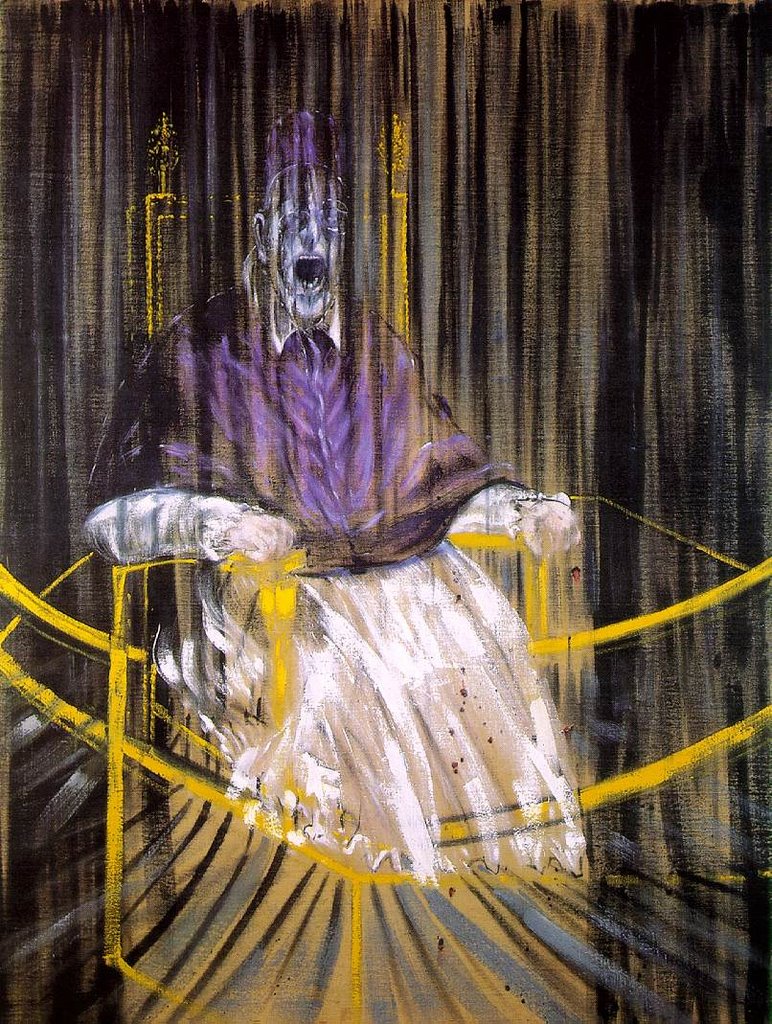
Who knew that the first head to roll after the midterm elections would be one from a Francis Bacon painting?
(Image courtesy of WebMuseum)
A good day for democracy
Yesterday, George Bush's America died. Voters pushed members of his party out of state offices, pushed them out of the majority in the House of Representatives, and depending on the results of two very close races in Virginia and Montana, may also have pushed them out of the majority in the Senate. There are still two years left in his term, but the capacity he once had to operate as if he were in a one-party state is gone.
I would have to be a lot taller to get proper historic perspective, but let's hope that this administration is the bizarre aberration it appears to be, one horrifying detour from this society's path to democracy, an aggressive and ultimately failed effort at restoration by a residual clique of hardliners on its way out.
I would have to be a lot taller to get proper historic perspective, but let's hope that this administration is the bizarre aberration it appears to be, one horrifying detour from this society's path to democracy, an aggressive and ultimately failed effort at restoration by a residual clique of hardliners on its way out.
2006-11-06
Nikolic's visions
Nikolic outlined the other day just on how he envisages his "Greater Serbia" to be in an interview (see also here) with the good old Kurir. In response to Agim Ceku's visit to Montenegro he argued that Serbia should impose sanctions (and visas...). When asked about how this would be for Serbs in Montenegro, he noted that they would come to Serbia, just like Serbs from Croatia and Kosovo...
I vi biste ostavili na cedilu Srbe u Crnoj Gori prekinuvši sve odnose a predstavljate se kao njihovi zaštitnici?
- Svi koji su Srbi, pobeći će u Srbiju. Svi treba da dođu ovde.
I to je vaše radikalno rešenje?
- Zašto da ne? Pobegli su i oni iz Hrvatske i sa Kosova i Metohije. Sve će to Srbija da izdrži. Majka mora da prihvati svoju decu. Oni neće da njima vladaju Albanci
I vi biste ostavili na cedilu Srbe u Crnoj Gori prekinuvši sve odnose a predstavljate se kao njihovi zaštitnici?
- Svi koji su Srbi, pobeći će u Srbiju. Svi treba da dođu ovde.
I to je vaše radikalno rešenje?
- Zašto da ne? Pobegli su i oni iz Hrvatske i sa Kosova i Metohije. Sve će to Srbija da izdrži. Majka mora da prihvati svoju decu. Oni neće da njima vladaju Albanci
Pixels, justice and mediascape
Gavin Simpson and Sameer Padania have a question:
GV Eastern Europe editor Veronica Khokhlova has pointed to debates about video footage of atrocities in the past. However, in the realm of Balkan blogs, many of which are cross-linked on sites like East Ethnia, there seems to be something of a dearth of examples of vlogging or other home-grown initiatives dedicated to reconciliation.How might video be used in this or other situations? As training or education materials? As evidence? To promote reconciliation? What role can citizen journalism play?
I know there are a lot of people reading who are a lot more involved in the media and exchange scene than I am. What do you think? Video za pomirenje? Any interesting projects out there that you know of?
Chronicle of a death sentence foretold
I am guessing that I may not be the only person who is underwhelmed by the verdict against Saddam Hussein, which was timed to be announced just before the midterm elections in the United States.
Not to confuse the matter: he is undoubtedly guilty, not only of the crimes with which he was charged, but of a lot else as well. But the character of the process and the conditions under which it was carried out leave a lot to be desired. And the sentence of death by hanging calls up both bizarre images of ritual sadism and a despotic tradition of offing the people who occupied power previously – both images which do more to revive the character of Saddam Hussein’s rule than to point toward any sort of vision of a democratic or just future. This kind of a punishment is the act of an insecure regime.
One way of thinking about transitional justice is as a performance: a new regime demonstrates its capacity, in contrast with its predecessor, to apply the rule of law and settle the controversies surrounding its arrival to power in the process. By providing a fair trial, they embody the distinction between an old despotism which exercised summary justice and a new legal state which does not fear its opponents’ evidence and arguments. By providing a public trial, they create the opportunity for a forum on the legacy of the past in the process which Mark Osiel calls “making public memory, publicly.” To the degree that they (in the words of Nuremberg prosecutor Robert Jackson) “stay the hand of vengeance,” they demonstrate their commitment to be constrained by legal rules.
The Saddam Hussein trial failed on all these points. The charges were selective, standing in the way of producing a comprehensive account of the character and actions of the old regime (not all of which would have reflected well on the occupying power or the current paragovernment). The court and government manifestly failed to control the proceedings, maintaining neither the loyalty nor the security even of the officers of the court. The fear of what might come out in the course of the proceedings was such that the trial was broadcast – but with a twenty minute delay, to allow for the editing out of inconvenient moments.
As for the rule of law, there is no such thing in Iraq to be represented in a trial, a fact of which the occupying powers who are obligated by international law to maintain public services and public order are no doubt aware, regardless of what their representatives say to the press.
There are probably not many people in the world more deserving of severe punishment than Saddam Hussein. It is only in the context of a misbegotten fiasco like the occupation of Iraq that his conviction on charges of which he is guilty could be made to appear like another desperate and empty act of revenge.
Not to confuse the matter: he is undoubtedly guilty, not only of the crimes with which he was charged, but of a lot else as well. But the character of the process and the conditions under which it was carried out leave a lot to be desired. And the sentence of death by hanging calls up both bizarre images of ritual sadism and a despotic tradition of offing the people who occupied power previously – both images which do more to revive the character of Saddam Hussein’s rule than to point toward any sort of vision of a democratic or just future. This kind of a punishment is the act of an insecure regime.
One way of thinking about transitional justice is as a performance: a new regime demonstrates its capacity, in contrast with its predecessor, to apply the rule of law and settle the controversies surrounding its arrival to power in the process. By providing a fair trial, they embody the distinction between an old despotism which exercised summary justice and a new legal state which does not fear its opponents’ evidence and arguments. By providing a public trial, they create the opportunity for a forum on the legacy of the past in the process which Mark Osiel calls “making public memory, publicly.” To the degree that they (in the words of Nuremberg prosecutor Robert Jackson) “stay the hand of vengeance,” they demonstrate their commitment to be constrained by legal rules.
The Saddam Hussein trial failed on all these points. The charges were selective, standing in the way of producing a comprehensive account of the character and actions of the old regime (not all of which would have reflected well on the occupying power or the current paragovernment). The court and government manifestly failed to control the proceedings, maintaining neither the loyalty nor the security even of the officers of the court. The fear of what might come out in the course of the proceedings was such that the trial was broadcast – but with a twenty minute delay, to allow for the editing out of inconvenient moments.
As for the rule of law, there is no such thing in Iraq to be represented in a trial, a fact of which the occupying powers who are obligated by international law to maintain public services and public order are no doubt aware, regardless of what their representatives say to the press.
There are probably not many people in the world more deserving of severe punishment than Saddam Hussein. It is only in the context of a misbegotten fiasco like the occupation of Iraq that his conviction on charges of which he is guilty could be made to appear like another desperate and empty act of revenge.
Subscribe to:
Posts (Atom)
