2007-01-14
Lawyers and torture
I received this essay from a mailing list I subscribe to today. Apparently it is the transcript of a lecture by P. Sabin Willett, "My worst moment as a lawyer." It goes over justifications for torture, the way prisoners are produced, and a defendant who decided to give up.


2007-01-13
Homily
Thanks to the loyal and dedicated reader who drew my attention to this inspiring story, which shows how the love of baked goods is stronger than the hatred of some ethnicity or another, regardless of whether people agree as to how the object of the hatred should be labelled, and what all this has to do with real estate.
2007-01-09
... a pivo voli nas
How to strike up a conversation with Europeans in the US: join in the complaints about top-loading washing machines and American beer. On the washing machines, point granted. The old saw that American beer is bad applies pretty much to the mass-marketed national brands, which are uniformly watery, flavorless, and pretty much only good for marinating beef (even then, a proper beer would be better). People with longer or tastier experience in the Statiunitima know that there are a lot of very fine small-production and local brews. Personally, I'm a fan of the products of the Ommegang brewery in Cooperstown, NY. Americans are moving away from the stereotypical product as well: domestic sales are stagnant, while imports are growing rapidly.
The most representative of the domestic mass-market bunch, and object of innumerable jokes (one of them involves canoes, but that is as far as I am going), is the flagship product of the brewery giant Anheuser-Busch, Budweiser (introduced in 1876). For over a hundred years, Anheuser-Busch has been in a trademark conflict with the Czech Budweiser Budvar brewery, which has marketed a far superior product under the same name since 1895. A-B claims exclusive rights to the Budweiser name, which kept the Czech product out of US markets for a very long time and may cause some easily resolved confusion in Europe.
Now Anheuser-Busch and Budejovicky Budvar have reached an agreement, whereby A-B (which already has marketing agreements with several international producers, including the Belgian giant InBev), agrees to market and distribute the Czech product in the US. It will continue to be sold under the deeply unsatisfying compromise name Czechvar.
It is one small step.
The most representative of the domestic mass-market bunch, and object of innumerable jokes (one of them involves canoes, but that is as far as I am going), is the flagship product of the brewery giant Anheuser-Busch, Budweiser (introduced in 1876). For over a hundred years, Anheuser-Busch has been in a trademark conflict with the Czech Budweiser Budvar brewery, which has marketed a far superior product under the same name since 1895. A-B claims exclusive rights to the Budweiser name, which kept the Czech product out of US markets for a very long time and may cause some easily resolved confusion in Europe.
Now Anheuser-Busch and Budejovicky Budvar have reached an agreement, whereby A-B (which already has marketing agreements with several international producers, including the Belgian giant InBev), agrees to market and distribute the Czech product in the US. It will continue to be sold under the deeply unsatisfying compromise name Czechvar.
It is one small step.
2007-01-08
Where was the previous Provence?
Travel and Leisure magazine declares that Istra is "the next Provence," whatever that may mean. This may well be the case, althugh it remains unclear just what this may mean for the present Provence or for any of the Provences which may have come after it. Before the next Provence pops up, though, they note the construction of some new sites for mass elite tourism and the intrduction of cheap air routes from the UK. My advice would be to avoid the better-known "beaches," which "sparkle as brightly as those of the better-known coast to the south" (why would you want a beach to sparkle?) and head inland.
2007-01-04

2007-01-03
Intelligence dump
There may or may not be something of interest in the documents released by the National Intelligence Council, representing some of the intelligence estimates on Yugoslavia prepared for US agencies between 1948 and 1990. What may be most interesting of all is the introductory essay to the collection by Marten H.A. van Heuven, attempting to assess just where intelligence succeeded and failed, and noting the strong and perhaps excessive emphasis placed on trying to understand Yugoslavia through the lens of the Soviet Union.
Related?: The CIA's role in the publication of Dr Zhivago?
The future of education?
I have the same mixed feelings as most of the folks who teach at private universities about the increasingly consumerist nature of the whole enterprise. We old folks often complain that paying students are encouraged to feel entitled to any number of things -- our time, a grade, a degree -- while the financial constraints often mean that we serve a fairly narrow social group (although like at most costly institutions, a minority of the people there pay full tuition). Interestingly, in discussing teaching with my colleagues from "the former countries of real socialism" (anyone remember that phrase?), many of them have the sense that high tuitions mean that the people paying them are more likely to be highly motivated than just passing through. For people in the teaching field, it often seems as though the goal is something not entirely realistic, providing knowledge and insight to people who really want it but do not really need it. I render this with a little bit of irony, but still hold to the belief that the best students will usually be the ones who have chosen what they are doing, for reasons of which they are aware.
For those reasons and a bunch of others, the Toronto-basedAnarchist U(niversity, no?) project looks very intriguing. It is not entirely new, having operated since Fall 2003. And it is not so big, with just three courses this term and not much more than five or so in other terms. Courses are free (there may be a charge for books and copies) and non-credit, and most of them are on political and social themes. Although it seems that course development and enrollment are e-mail and wiki-based, the classes themselves are nonvirtual, with people gathering in rooms at particular times.
Probably this sort of model is not likely to substitute for the kinds of institutions where most instructors and students find themselves now. But it looks like a mighty good way of making it possible for both teachers and students (broadly, rather than professionally, defined) to do a bit more of the stuff that attracted them to the world of knowledge in the first place.
A test post
This post is a test. I am trying out a new (to me) blog posting program called Bleezer.
Okay, it seems to work. What I like about it so far is that it circumvents the Blogger interface, and that it makes adding tags easy. No complaints yet.
You'll also find some fancy new links on the link list.
2007-01-01
Particularly chalga
Aside from continuing to synthesize fear of immigration, UK media are also welcoming Romania and Bulgaria to the EU by showcasing their pop culture. Apparently Bulgarian chalga artists run the gamut from "at least Bulgarian" to "not particularly Bulgarian." Thanks to Mirko for the tip.
2006-12-31
Because I cannot help myself
Sretna nova godina
The remainder of the day, and hence the year, will be divided between grading papers (down to the deadline, again!) and cooking. Our menu for this evening:
However and whomever with you are celebrating, a happy new year to you and yours.
- Mushroom soup in the style of the Hungarians, if they were Japanese
- Lentil salad (this is supposed to bring good luck)
- Ruska salata
- Stinco di vitello al vino
- A bunch of fruit and cheese
However and whomever with you are celebrating, a happy new year to you and yours.
Srđan Vrcan (1922-2006)
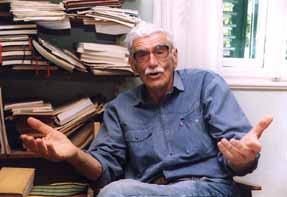
Sad news to end the year. This text arrived last night from Christophe, friend of East Ethnia. The text of the obituary is by Srđan Dvornik:
Srđan Vrcan was professor of sociology at the University of Split, Croatia. Born in 1922, he was the head of the Chair of Sociology at the Law School of the Split University from 1961 to his retirement in 1990. In 2003 he was awarded the title of Professor Emeritus. He also taught at graduate and post-graduate studies in Zadar, Zagreb, Ljubljana, Belgrade, Sarajevo, Vienna, Rome, Pecs, Berkeley, Sacramento. For many years he was a co-leader, together with the German professor Rudolph Siebert, of the seminar "The Future of Religion" at the Inter-University Centre for post-graduate studies in Dubrovnik. He presented the results of his scientific researches at conferences and symposia in Rome, Florence, Bergen, Dresden, Moscow, Berlin, Paris etc.
He was the Chairman of the Croatian Sociological Society. Through three consecutive terms he served on the Executive Board of the International Conference for Sociology of Religion in Lille/Paris. For many years he was on the Editorial Board of the journal for sociology of religion Social Compass, first published by the Catholic University of Leuven (Belgium), later by the Sage Publications (London). He was among the founders of the journal for social issues Pogledi (Views), which was published in Split from 1969 to 1990. He was also on the Editorial Boards of journals Sociologija (Sociology, the journal of the Yugoslav Sociological Association) and Revija za sociologiju (Review of Sociology, the journal of the Croatian Sociological Society).
The main field of Vrcan's scholarly interest was sociology of religion. On that subject he published the books Raspeto kršćanstvo (Christianity Crucified, 1980, co-authored by Boris Vušković); Od krize religije do religije krize (From the Crisis of Religion to the Religion of Crisis, 1986); Faith in the Swirls of Transition (Vjera u vrtlozima tranzicije, 2001). He studied social inequality (Social Inequalities and the Modern Society – Društvene nejednakosti i moderno društvo – 1974); the relationship between sport and violence (Sport and Violence Here Today – Sport i nasilje danas u nas, 1990; Sport, Violence, and Politics – Sport, nasilje i politika – 2003); as a co-author, he participated in two studies of voting behaviour (A Raid on Voters – Pohod na glasače, 1995; Packaging Power – Pakiranje vlásti, 1999); he was also a co-author of a study of youth (Position, Awareness, and Behaviour of the Young Generation of Yugoslavia – Položaj, svest i ponašanje mlade generacije Jugoslavije, 1986). He also published hundreds of scientific and review articles, articles in newspapers and interviews, which makes him one of the most productive Croatian sociologists.
Vrcan's particular merit is establishing and development of the particular sociological disciplines such as sociology of religion, of sport, of politics, of the youth, and of elections and electoral systems.
Srđan Vrcan actively supported democratic civic initiatives; thus, he was among the founders of the Association for Yugoslav Democratic Initiative, the first political civic initiative in the communist Yugoslavia (established in early 1989). He participated in many civic education activities, such as summer schools for democracy and human rights, and spoke at many public panel hearings on relevant political issues.
The photo is from an interview with Rade Dragojević in Zarez, in which Vrcan discusses his research on football fans and politics.
2006-12-30
Revenge served clammy
It is not necessary to have any sympathy for Saddam Hussein -- who was a revolting thug -- to see the futility of his rushed and widely publicized execution. Alive, the only people to whom he presented a danger were those who might be mentioned in the evidence he could give in trials that will now not be conducted. Dead, he is a monument to his failed trial and the fictional government that has now taken its useless revenge on him. Some people will now try to turn him in a martyr, which can only further increase the level of violence in the world. As far as deterrent effect, his killing ought to prevent the survival of the sort of political movement he developed about as much as the hanging of Mussolini did.
2006-12-29
Ford passing on the right
How surprising to see Gerald Ford dominating the news. He lived a long time, and during his brief, accidental presidency, he showed himself to be not an especially capable politician. His pardon of Richard Nixon set a precedent for impunity that has been called upon several times, and won him the undying gratitude of the handful of people who circulate between high positions in Washington. He plucked Donald Rumsfeld and Dick Cheney out of obscurity and set their bizarre mix of sadism and ressentiment on the world. It is a wonder that he is remembered at all.
He did, however, have a sense of humor.
He did, however, have a sense of humor.
2006-12-27
Povratnik

I'm back from my brief Balkan sojourn, partly unpacked with gifts properly distributed to their intended recipients. While there are many good things about being back at home, one that stands out is the ability to shower for longer than five minutes, without being confronted by the dilemma of whether to shower or shave today. Regular blogging to resume as soon as the inspiration strikes me.
Photo: Eric takes a moment for discussion with the youth of Niš.
2006-12-18
Great moments in tailoring
Hrvoje Petrač led the search for innovative uses of religion at the moment of his sentencing for kidnapping. Despite repeated instant messages, God could not be reached for comment.
Update: Loyal reader AR drops a note to point out that the text which Mr Petrač cited a bit selectively does not promise so many good things for him.
Update: Loyal reader AR drops a note to point out that the text which Mr Petrač cited a bit selectively does not promise so many good things for him.
Election slogans
A few of the election slogans I have seen around (not all parties have begun media campaigns yet), with cheeky commentary:
Noted at the bus station while waiting for my luxurious ride to Niš: the buses that claim to go to Sarajevo but in fact go to Lukavica no longer have a little sign in front saying "S. Sarajevo" ("Srpsko Sarajevo"). Now the sign says "I. Sarajevo" ("Istočno Sarajevo").
DSS-NSS-Palma -- Živela Srbija ("Long live Serbia!," or alternatively, "Serbia lived!")
Jes da je živela određeno vreme, a vi se možda time ponosite, a?
G17+ -- Stručnost ispred politike (Expertise before politics)
It is not clear to me why any party would want to highlight its inability to do politics. The slogan might seem to call to mind some other things that G17 has put ahead of politics, which would not be so beneficial for the party.
DS -- Život ne može da čeka (Life cannot wait)
Is this a slogan for a political party or for a cosmetic product?
LDP i ostali -- Od nas zavisi (It depends on us)
Who thought that it would be a good idea to bring up the image of dependency in a slogan?
The phantom PSS -- Srbija ima snage (Serbia has energy)
I always thought that this slogan, the same one they used in the last election before the party leader hightailed it to Russia to avoid prosecution, should be "Srbija ima snaje." True and appealing, at the same time.
Noted at the bus station while waiting for my luxurious ride to Niš: the buses that claim to go to Sarajevo but in fact go to Lukavica no longer have a little sign in front saying "S. Sarajevo" ("Srpsko Sarajevo"). Now the sign says "I. Sarajevo" ("Istočno Sarajevo").
Pozdrav iz Beograda
(written Friday; posted when I found an internet connection)
I arrived on Thursday, after a more or less okay trip. Belgrade looks much the same, at least what can be seen of it through the fog. It looks like posting will be intermittent for a while -- we thought that we had resolved the question of internet connection in our palatial vračarska garsonjera, but in the meantime the building changed cable providers, which means we are back to step one. There are promises that this can be quickly and easily resolved.
From the first moment I began to encounter the things I like about Belgrade, which include:
Politika announced today that it has placed on the web site of the Narodna biblioteka its issues from 1903 to 1941. Just 65 more years of digitizing, and it will be possible to read recent articles from the paper online as well, which every other major paper in the country offers.
On Sunday it is off to Niš. The fog, I might add, is gorgeous. I woke up this morning and looked out the window, and thought maybe someone had come in and closed the shades while I was sleeping.
I arrived on Thursday, after a more or less okay trip. Belgrade looks much the same, at least what can be seen of it through the fog. It looks like posting will be intermittent for a while -- we thought that we had resolved the question of internet connection in our palatial vračarska garsonjera, but in the meantime the building changed cable providers, which means we are back to step one. There are promises that this can be quickly and easily resolved.
From the first moment I began to encounter the things I like about Belgrade, which include:
Friends and family: Here they are. As it turns out, though, some of them have jobs for me to do.Of course, in addition to the things that I like, there are also other things. The first major success of the special prosecutor for war crimes, last year's Ovčara conviction, has been reversed by the Constitutional court. Last summer, when it seemed as though the far right might be returning to power, this sort of thing looked like a strategy of stretching out the cases until everybody could be pardoned; now that it seems like the upcoming elections will probably just bring a reshuffle of the balance of power between DSS and DS, it is less clear what the judges are trying to do (or prevent from happening). Maybe they would like the trials to last forever?
Burek: This week about 93% of the people in Serbia will celebrate sv. Nikole, which is a "posna" slava (not a good thing), but as a side effect the bakeries have burek with mushrooms (a fantastically good thing).
Beogradski rokenrol: over the next two days at SKC, we have Partibrejkersi, Disciplina kičme, Obojeni program and much much more.
Beogradski radio: Every station, including the ones I don't like, has its individual character. Here is an idea for a društvena igra: look at the face of a taxi driver and try to guess what station is playing in the cab. Your guess is certain to be wrong.
People on the streets: There they are.
Politika announced today that it has placed on the web site of the Narodna biblioteka its issues from 1903 to 1941. Just 65 more years of digitizing, and it will be possible to read recent articles from the paper online as well, which every other major paper in the country offers.
On Sunday it is off to Niš. The fog, I might add, is gorgeous. I woke up this morning and looked out the window, and thought maybe someone had come in and closed the shades while I was sleeping.
2006-12-13
Svuda prođi
I'm travelling today, back at you from the sunny Balkans, if I find an internet connection.
Subscribe to:
Posts (Atom)
