There is time for a quick dispatch from Champaign (that's in Illinois, Francesco, though I would love to be in Campania--can you believe that none of the members of Almamegretta live here?). Yesterday was a fine lecture, if I do say so myself, and socializing with people from the excellent Russian, East European and Eurasian Center at the University of Illinois. I never believed that a Friday afternoon talk on the Balkans would fill a room! Today will be a brunch with the graduate students in the program, then back to Boston.
The actual transport portion of travelling remains one of my least favorite activities, hard on the arms and knees. But the pleasure is in arriving. They have a large and tremendously active program (I keep imagining the suspense film in which one of the characters squints at the camera and says, "I've got a Title VI library and I know how to use it."), and the center is located just steps away from an entirely good enough coffee place and a truly outstanding tapas bar. Although the institution itself gives every impression that space aliens came and ported a huge university to the middle of a cornfield, the fine culinary resources seem to assure that interest is high, questions and comments are sharp, and that the importance of the sounds of Jarboli to any discussion of the region is perfectly obvious. The award for toughest question certainly goes to the formidable and beguiling Maria Todorova, but neither faculty nor students lagged behind. It was a pleasure afterward to relax over dinner and good conversation with Donna Buchanan, Zsuzsa Gille, and Judith Pintar. Without my beloved family here, I had the opportunity to get to sleep early and stay asleep late, and now I've got an hour or so before the next encounter to relax with a new manuscript by the Nishville sociologist Nikola Božilović.
This may be the last moment I get to compute in peace before Monday, so I can join the readers of this blog in the joy that accompanies the return of the mysterious Mr Teekay.
2005-10-08


Back
Just returned from couple days in Germany's ugliest town (want to take a guess? No, it's not in the east) after spending 36 days (if I counted correctly) on my Big Balkan Reunion Tour. In fact, Germany's ugliest town looked a lot like what I imagine some forgotten industrial corner of Belarus might have looked in the mid-1980s. (Never mind that this town is supposedly rich and all that.) While I was away: Croatia gets membership talks with the EU. Turkey gets membership talks with the EU. Carla Del Ponte makes best friends with Kostunica and Sanader. Serbia gets SAA talks with the EU. RS is bribed into "agreeing" on police reform. Bosnia gets SAA talks with the EU. Anything I forgot?
2005-10-07
A brief blog silence
I am heading off tomorrow morning for a brief guest gig in lovely Urbana-Champaign, so there will probably not be new posts here before Monday. Enjoy a fine weekend, and visit the blogs on the link list to the right.
2005-10-06
The Pink empire, more interesting than ever
The Catholic church owns 26 percent of the shares in the Slovenian broadcast outlet TV Prva. Now the Belgrade-based RTV Pink would like to buy the other 74 percent. Pink is of course well known for its turbo-folk promotions, its echt-popular films and series, and of course its glitzy and model-filled "entertainment" program. It has been on the Bosnian market for a while, and in Serbia has recently positioned itself to compete with the slumbering state-owned giant RTS for a shot at dominating the news market. The church might not be so delighted to enter into a partnership with Pink, as the two institutions have some diverging thematic interests. But the results would certainly be interesting.
2005-10-05
Gentle and reassuring words of cultural sociology
For anybody who cares to read it, I gave an interview last week to the talented young journalist and writer Nedim Sejdinović. Have a look at his site: in addition to conversations with me, he has also talked to interesting people.
Large scale crime, large scale complicity
There is a little problem with the "individualization" of gross violations of international law. It turns out that murdering thousands of people over the course of a few days, then covering up the evidence is a large technical undertaking. It requires administrative arrangement, technical resources of various types, and the engagement of personnel. How many people? According to the report filed today by the Republika Srpska Srebrenica Working Group, 19,473 "immediate participants" are identified, with as many as 25,083 involved in the events in and around the operation. The larger figure includes 22,952 people under the command of the RS defence ministry, 34 contract drivers and 209 people under the command of civil defense, as well as 1,988 people under the command of the RS interior ministry, "including 15 members of the 'Scorpions' unit" (Note of caution: my calculator says that when the numbers from FENA's report are added up, the total is 25,183, not 25,083). Of the military participants, all but 268 have been identified by name. The names, among which are the names of people still working in public institutions, have not been made public. But aside from opening up the possibility of new prosecutions against people who know very well who they are, the report also underlines the fact that killing on the scale carried out around Srebrenica in July 1995 cannot be done without considerable commitment of resources, planning, and the involvement of institutions.
2005-10-04
Ambulatory ambalaža
If you are an admirer of clever technology and small vehicles, then the new "concept design" urban car by Nissan is pretty amazingly cool. In the East Ethnian region, though, they might want to think of marketing it under some name other than "Pivo."
Ne magija istim žarom
When his performance in Belgrade was announced, we reported that David Copperfield had given rise to some Great Expectations. They were not to be. If the review and the response from well-known members of the audience reported in today's Blic are any indication, his show was a disappointing collection of card tricks and the tricking of ducks, with some video recordings of more impressive feats he had carried off earlier. The handbag went quicker than the eye.
2005-10-01
Half harmful ... and half harmless?
Although this list came out in May, the blog-based response to it seems to be getting under way now. First the infrequently read right-wing magazine Human Events asked a group of panelists to assemble a list of the ten most harmful boooks of the 19th and 20th centuries. Now a bunch of bloggers are being asked how many of them they have read (I found one list at Majikthise, certainly there are more). I've read 5 of the 10, but undoubtedly should have read more.
They also have a list of 20 "honorable mentions" that did not make the list, of which I have read 9. For my own part, I stand by my position that the most dangerous book is a heavy one on the top shelf.
Update: Another point of view ... the American Library Association maintains a list of the 100 most challenged books, which people have requested be removed from library collections.
K. Marx and F. Engels, The Communist Manifesto: No surprise here, probably everyone who has studied sociological or political theory has read it.
Mao Zedong, Quotations from Chairman Mao: I did indeed pick this up out of curiousity when I was very young, and found it quite opaque. A line I remember: "A revolution is not a dinner party."
K. Marx, Capital: Charmingly, they give the title in German, even though it is eminently translatable. I'll happily confess to not having read the whole thing.
A. Comte, The Course of Positive Philosophy: I am a little puzzled as to why this is on the list, but then there are a lot of things about the mind of this panel that could be thought of as puzzling.
F. Nietzsche, Beyond Good and Evil: Not my favorite of his books, really, but still Freddy gets blamed for a lot of stuff that wasn't his fault.
They also have a list of 20 "honorable mentions" that did not make the list, of which I have read 9. For my own part, I stand by my position that the most dangerous book is a heavy one on the top shelf.
Update: Another point of view ... the American Library Association maintains a list of the 100 most challenged books, which people have requested be removed from library collections.
"A thought experiment"
There is a good chance everyone knows by now about the Republican party's official spokescretin for virtue and genocide, Bill Bennett, and his advocacy of crime control through applied eugenics. For those who do not, he outraged a good number of people last week by speculating about how "you could abort every black baby in this country, and your crime rate would go down."
Yesterday he excused himself by calling his remarks "A thought experiment about public policy." In this thought experiment, he was most likely the control group.
Helmut, the East German taxi driver played by Armin Mueller-Stahl in Night on Earth, received another version of experimenting in thought:
Yesterday he excused himself by calling his remarks "A thought experiment about public policy." In this thought experiment, he was most likely the control group.
Helmut, the East German taxi driver played by Armin Mueller-Stahl in Night on Earth, received another version of experimenting in thought:
I wonder, what would be the impact on crime of providing all black babies with the financial and social resources available to George W. Bush? Property and violent crime rates might decline, but DWI convictions would skyrocket. The incidence of illegal insider stock trading would increase, but neither the indictment or conviction rate would change.Neither one of these exercises is a proper experiment, of course, but only the second one offers the prospect of projecting a result from existing evidence.
Barbarogenije is back, and a little disappointed
The Balkans used to be backward, lazy and violent. No more. The wonderful Ivan Čolović explains why they are now authentic, spontaneous, diverse and passionate. They take pleasure and pain to their extremes. The European Union should be begging to join them. Not the way they are, of course, but the way music publishers would like to be proud of. All this is, says Čolović, a marketing trip from one krajnost to another. Just as the ethnologist Dunja Rihtman-Auguštin "refused to be ashamed of the Balkans when she was expected to be," probably today she would "refuse to envy them, now that it is all the more frequently demanded of us." Because sometimes a Balkan is just a Balkan, and not an existential category.
Friday dog blogging
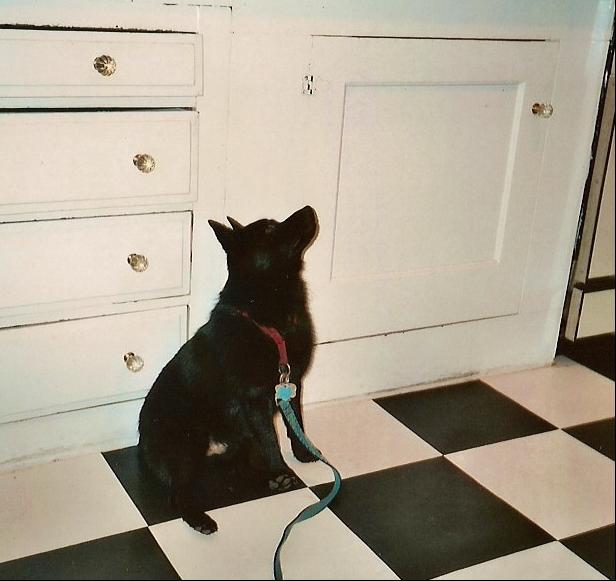
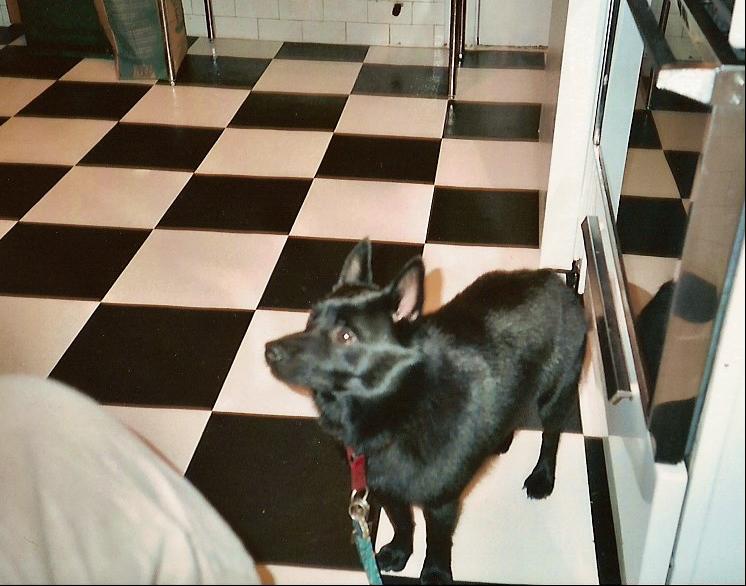
No Friday Random ten this week, as I am feeling a need to acquire new music. I did, however, hear on my favorite local radio station Medeski, Martin and Wood's version of "Hey Joe," must get a copy. This week we have Lajoš in the kitchen, looking very attentive to whatever may be going on in there. The survival strategy of a dog depends on always looking very hungry and very innocent, despite having a diet that is probably far more substantial and healthy than ours. He recently had the opportunity to meet one of his sisters, who was also walking at Jamaica Pond. There aren't too many Schipperkes around here, so when two of them meet the owners always question one another. This owner used her cell phone camera thingie to capture the siblings together, but still hasn't sent me the photo. Ah well.
2005-09-30
Unfortunate advertising offers
 Got this offer in the mail today as a part of a promotion for a new educational kit from the Southern Poverty Law Center's "Teaching Tolerance" program. I am quite sure that they mean very well, and that they have probably prepared some good materials. But no thank you, really.
Техничко питање за ово козмополитско читатељство
Инспирисао ме је Чип, ко овде коментарише чак на арапском. Јер сам ја заклети Маковац, а вероватно знате да једини ВП програм који не подржаба Јуникод јесте Мајкетисофт Офис за Мак. Сад смо гђа. Етнија и ја направили (на брзаку) један превод, и збиља смо се мучили с тим што не можемо да видимо сва слова. На крају сам неке пасусе пребацио на ТекстЕдит, чисто да видим која су слова у питању. Све једна велика и непотребна мука, можете замислити. Постоји ли неко техничко решење за то? Не могу да верујем да нико није до сада измислио нешто. Иначе су та техничка и визуелна решења за Мак углавном паметнија и једноставнија него она за ПЦ. Мала ствар, знам, али кад се бавим овим послом, морам признати да ми је фрка.
2005-09-29
Rock glazba made in Rijeka
Saturday, 9 October will be the world premiere of the film "Ritam rock plemena," in which director Bernardino Modrić and writer Koraljko Pasarić follow the rock n roll scene of Rijeka from 1960 to the present. After that, expect to find it at film festivals wherever there is an audience with a clue.
Globalize it, and I'll intellectualize it
Just came across this (I think) new publication by way of a link from one of my regular newspaper reads. Globalizacija is a "journal for political theory and research on globalisation, development and gender issues." It has several items taking a critical approach to neoliberalism and privatisation, with an emphasis on gender and economic issues. There is also an English language version for those who prefer it, and it would appear to be very much worth a look.
A widening corruption scandal, or something else
Here is a piece of breaking news that came out while we were walking our dog. Apparently Vladan Batić, the former justice minister who is president of the Christian Democratic Party of Serbia, is being held by police in connection with a corruption scandal. The given reason has to do with the release of an organised crime figure while he was minister. No concrete details, except that his party has issued a statement labelling the charges as political and saying that he has begun a hunger strike.
Update: It is still difficult to say what is up here. The official statement is that he "abused an official position" while he was minister, but it is not clear how. If the issue in question is the release from prison of a member of the "Kruševac group," this is something the justice minister could have achieved only indirectly, through prosecutors, judges, or the prison administration. On the other hand, the charge from Batić's party about the government using police to settle accounts with political opponents is not too persuasive either, as Batić can hardly be counted as a meaningful political force. My sense is that larger forces are probably not at stake, but that small ones may very well be.
Another update: On 30 September he was released, with no charges. This would tend to give credence to the thesis that it was political intimidation, though it remains unclear why anybody would have anything to gain by intimidating Batić. Alternatively, the government is such a panic over corruption that it no longer knows what it is up to.
Update: It is still difficult to say what is up here. The official statement is that he "abused an official position" while he was minister, but it is not clear how. If the issue in question is the release from prison of a member of the "Kruševac group," this is something the justice minister could have achieved only indirectly, through prosecutors, judges, or the prison administration. On the other hand, the charge from Batić's party about the government using police to settle accounts with political opponents is not too persuasive either, as Batić can hardly be counted as a meaningful political force. My sense is that larger forces are probably not at stake, but that small ones may very well be.
Another update: On 30 September he was released, with no charges. This would tend to give credence to the thesis that it was political intimidation, though it remains unclear why anybody would have anything to gain by intimidating Batić. Alternatively, the government is such a panic over corruption that it no longer knows what it is up to.
2005-09-28
A disturbing public opinion survey
A survey released today, commissioned by the British government and carried out by CeSID, suggests that if elections were held now, the Serbian Radical Party (SRS) would get 38%, the Democratic Party (DS) would get 31%, The Democratic party of Serbia (DSS) 9% and Bogoljub Karić's Forza Serbia (PSS) 8%. No other parties would get enough to support to gain representation in the parliament. The results are believable, in the sense that they are consistent with recent election results and other survey findings, and also with the expected erosion of support for the parties currently in power. CeSID also has a decent record of reliable research. Some time will probably pass before elections are called, of course, which means that the balance of forces could change, but not in a direction which would necessarily be predictable.
Assuming for a moment that the results would be as the survey indicates, this would mean: 1) once more there would be pressure for DS and DSS to form a coalition, which would certainly be hugely unstable, and 2) assuming the (not necessarily very likely) coalition mentioned in 1) is formed, the government would still be formed by whoever gets PSS to join the coalition, which means that Karić would be able to demand a very high price for his support. If the government were to be formed by a coalition of DS-DSS-PSS, it would be mostly incapable of action. If it were to be formed by SRS and PSS, the results would be disastrous for everybody both inside and outside the government. If DSS were to try to stay out of coalitions, this would leave an unstable minority government and also possibly the demise of DSS. There is always the possibility of a SRS-DSS coalition, which has been raised in various ways by DSS officials at various times, but would certainly be very controversial both in the party and outside of it. It might seem unreal, but then consider that SPS is keeping DSS in power now.
No matter how one tries to add up the numbers, they would not seem to mean anything good.
Assuming for a moment that the results would be as the survey indicates, this would mean: 1) once more there would be pressure for DS and DSS to form a coalition, which would certainly be hugely unstable, and 2) assuming the (not necessarily very likely) coalition mentioned in 1) is formed, the government would still be formed by whoever gets PSS to join the coalition, which means that Karić would be able to demand a very high price for his support. If the government were to be formed by a coalition of DS-DSS-PSS, it would be mostly incapable of action. If it were to be formed by SRS and PSS, the results would be disastrous for everybody both inside and outside the government. If DSS were to try to stay out of coalitions, this would leave an unstable minority government and also possibly the demise of DSS. There is always the possibility of a SRS-DSS coalition, which has been raised in various ways by DSS officials at various times, but would certainly be very controversial both in the party and outside of it. It might seem unreal, but then consider that SPS is keeping DSS in power now.
No matter how one tries to add up the numbers, they would not seem to mean anything good.
2005-09-27
The escape Klaus is in the fine print
The Czech president Vaclav Klaus expressed his worry about insistence on human rights to an international lawyers' conference, warning that respect for human rights might lead to regulation in the interest of defending them. Explaining his point, he argued that:
"Many partial, merely so-called rights, like the rights of consumers, children, women, disabled people and so on, replace a traditional understanding of human rights. When those new rights are brought into the legal system and lawyers accept them, they cause many serious consequences which begin to complicate social life and its quality."It is not entirely clear what sort of "complication" he is concerned about, but it would seem to have something to do with what is involved in respecting the rights of women, children and other groups of which Mr Klaus is not a member.
2005-09-26
Finska posla, Part II
I don't know how the story will turn out about the drunken Finnish EUFOR soldiers who spent an evening abusing the guests and staff and demolishing a club in Mostar. But it is not likely to enhance the welcome for international troops in Bosnia and Hercegovina.
Subscribe to:
Posts (Atom)
