2007-01-19
Izborna tišina


2007-01-17
Bajbuk

2007-01-15
Quotation of the day
Analitičar Milan Nikolić kaže da političarima ne treba zamerati zbog ljubljenja beba. "To je dokaz da političari pokušavaju da se prikažu kao obična ljudska bića, što u suštini nisu", kaže on.
2007-01-14
A week to election day
As much as I am not fond of Mr Koštunica and his DSS, and even less of his coalition partners, they deserve credit for what has got to be the most skillful effort to transcend political conflicts and issues in a political campaign. Everything from the campaign slogans "Živela Srbija" (živela!) and "Narod najbolje zna" to the new year concert which appeared to bring together opposed social forces, in this case Ceca and a random selection of rokeri, succeeded in being both memorable and content-free. Although they will probably end up with a third or fourth place finish next week (there! a prediction!), they have given the media impression of being a party of power about which other parties talk. It is easy to agree with the assessment by Dragoljub Žarković that Mr Koštunica has assured his success by outperforming the very low expectations which people had of him.
For the most part the opposite has to be said about the party that stands to gain the most from the election, DS. They act like a party of power which runs in terror from the risk of saying anything that prevents them from being all things to all people, and to top it off is not in power. The move of naming their candidate for PM, former finance minister Božidar Đelić, might help them, in the sense that he is a figure who is respected by many, despised by few, and comes forward with a clear program that he has recently published. The announcement may have come too late to help them much, but DS has calculated, probably correctly, that their best hopes are fuelled by inertia and dissatisfaction with the current government.
A few of the parties are in the race mostly to save themselves from oblivion. A few of them (like G17) may succeed in this, and some (like SPO, SPS, and a few curiosities) will more likely fail. But the most interesting reemergence from oblivion has got to be the campaign of the Čedomir Jovanović vehicle LDP. Shut out of his previous party for his radicalism and overreaching and because of a reputation (whether it is deserved or not) for corruption, Mr Jovanović will most likely come out of this election at the head of a parliamentary delegation, and will certainly come out with recognition as a force to be reckoned with. A sign of his power was observable during my visit last month, when LDP posters were the most obvious and frequent targets of anticampaigners and vandals -- there is probably something to the principle that whoever is being attacked most is probably threatening somebody who ought to be threatened. Another sign was apparent last night at the new year celebration/election rally hosted by DSS, at which a discredited former pop idol in a hat he borrowed from Branimir Štulić dedicated an insulting song to the party leader. If the best attack is an accusation of being a drug addict coming from a drug addict, this is pretty close to a sign of having achieved untouchable status.
The biggest open question of the election, of course, is with how much power SRS will emerge. It remains popular for government officials and NGO types to use the threat that the extreme right may come to power in order to extract money and support from the internationals. This is still happening. But the SRS campaign has been strangely quiet. It may be that they are running low on resources and that their original campaign plan to capitalize on the suicide of the party leader was scuttled by Mr Šešelj's failure to comply. On the other hand, the greatest advances by SRS tend to take place under the radar. It is a matter for research whether what happens under the radar is the mobilization of dissatisfaction or the engagement of clandestine services. But I will go out on a limb here -- the only time SRS has been close to ruling has been when there was a dictator willing to put them into that position. Their supporters will turn out, as they always do, and provide them with enough representation to assure that they have access to the publicity for scandalmaking well into the future. But they will underperform expectations, and will never be close to forming a government by legal means just as they never have been before.
What does this all amount to? Probably not much, which is either a disappointment or an achievement in itself, depending on how you look at it. I am guessing that the next government will be an everyone-but-SRS coalition, and that DS will be slightly more influential and DSS slightly less influential.
Lawyers and torture
2007-01-13
Homily
2007-01-09
... a pivo voli nas
The most representative of the domestic mass-market bunch, and object of innumerable jokes (one of them involves canoes, but that is as far as I am going), is the flagship product of the brewery giant Anheuser-Busch, Budweiser (introduced in 1876). For over a hundred years, Anheuser-Busch has been in a trademark conflict with the Czech Budweiser Budvar brewery, which has marketed a far superior product under the same name since 1895. A-B claims exclusive rights to the Budweiser name, which kept the Czech product out of US markets for a very long time and may cause some easily resolved confusion in Europe.
Now Anheuser-Busch and Budejovicky Budvar have reached an agreement, whereby A-B (which already has marketing agreements with several international producers, including the Belgian giant InBev), agrees to market and distribute the Czech product in the US. It will continue to be sold under the deeply unsatisfying compromise name Czechvar.
It is one small step.
2007-01-08
Where was the previous Provence?
2007-01-04

2007-01-03
Intelligence dump
There may or may not be something of interest in the documents released by the National Intelligence Council, representing some of the intelligence estimates on Yugoslavia prepared for US agencies between 1948 and 1990. What may be most interesting of all is the introductory essay to the collection by Marten H.A. van Heuven, attempting to assess just where intelligence succeeded and failed, and noting the strong and perhaps excessive emphasis placed on trying to understand Yugoslavia through the lens of the Soviet Union.
Related?: The CIA's role in the publication of Dr Zhivago?
The future of education?
I have the same mixed feelings as most of the folks who teach at private universities about the increasingly consumerist nature of the whole enterprise. We old folks often complain that paying students are encouraged to feel entitled to any number of things -- our time, a grade, a degree -- while the financial constraints often mean that we serve a fairly narrow social group (although like at most costly institutions, a minority of the people there pay full tuition). Interestingly, in discussing teaching with my colleagues from "the former countries of real socialism" (anyone remember that phrase?), many of them have the sense that high tuitions mean that the people paying them are more likely to be highly motivated than just passing through. For people in the teaching field, it often seems as though the goal is something not entirely realistic, providing knowledge and insight to people who really want it but do not really need it. I render this with a little bit of irony, but still hold to the belief that the best students will usually be the ones who have chosen what they are doing, for reasons of which they are aware.
For those reasons and a bunch of others, the Toronto-basedAnarchist U(niversity, no?) project looks very intriguing. It is not entirely new, having operated since Fall 2003. And it is not so big, with just three courses this term and not much more than five or so in other terms. Courses are free (there may be a charge for books and copies) and non-credit, and most of them are on political and social themes. Although it seems that course development and enrollment are e-mail and wiki-based, the classes themselves are nonvirtual, with people gathering in rooms at particular times.
Probably this sort of model is not likely to substitute for the kinds of institutions where most instructors and students find themselves now. But it looks like a mighty good way of making it possible for both teachers and students (broadly, rather than professionally, defined) to do a bit more of the stuff that attracted them to the world of knowledge in the first place.
A test post
Okay, it seems to work. What I like about it so far is that it circumvents the Blogger interface, and that it makes adding tags easy. No complaints yet.
You'll also find some fancy new links on the link list.
2007-01-01
Particularly chalga
2006-12-31
Because I cannot help myself
Sretna nova godina
- Mushroom soup in the style of the Hungarians, if they were Japanese
- Lentil salad (this is supposed to bring good luck)
- Ruska salata
- Stinco di vitello al vino
- A bunch of fruit and cheese
However and whomever with you are celebrating, a happy new year to you and yours.
Srđan Vrcan (1922-2006)
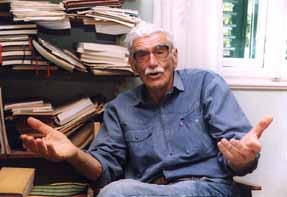
Sad news to end the year. This text arrived last night from Christophe, friend of East Ethnia. The text of the obituary is by Srđan Dvornik:
Srđan Vrcan was professor of sociology at the University of Split, Croatia. Born in 1922, he was the head of the Chair of Sociology at the Law School of the Split University from 1961 to his retirement in 1990. In 2003 he was awarded the title of Professor Emeritus. He also taught at graduate and post-graduate studies in Zadar, Zagreb, Ljubljana, Belgrade, Sarajevo, Vienna, Rome, Pecs, Berkeley, Sacramento. For many years he was a co-leader, together with the German professor Rudolph Siebert, of the seminar "The Future of Religion" at the Inter-University Centre for post-graduate studies in Dubrovnik. He presented the results of his scientific researches at conferences and symposia in Rome, Florence, Bergen, Dresden, Moscow, Berlin, Paris etc.
He was the Chairman of the Croatian Sociological Society. Through three consecutive terms he served on the Executive Board of the International Conference for Sociology of Religion in Lille/Paris. For many years he was on the Editorial Board of the journal for sociology of religion Social Compass, first published by the Catholic University of Leuven (Belgium), later by the Sage Publications (London). He was among the founders of the journal for social issues Pogledi (Views), which was published in Split from 1969 to 1990. He was also on the Editorial Boards of journals Sociologija (Sociology, the journal of the Yugoslav Sociological Association) and Revija za sociologiju (Review of Sociology, the journal of the Croatian Sociological Society).
The main field of Vrcan's scholarly interest was sociology of religion. On that subject he published the books Raspeto kršćanstvo (Christianity Crucified, 1980, co-authored by Boris Vušković); Od krize religije do religije krize (From the Crisis of Religion to the Religion of Crisis, 1986); Faith in the Swirls of Transition (Vjera u vrtlozima tranzicije, 2001). He studied social inequality (Social Inequalities and the Modern Society – Društvene nejednakosti i moderno društvo – 1974); the relationship between sport and violence (Sport and Violence Here Today – Sport i nasilje danas u nas, 1990; Sport, Violence, and Politics – Sport, nasilje i politika – 2003); as a co-author, he participated in two studies of voting behaviour (A Raid on Voters – Pohod na glasače, 1995; Packaging Power – Pakiranje vlásti, 1999); he was also a co-author of a study of youth (Position, Awareness, and Behaviour of the Young Generation of Yugoslavia – Položaj, svest i ponašanje mlade generacije Jugoslavije, 1986). He also published hundreds of scientific and review articles, articles in newspapers and interviews, which makes him one of the most productive Croatian sociologists.
Vrcan's particular merit is establishing and development of the particular sociological disciplines such as sociology of religion, of sport, of politics, of the youth, and of elections and electoral systems.
Srđan Vrcan actively supported democratic civic initiatives; thus, he was among the founders of the Association for Yugoslav Democratic Initiative, the first political civic initiative in the communist Yugoslavia (established in early 1989). He participated in many civic education activities, such as summer schools for democracy and human rights, and spoke at many public panel hearings on relevant political issues.
The photo is from an interview with Rade Dragojević in Zarez, in which Vrcan discusses his research on football fans and politics.
2006-12-30
Revenge served clammy
2006-12-29
Ford passing on the right
He did, however, have a sense of humor.
2006-12-27
Povratnik

I'm back from my brief Balkan sojourn, partly unpacked with gifts properly distributed to their intended recipients. While there are many good things about being back at home, one that stands out is the ability to shower for longer than five minutes, without being confronted by the dilemma of whether to shower or shave today. Regular blogging to resume as soon as the inspiration strikes me.
Photo: Eric takes a moment for discussion with the youth of Niš.
