2006-03-08

The ICJ genocide trial, 1: Did genocide occur?

There are several competing definitions of genocide in the academic literature. The term originates with the work of the lawyer Raphael Lemkin, who had the Nazi genocide specifically in mind when he developed the concept. He intended, however, both to account for similar historical experiences of which he was aware (the Armenian genocide, for example), and to produce a concept exhaustive enough to serve as a basis for prevention (Lemkin includes in his work sections on "cultural genocide," "religious genocide" and "moral genocide," for example). His broad definition sees genocide as directed toward:
"disintegration of the political and social institutions, of culture, language, national feelings, religion, and the economic existence of national groups, and the destruction of the personal security, liberty, health, dignity, and even the lives of the individuals belonging to such groups" (R. Lemkin, "Genocide," in A.L. Hinton [ed.], Genocide: An Anthropological Reader. Oxford and Malden: Blackwell, 2002, p. 27).
One of the results of Lemkin's engagement was the passage by the United Nations of the Convention on the Prevention and Punishment of the Crime of Genocide (popularly, the "Genocide Convention") in 1948. After considerable debate, the UN General Assembly opted for a definition which would exclude the categories of "cultural," "religious" and "moral" genocide, and which concentrated on physical destruction of people instead. The UN definition also narrowed the potential categories of victims, excluding, for example, political groups. The relevant part of the definition is in Article 2:
In the present Convention, genocide means any of the following acts committed with intent to destroy, in whole or in part, a national, ethnical, racial or religious group, as such:

(a) Killing members of the group;
(b) Causing serious bodily or mental harm to members of the group;
(c) Deliberately inflicting on the group conditions of life calculated to bring about its physical destruction in whole or in part;
(d) Imposing measures intended to prevent births within the group;
(e) Forcibly transferring children of the group to another group.
The UN definition is the topic of a good deal of legitimate controversy, mostly because of what it excludes -- but it is the only legal definition that exists in international law, and so it is the one that has to be used. Large scale killings which fall outside of the definition can be treated a number of ways. Some researchers have proposed definitions like "democide" and "politicide," which might be useful analytically but are not legal terms. One legal term which may apply to serious cases outside the scope of the Genocide Convention is "crimes against humanity," which the Nuremberg Charter (1945) defined as including "murder, extermination, enslavement, deportation, and other inhumane acts committed against civilian populations." The most current definition of "crimes against humanity" is in the Rome Statute of the International Criminal Court, where Article 7 paragraph 1 enumerates:
1. For the purpose of this Statute, "crime against humanity" means any of the following acts when committed as part of a widespread or systematic attack directed against any civilian population, with knowledge of the attack:

(a) Murder;
(b) Extermination;
(c) Enslavement;
(d) Deportation or forcible transfer of population;
(e) Imprisonment or other severe deprivation of physical liberty in violation of fundamental rules of international law;
(f) Torture;
(g) Rape, sexual slavery, enforced prostitution, forced pregnancy, enforced sterilization, or any other form of sexual violence of comparable gravity;
(h) Persecution against any identifiable group or collectivity on political, racial, national, ethnic, cultural, religious, gender as defined in paragraph 3, or other grounds that are universally recognized as impermissible under international law, in connection with any act referred to in this paragraph or any crime within the jurisdiction of the Court;
(i) Enforced disappearance of persons;
(j) The crime of apartheid;
(k) Other inhumane acts of a similar character intentionally causing great suffering, or serious injury to body or to mental or physical health.
I have not included paragraphs 2 and 3, which clarify terms in paragraph 1, but you can find those yourselves by following the link. One legitimate question that might be asked could be whether the distinction between "crimes against humanity" and "genocide" is all that important, since there is considerable overlap between the two. I am inclined to think that the distinction is on the one hand symbolic, like the difference between labelling a crime "really really bad" and "really really really bad," and that on the other hand it is related to political issues, as there is a greater moral claim associated with the status of being a victim of genocide. But I have no doubt that a great number of lawyers and human rights activists will disagree with me on this point (which they are certainly welcome to do).

All of this may seem like a huge digression, but it comes down to this: no reasonable person denies that a lot of murdering was carried out in Bosnia-Hercegovina, and that a majority of the victims were from one ethnic group. What is in dispute is whether this can be legally defined as genocide, or as something else.

The debate is going to turn in large measure on interpretations of legal terms. In particular, it will turn on the question of whether there was an "intent to destroy" a group, and on how big a "part" has to be to meet the standard of "in whole or in part." The requirement of "intent" means that the plaintiffs have to show that destruction was a matter of policy, while the defendants will argue that destruction was a consequence of a particularly nasty war. Numbers or scale may not be so important: the first criminal conviction to be handed down by an international tribunal on charges of genocide (in 1998) was against a Rwandan mayor, Jean-Paul Akayesu. Convictions against national officials came later. The precedent would seem to suggest that destruction on a national or international scale, as occurred in the Nazi genocide, is not necessary in order for a finding of genocide to be made.

For an idea of why this matters, it might be useful to recall a famous example of evasion: this exchange took place between journalist Alan Elsner and State Department spokeswoman Christine Shelly during the Rwandan genocide on 10 June 1994:
Q How would you describe the events taking place in Rwanda?

MS. SHELLY: Based on the evidence we have seen from observations on the ground, we have every reason to believe that acts of genocide have occurred in Rwanda.

Q What's the difference between "acts of genocide" and "genocide?"

MS. SHELLY: As you know, there is a legal definition of this. There has been a lot of discussion about how the definition applies under the definition of "genocide" contained in the 1948 convention. If you're looking at that for your determination about genocide, clearly, not all of the killings that have taken place in Rwanda are killings to which you might apply that label.

Some of the difficulties over actually arriving at a definition of "genocide" and formulations on genocide are the reasons why -- particularly, in late May, the U.N. Human Rights Commission, with the very strong support by the United States, appointed a Special Rapporteur for Rwanda, specifically to compile the information on possible violations of human rights and on acts which constitute breaches of international humanitarian law and crimes against humanity, including acts of genocide.

His preliminary report, which is due later this month, will provide the additional information about the human rights violations -- the types, and presumably how they might be characterized -- and that is something that we have to wait for.

As to the distinctions between the words, we're trying to call. What we have seen so far, as best as we can, and based, again, on the evidence, we have every reason to believe that acts of genocide have occurred.

Q How many acts of genocide does it take to make genocide?

MS. SHELLY: Alan, that's just not a question that I'm in a position to answer.

Q Well, is it true that you have specific guidance not to use the word "genocide" in isolation but always to preface it with these words "acts of"?

MS. SHELLY: I have guidance which I try to use as best as I can. There are formulations that we are using that we are trying to be consistent of our use of. I don't have an absolute categorical prescription against something, but I have the definitions. I have phraseology which has been carefully examined and arrived at as best as we can apply to exactly the situation and the actions which have taken place.
Thomas Franck of the BiH legal team has put the argument that the events amount to genocide in terms of a thesis that the type and scale of crimes, as well as the similarity of several events to one another, are evidence that what occurred was not a set of isolated incidents but a part of a strategic plan (for which there exists indirect evidence -- more on this in the following post). It is not yet clear how SCG representatives will argue against the applicability of the Genocide Convention. So far they are off to a weak start, arguing that the numbers and descriptions in the complaint by BiH are exaggerated. If they want to confront the arguments presented by the plaintiffs so far, they will have to present a position on the questions of organization and intent.

The ICJ genocide trial: Introductory notes

There would seem to be two issues that really matter in the dispute between Bosnia-Hercegovina and Serbia and Montenegro which is currently being heard by the International Court of Justice (ICJ). These are:
1) Did genocide occur in Bosnia-Hercegovina?, and
2) If there was genocide, was it a result of policy on the part of the Federal Republic of Yugoslavia (SRJ)?
Then there is a third question which, while it is of interest primarily to lawyers of a certain type, may determine the outcome of the proceedings, which is:
3) Does the court have the authority to try the case?
Then there is a question which is not a legal one at all, but might be the one that is most interesting to people following the case, which is:
4) What would be the political consequences of a guilty verdict?
I doubt very much that I can give definitive answers to any of these four questions, but I think I can try to give a picture of some of the issues that will have to be considered along the way to an answer. First, an observation -- the issues at stake are at bottom political issues, and judicial institutions do not necessarily provide the best forum for political issues to be resolved. However, when there is a lack of will on the part of political institutions, this may be the only forum available. In that context, I feel confident in making a prediction: no matter what the outcome, very few people will be satisfied.

Having said that, let me see whether I can shed any light on the questions, one by one. I will be posting short essays related to each of the questions in a series of four posts. A word of caution: although I do own a briefcase, I am not a lawyer. Merely a talented amateur, like Emma Peel.

2006-03-07

While I was away

For anyone who makes the mistake of getting their news from this site, here are a few of the interesting things that happened while I was away.

There was talk that Jasmila Žbanić's award-winning film Grbavica, about violence against women during the war in Bosnia-Hercegovina, would not be shown or well received in Serbia. In fact, it was shown to a capacity audience in Sava Centar, who kicked out the far-right provocateurs and gave the director and cast a hearty ovation. Whether the film would get a similar reception in Banja Luka remains open to question, since distributors refuse to bring it there.

The convicted war criminal Milan Babić committed suicide in prison. No sane person will miss him, but his death presents problems for the prosecution in cases where his testimony would have been useful, and raises problems once again for the prison management in Scheveningen, which has failed to secure the people for whom it has responsibility before. The departure of Ali Farka Toure, in contrast, is a loss for lovers of beauty everywhere.

A court in Niš acquitted bishop Pahomije (Tomislav Gačić), who is guilty, on charges of sexual abuse of children. Prosecutors promise to bring the case to a higher court.

There was far better religious news in Bujanovac, where the local Orthodox eparchate and the local Islamic community are joining forces to, in the words of muftija Nedžmedin Saćipi, "be a true bridge between Serbia and Kosovo. The lessons we have learned obligate the Serbs, Albanians and Roma of this place to be in the service of peace, to be a model of cooperation for people of good will."

There are several other ongoing stories, including the ICJ case between Bosnia-Herecegovina and Serbia, on which I will have some comment. I'll also share some impressions of lovely Tbilisi, where I got the hat that Azra is wearing to school today.

The Earth is getting younger, and my clothing smaller

Came across this job announcement today at the Chronicle of Higher Education, from Mr Falwell's school:
Biology: Liberty University invites applications for: Faculty member with Ph.D. and compatibility with a young-earth creationist philosophy. Teaching expertise in Microbiology and supervision of undergraduate research expected. Experience in molecular genetics helpful. Send letter of interest, resume, and statement of personal Christian faith commitment to [contact info omitted].
They require the same compatibility for their position in physiology but not, interestingly enough, for their position in chemistry. I do not know whether "a young-earth creationist philosophy" is compatible with what has been called "intelligent design." But I have been looking for a forum from which to promote my theory: "Italian design," which argues that people look fantastic, but are engineered in such a way that they require constant and intensive maintenance.

2006-03-01

Mind the gap


My travels are going to have me for a few days on what the online terminology calls a "blog hiatus" and what I call "not writing many posts." In the event that this leaves you with a burning desire for interesting reading (or if you had one to begin with), have a look at the wonderful journal published by the sociology students at the University of Zagreb, Diskrepancija. The current issue has original articles on a number of current themes, a new translation of an essay by Laclau and Mouffe, a special section critically reviewing Jeffrey Alexander's cultural theory, and reviews. There is an archive of past issues, a section in English for those who prefer it, and a photo section. For more news on sociology in Zagreb, including football match announcements, check their blog.

2006-02-28

Burek in the wilderness


Not much posting these days, as I am just back from a visit to scenic Colgate University (yes, apparently there is a connection to the toothpaste), and am off tomorrow for a visit to lovely Georgia, which Colgate's Nancy Ries assures me is indeed the birthplace of wine.

High point of the visit to Colgate: a dinner with students catered with pite from Amy's of Utica, NY. Amy is Amira Dizdarević, who with husband Dževsad provided sirnica, krompiruša, burek and ćevapi to a group of people who wanted them very much indeed. Nobody seems to import Sarajevsko pivo that far, though.

Photo: Amira Dizdarević in her shop

2006-02-27

Datum mobile

There are many interesting items in today's Danas. The mystery over whether Ratko Mladić has been arrested already, is in the process of being arrested, is about to be arrested, or is practicing variations of the alchemy of producing the voluntarity of a surrender has got to the point that -- the "deadline" is shifting again, this time apparently to 5 April. April, like all of the months that have passed to date, will also come and go. Continuing to match the speed of the Serbian government is ICTY. When the Milošević trial began in (yes!) February 2002, one of the questions raised was whether a conviction for genocide in that trial might have an influence over the suit pending before the International Court of Justice in which the government of Bosnia-Hercegovina charged the government of the federal Republic of Yugoslavia (which existed at the time) for genocide. Only now is it clear how big the assumption behind the question was: that a verdict would be given in one trial before one was due in the other. Arguments before ICJ begin tomorrow, and arguments before ICTY may end at some point in the future. In the meantime, a pro-indictee demonstration hosted by SRS in Belgrade is being described by BBC as a "mass pro-Mladić rally." I say bringing at most 10,000 people to Belgrade (because they aren't from there) is a sign that SRS has access to fewer buses than SPS used to have.

2006-02-25

Headline of the day

"Trust us on Mladic," says Serbia
today.reuters.com

2006-02-23

Version tracking for fugitives, cont'd

Or was he arrested yesterday in Romania by British SAS forces? That is what Pincom is reporting, anyway.

2006-02-22

As the Mladić bubble deflates

For Danas, Ratko Femić gathers up a set of responses to yesterday's conflicting and apparently inaccurate reports of the arrest or impending arrest of Ratko Mladić. An unidentified "source close to the Serbian government" believes that the government "tried something but did not succeed." Another anonymous "source from the security structures" believes that Mladić will be arrested soon, but that this will not be announced for some time "because discussions will have to be carried out then with the indictee." The same source (I think) also suggests that Mladić would have to be offered a large sum of gotovina, though why he would be paid off after being arrested seems a bit unclear.

Civil defence specialist Zoran Dragišić believes that the government is attempting to find a way to make Mladić's arrest "appear to be a voluntary surrender," and thinks that the "media noise" of yesterday was a part of this strategy. Military analyst Aleksandar Radić suggests a wider strategy to "send a variety of disinformation to the public" as a means of "applying psychological pressure," but Radić also does not exclude the possibility that the psychological action might not be directed toward the indictee, but toward testing the response of public opinion.

Nobody, of course, is persuaded by the denials coming from the government and from the ICTY prosecutors: these seem to be regarded either as signals that the opposite of what is being said is true, or as parts of a strategy to direct attention away from ongoing activities. And although nobody can say with any certainty how many people thought that Mladić had in fact been arrested when the news came out, one thing is clear: there were no protests, no support rallies, no rushed telegrams, and no campaigns to mobilise feelings of wounded innocence. The practitioners of violence who controlled the media persuaded themselves well that they have popular support. They do not.

Update: Oh, why not inflate the bubble a little again. The not-as-amusing-as-Kurir tabloid Glas javnosti is speculating that (take your pick) Mladić was either 1) already arrested on Cer, and authorities have not yet figured out how to get him to Scheveningen, 2) already arrested in Belgrade, several hours ahead of the point at which he had agreed to surrender, and that authorities are trying to persuade him to publicly fake a voluntary surrender, or 3) already arrested on Cer, sent to Belgrade, packed off to Tuzla, and delivered to the Hague. Vladeta Janković commented to the (unidentified, hm) journalist for Glas, "What are you thinking?" The article does not help to answer Mr Janković's question much.

Jugonostalgija

Index has a nice reminder from the earlier career of the newscaster Goran Milić, from when he hosted the evening news on the briefly active Yutel network. The recollection:

Radi se o isječku iz Yutelovih vijesti emitiranih 1991. godine, kad je Jugoslavija bila pred raspadom. Snimka prikazuje Milića kako književnim srpskim jezikom čita vijest o reakcijama iz svijeta na događanja u SFRJ.

Milićeve riječi praćene su grafikama uz pripadajuće naslove, od kojih jedan eksplicite kaže: "EEZ izražava zabrinutost zbog sranja u Jugoslaviji".

"Pardon, ovo je štamparska greška, treba da piše "stanja u Jugoslaviji". Mada, moram da kažem da ovo što je napisano nije baš sasvim pogrešno. Izvinjavamo se a vi sami prosudite da li je bilo namerno." - objašnjava Milić na kraju ove zabavne video snimke.

The article contains a link to the video of the broadcast (WMV, 38 seconds).

2006-02-21

Nobody knows the Ratko they haven't seen

Ratko Mladić may have been arrested in Belgrade. Or he may not have been. Or maybe there is an action to arrest him going on in Bosnia, perhaps near Tuzla. Or perhaps not. Maybe we will know something by the end of the day. Or maybe we will not.

Update: For a not particularly representative sample of responses to the news (which may be false) that the suspect was raspamećen, it's always fun to follow the comments on B92.

Update: Still no reliable signs that the report is true. In the meantime, however, Mirko Marjanović died.

Another update: Nezavisne novine is reporting that the recent stories are untrue, but that PM Koštunica has issued a warrant for Mladić's arrest. Is the implication that there was no legal basis for his arrest up until now?

Morning update: Still nothing solid. The government and ICTY are either denying everything or saying nothing, media are tending to converge around the story that he has been "located but not arrested" on Cer, and Toma Nikolić chose the moment to remind everyone that he is a necrophiliac.

2006-02-20

Dealing with the past, contd.

The BBC is reporting that Mittal Steel, the world's largest steelmaker, is abandoning plans to set up a memorial at the Omarska mine it recently bought, after the plans met with opposition from locals.

Omarska, a concentration camp during the 1992-95 war in Bosnia, was the site of some of the most horrific crimes committed by the Bosnian Serbs in their drive to "cleanse" the territories they had occupied of non-Serbs.

Mittal only agreed to erect the memorial after robust lobbying from activists of all ethnic backgrounds. It has evidently concluded that the goodwill of locals is more important than what people across Bosnia (or indeed abroad) might think.

Unfortunately, the attitude of people in Omarska is fairly typical for the mindset that still prevails in Republika Srpska. A vox pop on last night's main evening news on Bosnian TV included someone from Banja Luka who qualified the topic of Grbavica, a Bosnian movie on wartime rape that just won the Golden Bear at the Berlin film festival, as "tendentious." (Yes, the topic, not the specific treatment it gets in the movie. Even mentioning it is tendentious, apparently.)

2006-02-17

Django Reinhardt and Stephane Grappelli

The site Boing Boing labels itself a directory of wonderful things, and this is a wonderful thing: Django Reinhardt and Stephane Grappelli relaxing a bit with their instruments while the rest of the musicians play cards, then the whole band plays "J'Attenndrai." 'Tis a QuickTime file, size 12 MB. Visit WFMU for more musical delights.

Qualification

I am not really quite sure what to make of this news item. Apparently the examination for job candidates at the Croatian Ministry of Foreign Affairs includes, among its 300 questions, items asking people what sort of sexual practices they prefer. This may simply be an effort to avoid potential scandals in advance, or there may be a more elaborate plan. No indication is given as to what kinds of sexual preferences best qualify a person for the job, but it would seem that the best qualification for diplomats would be to incline toward compromising positions.

2006-02-15

Turbofolk, jobs and dreams

Among the features at the Zagreb Dox Festival of Documentary Film will be Posao snova (The job of your dreams), a documentary on the folk music industry (turbo, sevdah, novokomp) by Danijela Majstorović. The film focuses on the experience of women in the industry, as the director explains:
"Relations of power, domination and patriarchal ideology can be seen best in the Bosnian entertainment industry. Entertainment and pop culture represent a microcosm of the society, especially now, since so many people identify with people from the small screen. Although I am very critical of folk culture myself [...] my film offers a bit of a different reading of the entertainment scene. «Posao snova» has multilevelled messages and it is not simply a critique of entertainment, but a finding about the situation in which a majority of women find themselves in contemporary Bosnia and Hercegovina, but also in Serbia, and maybe in a more subtle way in Croatia."
The film does cover the manipulative aspects of the industry, the objectification, the dominating "managers," and so on. But it does not stop there: with the participation of Lepa Brena, Hanka Paldum and other luminaries, the film also discusses the expressive and liberatory potential of commercial entertainment. Or as Brena puts it, "they could all think of me as meat, but that meat had some brains!" Prepare for the first film treatment that takes on the phenomenon in a way that respects its complexity at the Tuškanac cinema in Zagreb, at 5 PM on 25 February.

2006-02-14

Meanwhile in the Bahamas

If you like awards competitions, the voting has begun for the Satin Pajama Awards at A Fistful of Euros. I've enjoyed using their list of nominated weblogs to discover some interesting new sites that I had not known about before. This site has been nominated in two categories: best weblog (not getting that one, I know) and best Southeast European weblog (who knows). Win or lose, it is an honor to be in the company of the SEE competitors: Argumente (business and strategy from Romania), Illyrian Gazette (not just showbusiness ethnopolitics, but also occasional hot Slovenian action), the newest incarnation of Draxblog (the SEE blog institution, plus film reviews), and Csikszereda musings (with a bit about Miercurea Ciuc, at no extra cost). But go and have a look at the nominees in every category, there is a lot of good reading around, for every taste from the technical to the personal.

Ko ne voli Bagasoru....

Đurđevdan nije, a ipak nismo gadovi.

2006-02-13

Not the only one who shakes his head

So: on Friday, the Šešelj-in-waiting Tomislav Nikolić declared that if Kosovo were to be granted independence, Serbia should declare it to be "occupied territory," and should seek to recover it "by any means possible." But that is not all he declared. He also claimed that he had made an agreement with prime minister Vojislav Koštunica to just that effect in the event that a decision on independence were to come down. This would of course go beyond a case of Mr Nikolić saying publicly the sort of thing one expects him by now to say publicly, and spill over into Mr Koštunica owning up to what one expects that he thinks privately. So naturally, Mr Koštunica issued a swift denial, right? Wrong, actually. By Sunday night, neither he nor any government representative had given any confirmation or denial. The closest anybody came was Slobodan Antonić, an intellectual supporter of Mr Koštunica, who told Danas that "Vojislav Koštunica, as is well known, has the custom of nodding his head and occasionally saying yes, which his interlocutors interpret as agreement, but afterward find out that that was not really the case." So we are happy to have been able to clear that one up.

PS: While Mr
Koštunica may be as enigmatic as the Buddha, he is not as long-suffering as Jesus Christ. That role belongs -- of course! -- to Silvio Berlusconi.

Who lets these folks near implements that could affect the lives of other people?

Just because everybody else is ridiculing the bumbling Dark Lord Cheney for failing to distinguish an elderly gentleman from a small and tasty bird doesn't mean that I have to join in. Doesn't mean I have to avoid joining in either.

Update: Ignore the news reports that describe Mr Cheney as an avid and dedicated hunter. Thanks to Pharyngula, we find that what he prefers is "an increasingly popular and deplorable form of hunting, in which birds are pen-reared and released to be shot in large numbers by patrons. The ethics of these hunts are called into question by rank-and-file sportsmen, who hunt animals in their native habitat and do not shoot confined or pen-raised animals that cannot escape." This is not hunting at all. As Harry Hutton points out with regard to another pseudosport, "You could create a similar afternoon’s amusement by poking a caged rat for a couple of hours, then blowing its head off with a pistol."

2006-02-10

Shoes over California?

As Diego Gambetta points out, stories of foiled terror plots are often difficult to take seriously because the means involved do not always seem to add up to a plausible threat. Taking down the Brooklyn Bridge with a blowtorch? Technically improbable mass poisoning schemes? On the other hand, it also does not seem so likely that a small group of men with box cutting knives could have managed what they did, and they did. But the story offered yesterday by US president George Bush, who "said that in early 2002 the United States and its allies disrupted a plot to use bombs hidden in shoes to breach the cockpit door of an airplane and fly it into the tallest building in Los Angeles," seems odd at best. The bomb-in-a-shoe threat was tried once and failed for reasons that were fairly predictable -- it might be more persuasive than radio receivers in a rock (24 hour rock radio!). But even accepting the whole shoe proposition, as a matter of planning bombs would make a poor hijacking instrument. The perpetrators would be just as likely to destroy the plane as to take control of it. Then there is the matter that if there was a threat in Los Angeles, somebody appears to have neglected to tell the city government about it. In a restrained comment, LA Mayor Antonio Villaraigosa "told the Associated Press news agency he had not been forewarned about the president's revelations," and said, "I'm amazed that the president would make this [announcement] on national TV and not inform us of these details through the appropriate channels," he said. John McKay points out the striking resemblance between the plot Mr Bush described and another one which failed in 1995.

Formally, there is another matter: Mr Bush made his remarks in the context of a widening controversy over his illegal program to practice surveillance over people's private communications. But there is no indication that this secret program provided useful intelligence regarding this or any other plot. As Mr Bush himself noted, "It took the combined efforts of several countries to break up this plot." Which suggests that compulsive secrecy and deliberate self-isolation continue to be poor strategies.

Update: The more I think about it, the less clear it is to me whether the quotation from the LA mayor refers to the threat itself, or to the president's decision to make information about it public.

2006-02-07

Enthusiasm!

For all those not yet convinced that "Serbian music is great!" Thanks to Illyrian Gazette for linking

All over the world of entertainment


Comeback efforts that nobody wanted are not limited to the remix/reissue of the ouevre of Leo Sayer, but also include the return of the very diplomatic Vibbi, about whom if there is anything to be said he will &(*%$#@^ well say it himself. Before the plague of reappearance strikes people you want to see again in the wrong way, you may want to consider signing the petition by the "Odbor za očuvanje dostojanstva profesora Baltazara."

Image courtesy of Društvo hrvatskih filmskih redatelja.

2006-02-06

The secret

There are two reasons that there was no posting over the weekend. One was that the Blogger service was misbehaving, so it was not possible to post anything. Whatever the problem was, it seems to be working fine now. The other was that I was doing some experimenting with bread making. Commercial yeast is a fine and useful thing, but I have found that using just that with bread sometimes gives it an overpowering flavor, and the crust and texture are not as good as the stuff you get from the really good bakeries. What the good bakeries do, of course, is get their yeast from the air, which is easy for them because they have big warm rooms with lots of dough rising. But that is what gives the bread its nice complex flavor, which should not be the least bit chemical. It would probably be possible to cut out using commercial yeast altogether if, say, we had a steambath in our apartment and I had unlimited amounts of time to devote to baking. But I've combined a few recipes to come up with a technique that uses a little instead of a lot of commercial yeast, only takes more time in the sense that you have to remember to spend two minutes setting it up the night before, and produces a loaf of bread that rivals just about anything you can buy. Here is how it looks after a couple of tries:
THE NIGHT BEFORE
Put about half a cup of warmish water and half a teaspoon of yeast in a bowl, stir it until the yeast dissolves, then mix in just over a cup of flour. Cover the bowl with plastic wrap, poke little holes in the plastic wrap, and leave it overnight. In the morning the mixture will have grown, and will be soft and insubstantial, like an initial thought.

THE NEXT DAY
Add about 3 cups of flour, a cup and a half of water, another teaspoon of yeast, and two teaspoons of salt, and mix the whole glop together gently with a spoon. When it assumes some sort of form, put the contents of the bowl on a board and knead it. The kneading will be difficult because the dough is wet and sticky, but try to avoid the temptation to add more flour than you need to keep the dough off your hands. The high proportion of water to flour is what will make the crust good later. Then pour some olive oil in a big bowl, flup the dough around in it a little, and cover it again with the plastic wrap with holes in it. Let it rise until you are astounded at how much it has risen (at least 2 hours, maybe 3). Then shape it into your favorite shape loaf and put the loaf on a thin board that has been covered with a generous amount of corn flour (to keep the loaf from sticking to the board). Let it rise again for at least a half hour, longer if you can, and in the meantime put a "pizza stone" in the oven and let it heat up to 500 of those illogical Farenheit degrees. Sprinkle the top of the loaf with whatever you like to see on the tops of loaves, if you are into that sort of thing. Ploop the loaf from the board onto the stone and bake it for about 30 minutes. Take it out, let it cool, and amaze everybody.
There are people who say that the crust can be even better if you let the loaf rise in the refrigerator for 10 to 12 hours, but these must be people who never leave home, or who have all kinds of unexplainable space in their refrigerators.

So this is freedom

By the time prosecutors brought charges against the Karić brothers (for tax evasion, as it turns out), all four of them had left the country. The general assumption is that they are in Russia. The lawyer representing Bogoljub Karić, Zdenko Tomanović, says that his client will not return to the country to face the charges because, as B92 reports, he would prefer "to defend himself in freedom." He gave no suggestion as to how his client would defend himself as a fugitive, or why absentia is a synonym for freedom. His statement has interesting implications for another defendant Mr Tomanović is representing, who would also like to visit Russia.

On hinting at sadness, and being worldly and wounded

Christopher Solomon paid a visit to Sarajevo. He squinted in distant wonder at people's war stories. He remembered the names of some old ski champions. He chatted with some journalists. He did a little shopping and snacking. He went skiing. He found turbo-folk catchy. He wanted us to know that he can adjectify the name of Samuel Beckett. He wrote a feature for the New York Times about it.

All in a day's work.

Update: Mat wasn't impressed by the piece. But (I think) Quod was.

2006-02-02

Cuisinia Slovenia

I have just been told by a highly-placed and well-informed source (my sister) that this month's Gourmet magazine has a feature on the delights (nay, glories) of Slovenia. They don't make their articles available online, though, so my report on it will have to wait until I get a chance to visit a store. Has anyone had a look?

Ma nemoj!

The army, you say? Next thing you know, someone might say that the people responsible were higher-ranking than a retired "colonel" in an "army" that never existed except as a bureaucratic ruse to cover for what the army was doing.

2006-02-01

Our relations to the world: under construction

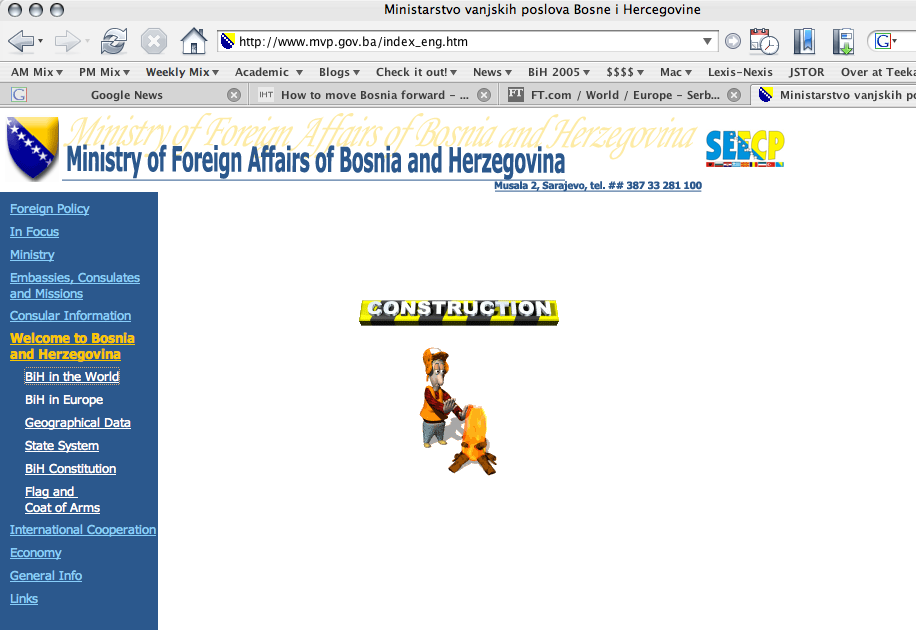
This is the page that greets visitors to the "Bosnia and the world" section of the Bosnian foreign ministry's homepage: it's under construction, and a cute little Bosnian construction worker is working very hard to bring this to you uskoro. (In case the screen shot is too small: it's some dude warming his hands against a fire.)

Who's got a secret?

The petition for release pending trial by the former "VRS" colonel Jovo Đogo, arrested on suspicion of assisting in the harboring of the fugitive Ratko Mladić, has been denied, according to his lawyer. This neither surprising nor particularly interesting. Much more interesting is the last sentence of B92's article about the fact, according to which "the court in the meantime declared the case to be a state secret." Clearly it is not a secret that Mr Đogo has been arrested, and the nature of the charges against him is also not secret. Nor is his relationship with official institutions secret, and neither are the relationships of other people believed to be accomplices the operation secret (they are active military officers). So what would the motivation be for declaring a state secret? Here are some possibilities:
  1. The interests and reputation of the state are involved (i.e., the operation involves individuals and institutions working on the basis of something other than individual initiative)
  2. The ongoing operations of the state are involved (i.e., as has been recognised by some but denied elsewhere, there is continuing contact between state institutions and the fugitive)
  3. The past operations of the state are involved (i.e., the collusion between representatives of state institutions and the fugitive dates back some time, and may involve current officials)
  4. Investigations by state institutions are involved (i.e., currently active prosecutions and investigations may make use of information which the defendant is expected to provide)
The list is not exhaustive, of course. For now, it would have to be guess which motivation explains the most.

2006-01-31

Njega i Rusa 200 miliona

I've yet to see this reported anywhere else, but Index.hr is reporting that ICTY has agreed to ship off Slobodan Milošević for "medical treatment" to Russia, and that Mr Milošević has agreed for his trial to continue (and verdict be delivered?) in his absence. More information would be needed to tell whether Index's "well informed sources" are correct, but even if they are, the news leaves several questions unanswered. In particular, it leaves open the question of who would be representing the side of the accused, which is in the process of presenting the defence. If the job is done by attorneys (which ones?) it would be reasonable to expect a major change in defence strategy, in which case the result might be more rather than less delay. Another detail of the report is that Milošević would await his verdict, and likely also serve whatever sentence he may receive, in a luxurious suburban villa. Delightfully tendentious line from the report: "Representatives of the Tribunal are not exactly thrilled with this development of events, but they are aware that the trial of Milošević, with the evidence that has been gathered by Carla del Ponte, has reached a dead end and that the sentence which he could receive on the basis of it would not in any way approach the level of his guilt." Does that come from a well informed source, as well?

2006-01-28

Diplomatic passports

Police are not saying how many blank diplomatic passports were stolen by thieves who raided a warehouse belonging to the Serbia-Montenegro ministry of foreign affairs, reports Danas.

One for all you vertebrate biology types

Every once in a while one runs across a news item like this one about an apartment building in Šabac where the residents were left without telephones, electricity and heat because rats ate through the cables. A little gross, yes, and I know there is nothing special about Šabac here because rats are at home pretty much anywhere (but most of all, I think, in the NYC subways). But my question is: electrical cables? They will really eat metal? Wouldn't they be shocked? Your animalistic analyses, please.

Update: Andras found this answer from a "nuisance wildlife control company" in Orlando, Florida. It's illustrated, high "blecchhhh" factor.

2006-01-27

A bit more about "Captain Dragan"

Mildly interesting: an Australian court has refused to grant bail for Dragan Vasiljković, and it looks fairly likely that he will be extradited to Croatia. More interesting: a short biography, describing the meteoric rise and soufflesque fall of Mr Vasiljković, with a dose of reserve about the charges against him, by Miloš Vasić in Vreme.

2006-01-24

Prosecution abandons charges against Orhan Pamuk

The justice ministry refused to support (but also declined to oppose) the move to charge the celebrated writer Orhan Pamuk with a violation of Article 301 of the Turkish penal code, according to which it is illegal to insult the republic, parliament or any organs of state, or something called "Turkishness." The justice ministry's decision relieves the country of a source of embarassment, but also removes the most prominent object of prosecution from public attention, making it easier to continue to proceed against less well-known people charged with the same offence. Ironically, the prosecution was meant to punish Mr Pamuk for telling a Swiss magazine last year, "One million Armenians and 30,000 Kurds were killed in these lands, and nobody but me dares talk about it." Among other effects of the publicity surrounding the harassment of a major literary figure, more people than him are talking about it.

Coming: Extradition request for "Captain Dragan"

In an interview with Biljana Bašić for the daily Vjesnik, Croatian justice minister Vesna Škare-Ozbolt predicted that a request for the extradition of Dragan Vasiljković would be sent to Australia by Friday, which would be well within the 45-day period within which Australian law requires such requests to be made. The request will have to be accompanied by evidence that there is reason to make charges against Mr Vasiljković, as well as by assurances that he would not face a death penalty in the country to which extradition is requested. The charges against him so far are based on events in June and July 1991, and February 1993, for destruction of civilian objects, theft, and forced expulsion of civilians in Glina and in Gornji and Donji Viduševac, and for abuse of prisoners in Knin and Bruška. These are the charges developed by local prosecutors in Šibenik, but Ms Škare-Ozbolt leaves open in the interview the possibility that an eventual prosecution may move to another jurisdiction.

Update, 25 January: The Australian reports that Dragan Vasiljković's lawyer, George Draca (who is representing him together with Richard Thomas and Bradley Slowgrove), has announced a plan to challenge the arrest as "arbitrary detention" and demand his release. No details on what Mr Draca plans to argue is arbitrary about the detention.

2006-01-21

Studentska posla


Just an ever-so-brief note to the people who are kind enough to read here: you may have noticed that posting has been less frequent, and that is because the semester has begun. I am East Ethnia by night, and by day a mild-mannered professor of sociology at the fetching Clark University. This semester is the "heavy" semester (three classes instead of two), so a lot of time goes to teaching and related activity. I am trying to eliminate the use of paper as much as possible, and make as much activity as I can electronic. You are welcome to follow that bit of cyborg academia at The Iron Cage, should you care to.

Amusing photo courtesy of Srbovanje.

2006-01-20

Breaking news

Dragan Vasiljković arrested in Sydney. More news as it happens.

2006-01-19

Annoying little brother would like someone else to be watching you

Horrors! There may be people in the field of education with perspectives different from the ones held by the people currently in power! At one institution, students have the ability to make a little pocket change by ratting them out. This is the service promised by UCLAprofs.com, which invites students:
"Do you have a professor who just can’t stop talking about President Bush, about Howard Dean, about the war in Iraq, about MoveOn.org, about the Republican Party, about the Democratic Party, or any other ideological issue that has nothing to do with the class subject matter? It doesn't matter whether this is a past class, or your ongoing class this winter quarter.

If you can help UCLAProfs.com collect information about abusive, one-sided, or off-topic classroom behavior, we’ll pay you for your work."
Their price list ranges from $100 for surveillance and recording, $50 for technically unaided surveillance, and $10 for hearsay. The material goes to support the essayistic impulses of the group's president (and only member), one Andrew Jones, who would like to be a major-league right-wing provocateur and thinker once he learns to assemble a sentence. His previous achievements include a public stunt to sell cookies to people at different prices according to their ethnicity, presumably to show that there is no such thing as discrimination. Isn't that clever?

Živeli!

In the spirit of the photo of the day from Dnevnik, I offer you my recipe for stuffed onions in the style of the world onion prestonica, which is not Walla Walla (as I was raised to believe) but Makó.

For the osnovica:
  • 8 onions, medium size
  • A cup or so of bread crumbs, from good bread, preferably homemade
  • A handful or so of parsley, chopped up
  • 3-4 teaspoons of oil
  • 1 egg
For the sauce:
  • 3 teaspoons of butter
  • 4 tablespoons of flour
  • About a teacup or so of milk
  • Half that much cream
  • The yolk of an unfortunate egg
  • Grated cheese
  • Pepper and salt, naturally

  1. Soak the breadcrumbs and squeeze them.
  2. Cut the tops off the onions so that they can be used afterward like little pot lids. Scoop out the insides of the onions with a spoon and chop the whole mess up.
  3. Saute the chopped onion innards until they are soft and brownish. Mix it up in a bowl with the breadcrumbs, parsley, an egg, and a bit of salt, and stuff the hollow onions with it.
  4. Arrange the onions in a baking pan with a bit of oil in the bottom, cover them with their tops, add an inch or so of water, and bake the whole thing until the onions are soft.
  5. Do up a nice little bechamel with the butter, flour, milk, cream, and pepper, them stir in the egg yolk when it is done. You have done this a thousand times, no need to tell you how.
  6. Take the onions out of the oven. pour the bechamel over them, sprinkle on the cheese and put it back. Take it out when it is done.
  7. Serve with a nice, sort of sharpish white wine, and you will not regret it.

2006-01-18

Epic poetry: Limerick for Ratko Mladić

About town for a tenth of a veka
Then in barracks ga penzija čeka
They searched hard (or they didn't)
The far right says they shidn't
Not in Russia? Well then, Crna Rijeka

2006-01-17

Disciplina sve je veća!

There is a lot of nice stuff to download from the site of the legendary Disciplina kičme (or if you prefer, Disciplin a Kitschme). Including clips from several versions of the song that has been repeating in my head since it was released: Političari virusi - čekaju me u zasedi - svako jutro svako veče - su mi u kompjuteru. Addictive. I was reminded of them again by this interview with Koja at the delightful kulturpunkt.hr.

Fulsome prison blues

When he was director of RTS, Dragoljub Milanović used the inside information to which he had access to save himself and his high-ranking staff from the bombing of the RTS headquarters (which was indeed, since you asked, an illegal attack -- see Arts. 48-51 -- against a civilian target), while sacrificing the lives of sixteen of his lower-ranking employees. Now the families of those sixteen victims are complaining that while serving his sentence for his responsibility in their deaths, Mr Milanović has access to some extraordinary privileges, including weekends off and vacation time. They blame justice minister Zoran Stojković. Perhaps Mr Stojković has forgotten who is no longer in power. Or maybe it only seems that way.

2006-01-16

Beyond

In the United States, today is a holiday dedicated to the memory of Martin Luther King, Jr. So it is not all a bad day to pay a visit to Stanford's MLK papers project and have another look at his 1967 address "Beyond Vietnam," among the other resources the good folks in Palo Alto have prepared.

The ethical predicament that isn't

Over at the Post, Howard Kurtz finds himself in a "murky maze" that makes it hard to see "the right course of action." Here's his problem:

Should major newspapers and networks have agreed to suppress the news that Christian Science Monitor stringer Jill Carroll had been kidnapped in Iraq? The impulse is understandable, given the Monitor's plea that publicity might endanger negotiations to win her freedom. But since when are journalists in the business of sitting on news? And would they have imposed a 48-hour blackout for a non-journalist?


The first part seems rather easy to me. There's two goods the editor has to weigh up against one another: the right of readers to be informed of important news and the obligation of the paper not to endanger anyone through their coverage. Where's the conundrum? Does Kurtz really think amusing the liberal middle classes over their Sunday breakfast is a higher good than potentially protecting the life of a fellow reporter -- or indeed any fellow human being?

And that answers the second part of Kurtz' predicament.

2006-01-15

Chain of command

ICTY has already changed its indictment against Jovica Stanišić and Franko Simatović -- Srebrenica is in, and Ovčara is out. Now there may be pressure for Serbia's prosecutor for war crimes to change its indictments against the "Scorpions." Insajder is promising the details in tomorrow's broadcast, but here is a tidbit from today's announcement of what will come tomorrow:
"According to Insajder's information, the 'Scorpions' were transferred to Bosnia at the beginning of the summer of 1995 by order of Jovica Stanišić and Franko Simatović. The goal of transferring the unit was to create the impression that something was being prepared near Sarajevo, so that Bosnian forces would move away from their positions around Srebrenica. This was agreed at a meeting in Dalj between Stanišić, Goran Hadžić, and Milan Milovanović Mrgud, who was one of the originators of the 'Scorpions.' However, the indictment by the special prosecutor for war crimes only includes those individuals who were seen on the video recording [of the execution of prisoners in 1995]. The people who ordered the crime to committed are not included."
Taking this sort of information into account would be a major step for the special prosecutor, which already had a major success in December with the conviction of some of the perpetrators of the Ovčara massacre. At the time prosecutors promised that the conviction of perpetrators was the beginning of their work on war crimes cases, not the end. How far a domestic prosecutor can carry an investigation is a good sign of how well domestic courts will be able to do the work that ICTY has not done.

New issue of Hidden Europe

The issue is actually dated 3 January, but it is new to me. The January 2006 issue of Hidden Europe has articles on the cultures of Sardegna, on the suburbs of Bratislava, on the search for the perfect dumpling, and several other burning questions. Sure to interest readers of this site.

2006-01-11

Kad kiša pada poleti iznad grada

The amusingly named discount air carrier Wizz Air will be introducing a line between London and Zagreb on 27 March with one-way fares starting at 43 Euros, and a promotional fare starting at 33 Euros. That is more than the 15 Euros that B92 is reporting (though they do specify, "before airport taxes"), but still one heck of a price. Zagreb, prepare yourself for a rush of drunken weekenders.

Festive photos around the web

Chantelle W has some nice photos of holiday lights in Belgrade. And today's Blic has portraits of Lepa Brena's doggies. She has four of the critters, but Blic won't have a direct link to the article until tomorrow, when I will post it.

Okay, here's the link to Brena's doggies.

2006-01-10

Is he plagiarizing Šešelj? Not too well.

You file charges, you get letters. As linked by Ed (in his flawless English), it looks like when Dragan Vasiljković opened his new checking account, he passed on the toaster and got a free poison pen instead. It is possible that his new profession as golf instructor has him thinking about knees more than a person ought to.

Hangin' with Zloba and the lads

Via War and Piece, a portrait of the butchers' bonhomie down Scheveningen way. And why would erstwhile colleagues not socialize, when there is nobody with whom they have more in common than one another?

2006-01-09

Charged

On Thursday this site speculated that prosecutors in Novi Sad would bring charges against members of the neofascist group "Nacionalni stroj" on Friday. In fact, the charges were filed on Monday. Accused of promoting racial, religious and national hatred are Goran Davidović, Radomir Dickov, Miodrag Milikić, Mario Milosavljević, Vanja Radosav, Milan Trbojević, Vladan Tanasić, Goran and Vladimir Ðermanović, Miodrag Stefanović, Marko Kulačanin, Borko Nović, Slavko Bohocki, Nikola Karalić, Nebojša Milankov, Nikola Pjevač, Marinko Vasiljev and a minor identified with the initials M.M.

2006-01-08

Cabbage in a jar

Just did a bit of pazarenje yesterday at the Market Basket in Chelsea, recommended by a friend for their selection of Balkan products. It is one of those huge supermarkets in which you feel a sense of accomplishment for having got from one side to the other (a local family-run chain, though, no cold dead hand of the Sainsbury Corporation here). In fact there is a small section in the eastern part of the "Ethnic" aisle, but it has many of the basic necessities: vanilla sugar, kiseli kupus from Macedonia in a jar, Bosnian mineral water. The meat section also has the right kind of suho meso for sarme and pasulj. But the real wealth of the place is in products from Central and South America. The selection is not just limited to the mediocre products of the Goya company, but includes all the sizes of dried corn a person needs, several brands of masa harina, and frozen and refrigerated pupusas and arepas. Not necessarily a wildly lucky find, but good enough to be worth some return visits. Be ready for crowds.

Update: A friend of East Ethnia observes that not everybody lives at a convenient distance from Chelsea, but that people in this category may be able to use the services of this online distributor. I have never ordered from them, and so cannot recommend one way or another, but they do seem to have a nice set of offerings. Though I would be inclined to take a pass on the frozen ćevapi by mail, myself.

2006-01-07

The coyotes among us


Thanks to Bora for linking to this. There are apparently a lot more urban coyotes than anyone imagined before, and they are healthy and beneficial. In Chicago, there are probably between several hundred and 2000, in every part of the city. They control the goose population by eating the delicious critters, and avoid humans with great success. And they go out at night more frequently than their rural relatives. Have a look at more details of Stan Gerht's urban coyote research.

Mir Božiji, itd.

To any readers who are beginning their Christmas celebrations today, a very happy holiday to you.

Fond greetings also to anyone who is beginning to celebrate Kurban bajram, and a special shout out to the Bosnian Rastafarians (thanks, AR).

2006-01-06

NS: indictments against neofascists

The district prosecutor in Novi Sad, Zoran Pavlović, told reporters to expect indictments against 19 of the 20 members of the neofascist group "Nacionalni stroj" on charges of promoting racial, religious and national hatred. The indictments would be issued, Dnevnik reports, "by the end of the week." Which would mean tomorrow.

2006-01-05

Results of the East Ethnia poll

Since the thing was set up to accept multiple answers, and the program does not track, I do not know how many responses the survey got. It could be as few as 15 and as many as 62, probably somewhere in between. Unsurprisingly, the results show that people want most news and commentary (15 votes each). More surprisingly, the next most popular response was "Eric blathering on about his personal life (9 votes), followed by recipes and items about academics and the arts (7 votes each). The least frequent response was for jokes and funny pictures (6 votes). Three people expressed a preference for "something else," but didn't say what that was. So I interpreted it to mean that they wanted photos of very large heads of cabbage.

Hardly a scientific survey, but there you have it.

Some really large cabbage

In his village near Trebinje, Rade Kokić grows some shockingly large cabbage. So large, nobody has got around to measuring it. But there is no doubt that it is large.

Yes! Cambodian rock n roll!

Yes, Cambodian rock n roll.

2006-01-04

What did Koštunica write for Obraz?

I first heard about the possible connection between current Serbian prime minister Vojislav Koštunica and the bizarre far-right group Obraz (the Vojvodina Assembly defined this cheeky group as "clerical-fascist," and has asked that they be banned) when the social psychologist Jovan Byford discussed an article that Mr Koštunica wrote for the movement's magazine (called Obraz, but the magazine predates the movement) in 1996. Dr Byford discussed the matter, and the genesis of far right movements generally, for Peščanik on 23 December.

The full text of the article is reproduced by B92. Anyone looking for shocking revelations, or even interesting reading, will be disappointed. The article is basically a recital of themes that are more or less standard in Mr Koštunica's milieu, most of them derivative of earlier renditions by writers like Vasilije Krestić and Dobrica Ćosić. So conclude what you will. I conclude that Mr Koštunica is not an original thinker and that he chooses his company poorly, but then we already knew that.

2006-01-03

Update on "Captain Dragan"

The district court in Šibenik has announced that it has begun a criminal investigation against Dragan Vasiljković on suspicion of crimes against prisoners of war and against civilians. The announcement provides no details of the time, place or nature of the crimes. The court has also ordered that Mr Vasiljković be held in custody, which would be mostly a formality since he is in Australia, but it allows prosecutors to issue an international arrest warrant. In the recent past, Dragan Vasiljković has declared that he would willingly face any charges, on the condition that the Croatian government covers the cost of his airfare from Australia. I do not believe he specified whether he would demand business class or a vegetarian meal.

For a snowy day

Today was to be the first day back at work for much of the family but snow has closed all the schools. So it is as good a day as any to join this online gamelan, wouldn't you say?

Just a note on the snow: there has been nary a flake all day. This may be what hardened educational professionals call an opportunistic snow day.

Update: Snow finally did start coming down around 1 PM (that's 1300 for y'all who prefer that sort of chronological measurement). A friend recently arrived from the tropics of Finland writes: "This was a real surprise to us that schools and daycare can be closed because of rain, like 'snow expectance'!"

The Church on time


The last and only time that elected officials looked closely at the abuse of intelligence privileges for political purposes was when the "Church Committee," headed by Senator Frank Church of Idaho, produced its report in 1975. The activities uncovered included not just efforts to assassinate international leaders and destabilise governments around the world, but also another question that has been gathering attention recently: the use of intelligence powers to spy on US citizens. A selection of Church Committee documents is available in PDF form online. It would seem to make for timely reading again.

The director of the CIA at the time when the Church Committee issued its report was one George Bush. The secretary of defence was some guy named Donald Rumsfeld. Frank Church lost his reelection bid in 1980 and passed away in 1984, and neither of the others has been heard from since.

2006-01-02

An ounce of prevention is worth a lifetime of alienation


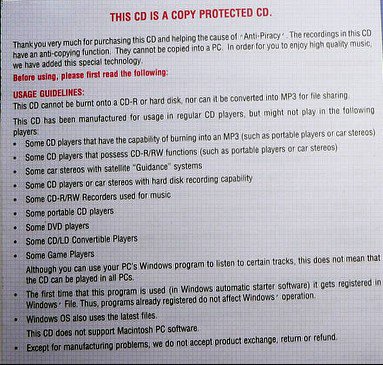
Via Boingboing (who got it from Itch.in), this insert was found in a CD by the band Coldplay, published by Virgin Records. I have nothing against Coldplay, although they are not high on any list of favorites either. I even have a sort of grudging respect for Virgin, however much their anti-corporate corporacity (something like mass pseudo-demassification) has worn thin over the decades (try as they may, they won't match Ralph Records). In any case, the overly aggressive "antipiracy" scheme has to be traced more to the corporation than to the artists, who will probably be blamed. A couple of notes here: 1) the strategy of telling people what they can do with products they have purchased is not likely to win lots of friends for the recording industry in this period of intensive decline caused by their failure (not for the first time) to adapt to new technologies that change the structure of the market, and 2) the declaration of contractual obligations of which one party is not aware until it is too late (the "contract" is hidden inside the shrinkwrap) should not get them too many micrometers past the door of a courtroom. Music publishers are sprinting toward a brick wall by trying to use repression as a response to their general decline, while there is good evidence to question the assumption that downloading and filesharing damage sales, and reason to suggest that these activities might increase sales, especially of work by lesser-known artists. But then, closing ranks is a sign of an institution in decay, and opening possibilities is a sign of emergent creativity.

2006-01-01

Interesting site of the day

Human rights archaeology is a combination of diary, fieldnotes and short essays on the subject of cultural heritage in Kosovo and conflicts over it. The author, Sam Hardy, also maintains another blog dealing with questions of anthropological and archaeological theory more generally. Interesting reading, and also a good example of what can be done from the field with a combination of exposure, intellectual engagement, and the magic of network technology.

2005-12-31

Happy new year!

Best wishes for a far better new year to everyone! We are off for an end of year road trip today (have never seen the mighty state of Maine, must take a peek at it), so I will not be posting. Until next year.

Documents on "rendition" and torture in Uzbekistan

This information comes by roundabout way of Jesus' General, who has satiric and nonsatiric takes on it. Craig Murray was recalled as UK ambassador to Uzbekistan after raising concerns about the use of torture to obtain evidence evidence passed on to the Foreign Office by the Uzbek security services. He documents his exchanges with the Foreign Office over the matter. Now the former ambassador is in a conflict with the Foreign Office over the manuscript for his book -- they would like him to remove all references to documents indicating the practice of torture and rendition. In particular, the concern relates to two documents, one of them (in PDF format) the telegrams sent by Murray to the Foreign Office compaining about the practice, and the other a legal opinion declaring the use of evidence obtained by torture not to be a violation of the UN Convention on Torture. Mr Murray is refusing to suppress the documents, and has published them on the Web instead. The Guardian reports as well.

2005-12-30

Best developments on the Croatian blog front

You can now find the work of many of many of your favorite Croatian bloggers aggregated and organised by topic at Bestseler, the blogerski onlajn magazin. Worth a daily visit, no question!

2005-12-28

People with whom I am proud to have crossed paths


One of them (with me in the photo) is Nikola Božilović, a sociologist from Niš. He has released two excellent studies of popular culture, one of them an exhaustive investigation of what rokenrol means in the history of the world, and the most recent one, Kič kultura, a multidisciplinary explanation of the varieties of false glamour in entertainment, politics, and cultural life. His work asks people to take seriously the things they encounter, no more and no less.

I am also delighted to have made the acquaintance of my brilliant friend's brilliant sister, the theatrical writer Milena Marković. I got a copy of her recent documentary film, Minerska opera, which records her experience in the dying mining town of Bor, where she and a group of local people staged a production of Bertolt Brecht's Threepenny opera. The film records the production, but also the joint efforts of the director and the locals to apply the aesthetic of the opera to their own hopeless situation, as seen through the experiences of two miner-musicians. The romantic guitarist Miki finds beauty in a variety of original and Communist songs ("Comandante Che Guevara," "O bella ciao," and "Bandiera rossa," the last two in a version most clearly derived from their performance by Pankrti), while his friend Lovke wanders around in search of a substitute for the romatic sounds of his youth, but is sure that he likes the aroma of the burning trave from his bottles of rakija. Mrs Ethnia and I (mostly she) did the English subtitles for the film -- we are still not sure that we did this honest work of art justice, but are proud to have had any kind of involvement with its production.

These are just two of the people who, during my last visit to Serbia, made me feel lucky to have some exposure with that part of the world. Sometimes I get the question as to whether I am "pro-Serb" or "anti-Serb." I have no idea what the question means. Actually, I could phrase that better: I know what the questioner thinks it means, but it makes no sense to me. I am in favor of honesty, creativity and hope. I admire the people who offer those things.

2005-12-26

Mladić ante haagus?

Eh, maybe. The arrest of Ante Gotovina means that Serbia now has a monopoly on the fugitive racket, not a very enviable position. The special prosecutor for war crimes made an enigmatic announcement, suggesting that he might know something but was not about to do anything. The interior minister made a petulant remark, blaming the preceding government for not having made the arrest (but implying, correspondingly, that his government might). A former police official made a dramatic claim, suggesting that negotiations were under way (but he is not in a position to know). And so today Danas editorializes that public opinion is being prepared for an arrest and extradition. Since we have all been here before, we can only wait and see.

Update: New reasons for not doing their job are blooming like a thousand flowers. Interior minister Dragan Jočić says that it is difficult to find people charged with genocide, because "they are experienced warriors, people who spent the war under difficult conditions and survived." Indeed, it must have been terribly difficult to wage war against unarmed civilians, but this hardly makes for warrior experience. Not that Jočić would have a basis for comparison. Manwhile, Kurir is raising the alarm (by way of Index.hr) that Mladić may prefer committing suicide to surrender. But since Mladić is not a civilian, we doubt that Mladić will kill him.

The first ever East Ethnia poll!

Give your answers sometime between now and 5 January. Choose multiple answers if that is your inclination. Alternative answers or answers with explanations are welcome in the comments.


What would you like to see more of on this site?
Regularly updated news from the East Ethnian region
Eric blathering on about his personal life
Eric's recipes and kitchen hints
Tendentious political commentary and posturing
Semicomprehensible osvrti on academics and the arts
Jokes and mildly amusing pictures
Something else


Free polls from Pollhost.com

2005-12-25

A holiday greeting


Having no talent for design of my own, I thought I might share with you the holiday greeting I got from my favorite media outlet.

The difference between knowledge and action

So Serbia's war crimes prosecutor Vladimir Vukčević says that he knows who is aiding Karadžić and Mladić. Or at least he has announced as much. But this seems like an odd thing for a prosecutor to announce, since he has neither named nor charged the people in question. Other agencies that might feel called upon to do something say that it is the job of the Bezbednosno-informativna agencija (BIA). But they have been too busy spying on parliamentary deputies in order to anticipate their votes, it would be a bit much to expect them to do any sort of job.

That crisp Massachusetts air

How tight was the connection in Paris? Let's just say that it was the first time I ever had to go up those steps leading to the plane and knock on the door in order to be let in. Otherwise the return was fine, my apologies for not posting these past few days but I ran out of hours on my fabulous dialup connection in Belgrade and had to see so many people that there was no time to go and buy more.

Much happened in between posts. Some of the perpetrators of the Ovčara massacre were convicted, and more are promised. The trial of the incidental players in Bosnia's most horrifying home movie began with the code of silence breaking down. Vojvodina's assembly set forth an initiative to ban neofascist groups, and the Serbian "diaspora" ministry promised (but did not deliver) an amnesty for people who refused military service in the last batch of wars. That is just a bit of the main stuff.

Burek from Prokuplje became a hit import product in Germany, and a proposal by a group of Croatian linguists to make the language sillier did not. A new Russian TV adaptation of The Master and Margarita became a huge hit.

On the culinary front, one friend taught me to make the dough for burek (it's not as complicated as it seems: it involves the strategic use of butter and a sheet, and the presence of Marlon Brando is not required -- and vinegar goes into the dough!). Another made me wild asparagus from Istra. The burek friend's daughter passed her last exam in architecture, so we made a Mexican dinner in her honor: salsa, arroz a la mexicana, chicken in a pepper and cream sauce, and of course Cesar Cardini's famous salad.

For a musical photo gallery of somebody more capable than me making burek, try this site. Thanks, Mirko!

Time now to rest and spend a bit of time with the family. To any of East Ethnia's readers who celebrate Christmas today, a happy Christmas to you!

2005-12-18

Return to Belgrade

Ha! I thought that once I delivered the books I had brought for the Nishville sociologists (thank you, uncle George, for permitting me that shopping spree), that I would be free of heavy objects to lug across slushy sidewalks. It was not to be. I received more books than I brought, so now I have a full selection of readings, on everything from sociology of culture and religion to one of the local specialties, Romologija (are you listening, Mat Savelli?). It may have only seemed that I had more to carry, because this can happen after five straight days of eating a lot of meat, another local specialty.

Generally I would have to say that the visit to Niš was a success. We have a plan for future cooperation and for involving more people in it. Anyone who may have thought that some strange American was coming to give them instruction was probably relieved to find that it was just silly little me. I am now the proud owner of an album of the greatest hits of Luis. In the meantime, two of my dearest friends got job offers. Every sign is good. Except for the bus that broke down halfway to Belgrade, but even that was a nice opportunity to chat with people.

In the coming few days that I have left in Belgrade, there are people to cook for and people whose cooking must be tasted. So I will still be a bit occupied, but promise to begin again with the posting of news items tomorrow. After I sleep.

2005-12-14

Greetings from Naissus!

I have to post in a hurry because the Nišlije are keeping me busy! Today was the first full working day of my stay here. The local sociologists are delighted with the books, thanks to everyone who made suggestions! There is a critical mass of ambitious young researchers at the sociology department here, who see an opportunity to do something of lasting value. This presents an energising contrast to the political situation, which is similar locally to what it is on the larger scale. Also, everything you have heard about the excellent barbecue in Niš is true (sadly, the same cannot be said for Niško pivo). We reached a compromise on language: I am permitted to lecture in my native tongue, with questions and answers in theirs. That leaves everyone a little confused, which is probably the goal of social science research anyway. More dispatches when I get a moment.

2005-12-10

See you in a couple of days

Just taking a break from packing to let you know that I travel today. I'll have more words for the esteemed readers of this site when I resurface in the lovely Balkans.

Bondsteel allegations remain unclear

Last week I posted an item indicating that the UN ombudsguy for Kosovo, Marek Antoni Nowicki, had given a statement offering vague support for the suggestion that the Bondsteel military base may have been a "secret prison" site. Now his office has issued a denial. It seems as though neither the statement nor the denial is definitive, and the question remains open.

2005-12-09

New blog for my students

This last semester I tried using a blog as a way of sharing interesting topical material with students. Now I have decided to expand the effort into one blog for all of my students in all of my undergraduate courses. The new site has a new name, and Blogger was kind enough to provide a standard template in the Clark University colors (which must now be ecru and burgundy, yes?). So I humbly offer you The Iron Cage. There isn't much there now, just some old posts from the previous incarnation and lists of books for next semester. There might be some stuff to interest people who are not taking my courses, but then again there might not.

If you are one of my students, this should be your first stop for basic information: anyone who mails me asking what books to buy or what the assignment is will get a note back from me saying "check the blog." It should also be a regular stop by which you can anticipate surprises. Discussion and debate are welcome, but comments are moderated.

If you are not one of my students, you will still be welcome to read, follow, comment, whatever.