2006-07-24

Serbia: Ideally Bad


The timing of Ceca has been impeccable in her more than 18 year long career as the star of the Serbian pop scene. From gangster bride to heroic widow and Serbian J-Lo, she demonstrated a better sense of where Serbia is going than some political analyst. Only in 2003, as she was arrest during the state of emergency following the assassination of prime minister Zoran Djindjić, her star seemed to wane as few stations wanted to play her music. However, this time, the timing was too good to be true.

Within a few days of Ceca releasing her new album “Ideally Bad” (Idealno loša) and singing its tunes to the biggest crowd ever gathered for a concert in the Balkans, more than 100,000 people saw her live at Ušće, the confluence of the Sava and Danube in Belgrade, on June 17 (the same place one of the biggest demonstrations took place to praise another idol, Slobodan Milošević in 1988), prime minister Vojislav Koštunica harshly criticized the EU for its treatment of Serbia and called it “deeply wrong” in his “ideally bad” interview for the news agency Fonet.

With both Ceca and Koštunica being ideally bad, one might ask is this just a coincidence. The text below suggests that the popular folk-star, cum widow of indicted war criminal Arkan, cum self-styled icon of Serbia, and the less popular prime minister Kostunica apparently have the same ghost-writer. In fact, the similarity between notes to Kostunica for recent talks with EU-Enlargement Commission Oli Rehn and Ceca’s tunes suggests nothing less.

Notes to Koštunica (unknown origin, crumbled up piece of paper, found in trash can near government building):

You might say to yourself:

“This world is for smarter ones,

this is the path for more courageous ones…

my heart is a chick, rained on, yellow and small”.

You might get cold feet before the meeting and say to yourself:

“Already I am panicking a little,

still nobody has invited me anywhere.

I will go by myself, what else. …

Everything annoys me here.”

But find your courage and tell Oli Rehn:

“Once the ground cracked beneath our feet…

You were the one I could call when the whole world forgot about

me.”

“But now, it is only will you leave or stay,

now everything between us is, do you want to or don’t you.”

“I offered myself to you, I offered but you rejected me.“

“Never, never, with you never again”

“In my room there, everything is crap and broken,

just as everywhere else in my city.

If you don’t know with whom you want to be, where you want to be, and why,

then for you this

is ideally bad.”

After you have told him, you might think to yourself:

“You don’t know anybody, but know them all,

that’s how it is when you’re alone,

as if it all happened to you before.”

(The text is taken from songs: “Čulo bola”, “Koža pamti”, “Ponuđen ko počašćen”, “Viski”, “Lepi grome moj”, “Idealno loša” and “Pile” on the new Album of Ceca Svetlana Ražnatović, Idealna loša)


Another connection

Was there a connection between the Serbian government and the self-declared military forces and paramilitary formations that operated in Croatia and Bosnia-Hercegovina? The Supreme Court of Serbia says yes. It has confirmed an earlier decision ordering the state to pay damages to seven (out of an estimated 10.000) refugees who were arrested by the military in 1995, then delivered under military security for "training" at a camp of the "Serbian Volunteer Guard" (Srpska dobrovoljačka garda) in Erdut, after which they were forcibly mobilised into units of the "VRSK" in Croatia and the "VRS" in Bosnia-Hercegovina.

2006-07-22

Worrying developments in Bosnia

[Updated version with links]

Last week I edited the draft of a report in which the author had written of "deteriorating political trends" in Bosnia. The donor wanted to have this changed to "worrying political trends." Whichever it is, it's for real. Until recently, for example, I'd have been inclined to dismiss calls for a referendum on independence for RS -- the miserable statelet ("entity") the Serbs carved out of Bosnia by killing, raping, looting, and shelling -- as mere campaigning. (Bosnians will vote for central and entity parliaments on 1 October.) The SNSD, a nominally moderate party with good links to the RS business community and a history of antagonism towards the RS' "natural" government party, the SDS of Dr. Radovan Karadzic, wanted to prop up its nationalist credentials, on this reading, and that's certainly part of the story -- but not all of it. RS prime minister and SNSD leader Milorad Dodik is very close to certain circles in Belgrade -- the very same circles that pay a lot of money to Washington lobbying firms to place well-written and superficially reasonable op-ed pieces in U.S. papers, pieces that nonetheless are full of threats if one reads between the lines -- and it's obvious to assume that he's not doing this for purely opportunistic, or indeed domestic, reasons (unless one has a rather big house). Indeed, after spending years denying that what happens in Kosovo would resonate in Bosnia, Western diplomats are getting *really* worried at the precedents they're setting in Kosovo.

But it's not just the Kosovo repercussions. Police reform -- a key prerequisite to conclude the first association steps with the EU -- is stalled, with the Serbs very openly obstructing talks. The international proconsul has announced he'd close shop by end of June 2007, so all they need to do is sit him out. The Serbs are now also second-guessing the distribution key for fiscal revenue and are being difficult on a number of other fronts.

Perhaps there's really no point in trying to keep them inside Bosnia if they really don't want to be there, as folks like David Chandler and Robert Hayden have long argued? Aren't they just a millstone around the necks of those who want to build a *real* state in Bosnia, and not just a conglomerate of self-ruling ethnic territories?

2006-07-20

What dread hand? & What dread feet?

What mysterious force persuaded the basketball player and would-be businessguy Vlade Divac, once the court had cleared the way, to suddenly abandon his plan to become the first private operator of the resiliently state-controlled Večernje novosti?

Akcija planiranja

According to the indictment issued by prosecutors against some of the (less highly placed) people who aided in harboring the fugitive Ratko Mladić, he shifted hiding places several times between 2002 and the end of 2005, but was hanging out principally in a series of rented apartments in Novi Beograd. This was, naturally, entirely unknown to DB, the police, landlords, neighbours, and to the mother of one of the conspirators who was dragged over to cook for the genocide indictee, who no doubt had quite an appetite.

All this should change utterly now that the government has adopted something called an "Action Plan." Nobody seems to know quite what this is, but the most vocal members of the government appear to be quite happy about it. Apparently it amounts to an effort to reproduce the success that the Croatian government had not too long ago in overcoming political barriers to continuing negotiations with the EU without actually arresting Ante Gotovina. Except that there are a couple of key differences. One is that eventually, Gotovina was in fact arrested: there was a shift from "action plans" to action. By contrast, responsible figures like interior minister Dragan Jočić continue to deny that planning to engage in action involves any obligation to act at all. Another is that, at least according to some reports, one of the preconditions for "action" is restructuring the state security services, which provided the base for Mladić's power at one point, and which (despite the existence any indictments of people with no rank or official position) facilitated his flitting about thereafter. People who have tried to touch these structures of power since the regime that operated through them appeared to have left power in 2000 have found themselves the targets of aggression and violence.

But not to worry: anybody who stands in the way will have to face prosecution by the special prosecutors for organised crime. Except there will be a couple of difficulties here, as the court to which this prosecution office brings cases is about to be abolished, and the prosecutor seems to be getting rid of prosecutors who actually want to bring cases at impressive speed.

Update: Politika continues its series. How did Mladić come to be under the protection of the real estate traders of Novi Beograd? Delivered by an agent of the military security service in 2002, apparently. Politika's journalist Milorad Vesić stops just short of saying that the agent in question, who is not charged in the indictment, is Radomir Ćosić.

2006-07-18

Competition

So the story appears to be: the folk-pop figure personality Severina Vučković makes a guest appearance on a television station in Kragujevac, in the course of which she receives as a gift one of the legendary "Yugo" cars from the Zastava factory. This leads her commercial sponsor, the Croatian representative of Mercedes Benz (or Daimler Chrysler, I presume?) to announce a lawsuit against her. No doubt the competitive pressure is difficult for MBZ to bear. Leaving aside whatever differences in quality, comfort or reliabilty that may exist between the product from Stuttgart and the product from Kragujevac, there does not seem to be much question which company's directors have a better sense of what makes for good publicity.

Update: TV 9 in Kragujevac says it ain't so, that Severina did not ask for a car, the station did not contact the factory, and the factory did not provide one. They do, however, invite people to support a campaign to raise funds to buy a car for the use of the safe house for women and the center for children who are victims of violence in Kragujevac.

An update on dining in Belgrade

Just some quick notes on places we have tried in the last couple of months:
Restoran Oskar: This was the discovery of the season for us, traditional dishes perfectly prepared, and a good selection of domestic wines. They made best sarme we have tasted, with Montenegrin hard cabbage. In Dorćol, ul. Braća Baruh below Dušanova.

Restoran Čubura: I came here one day with my student and we were thrilled by the fanstasticity of it. A few days later Mrs Ethnia went with some friends and was disappointed. Go figure. On Vračar, gradić Pejton.

Restoran Porto: Good fresh fish, fine service. However, be warned that it is obscenely expensive. Go only if somebody else (preferably, somebody against whom you bear a grudge) is paying. ul. Francuska, way off in the industrial zone.

Kafana ?: Amazingly enough, this year is the first time that we tried the food at this landmark spot. They offer up good classic roštilj, and they have renovated the toilets probably for the first time since opening. ul. 7. jula, between the bankers and the theologians.

Čobanov odmor: It's a takeout place, but you can get sandwiches in a freshly baked lepinja, goatsies, sheepsies or piggies with kajmak. Darn good, even with the folk styling. At Crveni krst, ul. Žarka Zrenjanina.

Kafana Proleće: Hardly a discovery, but we have noted again that this low-priced standby is still pretty darn good. It may well be the only remaining normal place in the central part of town. Preko puta Instituta za sociološko i kriminalističko istraživanje.

Pietro dell'oro: Italian šminka, owned by some sports figure or another. The design is excellent, the food is okay, and the service is on the level of "you should be happy just to be here." Admire from afar. Vračar, ul. Save Kovačevića.
The classics have remained classic, and we have at least not encountered any places that used to be good which have turned bad. Though we have no doubt that they exist.

2006-07-14

Moderate progress, within the limits of the law

Recognition where it is due: there was a time, for eleven or twelve years there, when the only reason to read the once-mighty daily Politika was for a bit of ethnographic voyeurism, to see what parts of their fantasies the bizarre characters of the old regime imagined were respectable enough to put out into public. It was kind of like the early-nineties work of Madonna, only inclining more to the horrifying than to the entertaining. Since late 2000 it has changed a bit. Now reading Politika is a little bit like shopping at Filene's Basement -- it's not that there is nothing worthwhile to be found, but there is a lot of other stuff to plow through before you find it. More recently the paper has also massively improved its graphic design, I am told through the services of the mighty Mirko Ilić. Now Politika has introduced a new web site. It is an improvement on the old one, but the old one was a disaster. Before they offered fewer than ten articles a day and took them all down after three days, with no archive. Now they offer many more articles, giving at least an impressionistic overview of the major sections of the paper. The selection is a bit odd: today they lead off with a long-range weather prediction, for example. They still do not provide an archive; every other major Belgrade paper provides a complete online archive.

The new Politika web site is a bit like the new Politika. It is better than it was, but considering what it was, it would have been hard for it to be worse. Bit of a synecdoche, really.
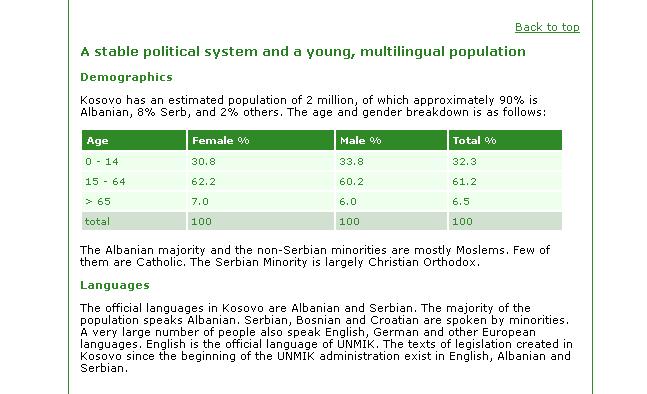
Understatement of the day from EU pillar in Kosovo ('Invest in Kosovo'). I am glad that in the section they did not dwell too much on the stabile political system part.

A new resource for language learners

Many years ago when I took a course in the language called Serbo-Croatian, the text we used was mostly oriented toward literary translation, in the spirit of most of the language courses, which were for the most part designed to meet the needs of Russian literature majors who were required to take a year of some other Slavic language. As a supplementary text we used one of the versions of the classic by the great Celia Hawkesworth, which was a bit more oriented toward everyday culture. Coming out these days is a new set by Ellen Elias Bursać and Ronelle Alexander. I saw some of the early versions of the lessons when one of my brilliant students took a language course at Harvard, and it looked good: there is a contemporary tone, and several prominent contemporary writers contributed study texts. The lesson book by both authors is accompanied by a "grammar with sociolinguistic commentary" by Ronelle Alexander. The web presentation includes sample chapters, links, a glossary, and many more goodies. The name used for the language in this set of texts (if I am not mistaken, the first to use this name) is "Bosnian, Croatian, Serbian," after the autochtonous language of of one of the tribes native to Scheveningen.

Ethnic Ambiance on East Ethnia

I thought that there is no better way to start my contributions to East Ethnia with the first of (hopefully) many nice examples on the topic of ethnic advertisement.
Here's one from Strasbourg: Zen tendencies equal an ethnic ambiance (in case the complex French was not obvious in English). I think SDA/HDZ/SDS are contemplating using this for their joint electoral slogan in the Fall elections in Bosnia.

In every dream home a heartache

So I see in Danas that Roxy Music is set to play concerts in Ohrid and Belgrade. People of my generation may remember them as the group that began its career by putting out three albums, every one a transcendent beauty fully worthy of the Nobel Prize for Pop Music, and then spent several years putting out heaven knows how many albums which were for the most part just this side of mediocre. My first response on seeing the announcement was hey, that's pretty cool. My second response was wow, are they still alive?

There are a number of pop figures who remain a mystery to me. When I was in Argentina, I encountered the belief that the personification of pop was (not Fito Páez but) some American musician named Johnny Rivers. My friends were shocked that I had never heard of Johnny Rivers, so I asked my mother. She told me he had been a one-hit sensation sometime in the mid-sixties, and I guess he went on to become the personification of pop in the Southern Cone, something like a Patagonian Dean Reed. The other one is a guy I saw in an old Russian documentary, but never learned his name (he looked a lot like Glen Cambpell). He went around the CCCP singing a little bit of Little Richard and Jerry Lee Lewis covers, doing the occasional performance in solidarity with the people of Chile--I'm guessing this must have been the early seventies. The high point of the documentary was him on a hilltop belting out the Ode to Joy in Spanish. Wish I knew who the fellow was.

2006-07-13

High points of our vacation

  1. The Croatian border guard whose manner changed drastically when I pretended not to understand the language he was insulting me in (NB: I think that this a characteristic of bucolic constables, not of Croatians)
  2. Hum (pop. 19), the "smallest city in the world," with abundant tartufi and wild asparagus
  3. Explaining to my daughter that when I tell her to use her head, I do not have Mr Zidane in mind
  4. Cheese with truffles, pasta with truffles, oil with truffles, the wonders achievable by well trained pigs (see #1)
  5. Arugula grows by the roadside, as a common weed
  6. The most unfortunately named restaurant in the world, the Fakin Buffet in Motovun (supply your own joke)

Onda su došle devedesete...

Thanks to our maniacal friend (and proud young father) Mirko, for those of you who are looking for it -- and you know you are -- here is a gallery of photos from the rockin' 80s in Belgrade, from the archives of the incomparable Miladin Jeličić.

For those few of you who have really missed me terribly, here is the interview I gave to a local Conde-Nastish-type glossy. My remarks are neither here nor there, but the introductory note by Marija Šajkaš is priceless.

2006-07-11

Ground control to Major Tom

I've been following the proceedings this morning outside Srebrenica, where over 500 bodies will be buried today, on the annniversary of the fall of the town to Serb forces in 1995. I couldn't help but think of this wonderful example of irresponsible gibberish, written by a pomo obfuscator named Tomislav ("Major Tom") Z. Longinovic in a thoroughly forgettable volume ("Balkan as Metaphor"):
The war crimes were committed by the nomadic clones of post-communist territoriality, regardless of ethnic and religious origin; "the serbs" [sic] were both the fiercest perpetrators and the most numerous victims of these anti-Yugoslav forces.

I'm too dumb to understand the whole piece but what I do understand I sure don't like.

2006-07-10

Disturbingly quiet on the Ethnian front

Greetings to the infinitely patient readers of East Ethnia from sunny Ljubljana, where we are on a brief vacation spell after enjoying the marvellous wedding of our dear friends and colleagues. My computer remains dead, much like the more valued machine which celebrates the Glories of Carniola. However, Mrs Ethnia has arrived with her sprava, we have set up (after considerable waiting) a fine cable connection in our gracious Belgrade chateau, so regular updates from this side ought to begin when we get back later in the week. In the meantime, gratitude goes out to T K for keeping us informed on the activities of various "humanitarians" during my long silence. I am aware of all of the things I have failed to comment on in the meantime, but don't go thinking that I do not have something snide to say about every one of them.

Expect updates as well from Florian Bieber, the newest East Ethnian grey eminence.

2006-06-25

Understatement of the week

There are flaws in this book.

Jonathan Freedland in his review of Chomsky's Failed States, New York Times, June 25, 2006

2006-06-17

"I didn't mean it that way"

I will spare the readers of East Ethnia the details of the tedious controversy -- interestingly enough, a mostly German debate that seems to have very little resonance in Serbia itself -- surrounding Peter Handke's statements about Serbia, the genocide in Bosnia (and especially Srebrenica), and the role of late President Milosevic. An excellent resource for the whole thing is Caroline Fetscher's blog, which is required reading anyway. (Should you still thirst for yet more and read German, today's Neue Zürcher Zeitung carries a long interview with Handke.) I will equally refrain from commenting on Noam Chomsky's recent interview with the New Statesman.

[I cannot bring myself, however, to refrain from quoting the interview's highlight: "The worst crime was Srebrenica but, unfortunately for the International Tribunal, there was an intensive investigation by the Dutch government, which was primarily responsible - their troops were there - and what they concluded was that not only did Milosevic not order it, but he had no knowledge of it. And he was horrified when he heard about it." If anyone can figure out what he's talking about, please let me know.]

Rather, the point I'd like to make is this: how come two people who have been professionally working with words for several decades and who have received numerous awards for that work don't seem to be able of any unambiguous statement when it comes to the question of war crimes and genocide in former Yugoslavia? Of course, Chomsky is equally obfuscating on a range of other issues, and his extreme negligence -- some might say, willful manipulation -- when handling sources and quotes is legendary. Indeed, the fallout from Chomsky's infamous interview with the Guardian's Emma Brockes (centering on the use of quotation marks and similar), and Handke's current troubles after he spoke at Milosevic's funeral all seem to stem from the same spectacular inability to simply and clearly state what they are trying to say. Pretty remarkable for two guys who make a living dealing with words, don't you think?

2006-06-16

The siege of Sarajevo, contd.

An AFP wire report yesterday provides excellent if implicit guidance as to how to deal with the dreaded time between June and September, when very little happens and editors are struggling to fill their pages. (Thankfully, this year we got the World Cup.) As an editor, I very much appreciate such pieces since they help me perfect my craft.

1. Headline properly
This one reads “Bosnian capital shaken by radical Islam,” an evergreen that will attract readers. Try to appeal to the reader's most visceral fears. [Note: This is the editor's job, not the hack's.]

2. Spot trends
It's imperative that what you report is not just a single event but a new tendency:
The people of Sarajevo, renowned for their pluralism, have
been shaken after a series of incidents including the murder of a Muslim woman by her Islamic extremist son who questioned her faith.
Never mind that the only other elements in this “series of incidents” were some couples making out in parks and being harassed by some self-styled guardians of virtue. This allows you to repackage old news--the murder happened on 27 February--and to link the insignificant (a bunch of punks bothering a bunch of kids) to the significant (a murder).

3. Make good use of quotes
This is a critical element in establishing your credibility as a reporter: you've been there, you know the situation, you've talked to the experts.
Upholders of Bosnia's moderate version of Islam say the
problem caused by an influx of hardline fighters during the country's 1992-1995 war has worsened in recent months, highlighted by the gruesome murder.

“Bosnia's tradition of Islam is tolerant, it promotes
pluralism and we should not allow those representing a
one-track ideology to teach us,” says Jasmin Merdan.

The 26-year-old -- a practising Muslim who portrays himself as a “victim” of the Wahhabi ideology before abandoning it -- is one of the few courageous voices in Bosnia who dares to criticise extremism.

The most important thing to remember when using quotes is that they don't actually need to be linked to anything you're saying, as the example above shows. Readers who expect the claim about a worsening situation to be backed up by a quote just don't get it, and the rest will be happy to hear about the courageous young man who dares to speak up.

2006-06-10

With you occasionally

Okay, here's the deal: my trusty computer has reached the point of no repair. This means that updating here will be highly limited, at least until Mrs Ethnia arrives in town with her computer next week. Points to Marshall McLuhan for observing many years ago that we tend to become dependent on those things that are invented for our convenience.

In the meantime, there is of course much to report from the country I am in, a different one from the one I entered although I have not gone anywhere. But I am following daily events less than I might, since I have been fortunate enough to get access to the archives of one of the popular daily papers, and am instead spending my days reading newspapers from years ago and scribbling their contents onto index cards.

Unfortunate things, aside from the ones that you might expect, include the weather -- heavy rain more or less every day, and the one sweater I brought along (at Mrs Ethnia's insistence) is getting heavy use. This has also been a sad year for restaurants globally: first with the closing of the best Chinese place in our neighborhood in Boston, and now with the surprise closing of Manjez, the last remaining nonšminkerski place in the center of Belgrade (aside from Proleće). News is that the famous and much admired konobar Draško has moved to Orašac on Bulevar Revolucije, or whatever forgotten personage they are calling that street after now.

Good things in Belgrade: Disciplina kičme, last night at SKC.

2006-05-24

Srbija i Fruška Gora

East Ethnia sends you greetings from lovely Niš, which must have more kafići per capita than any medium-sized city in the immediate vicinity. Greetings also from my friend Pedja's computer, which he has graciously allowed me to borrow since my screen has decided it would no longer take instruction from the skalamerija below. Presumably this can be repaired, although I expect that finding a Mac mechanic will have to wait until my return to Belgrade.

There is the possibility that I may arrive to one country and leave from another. The independence referendum in Montenegro appears to have succeeded, just barely, in one of those underwhelming results that lends itself to multiple interpretations. Probably the eventual independence of Montenegro will make little difference to most people there or in Serbia -- the concrete questions that will affect people have to do with property rights, pensions, and the ability of people (students, for example) to cross borders and use benefits freely. As long as these questions are not taken up in bad faith, most people will be likely to carry on as before. The result has been interpreted in international media in many cases either as an expression of anti-Serbian sentiment or as an additional step in the disintegration of what was once Yugoslavia. These are probably overinterpretations, at least in part. The referendum also put a legal stamp on a separation that was already proceeding in fact, and put an end to an expensive and dysfunctional federation which neither had much to show for itself nor, in the end, had much of a will or desire to argue for its continued existence.

Most of the immediate consequences of the referendum will be felt by political elites. About 3000 functionaries will be out of work, together with a smaller number of parliamentary deputies who will not be losing much work, and some ministers. Among these ministers will be two influential ones whose parties are not particularly favored by the Serbian government (of which they are members): human rights minister Rasim Ljajić and foreign minister Vuk Drašković. There should be some mild entertainment as PM Koštunica looks for a way to keep his government alive while trying to satisfy them with the smallest crumbs possible.

As long as I can get access to a working machine and a connection, I will try to post as regularly as I can from the banks of the mighty Nišava. With any luck all technical difficulties should be resolved soon after I get back to Belgrade, and your humble correspondent will humbly correspond.

2006-05-19

Clueless in the Balkans

I've been a harsh critic of the EU's approach to enlargement in general and the Western Balkans in particular, but the European Commission did the only thing it could realistically do when it postponed giving Romania and Bulgaria a firm entry date on Tuesday. If it had recommended to the EU member states to postpone entry by one year, it would have removed any incentive for further reform in Sofia and Bucharest since the two would have entered by 2008 one way or another. The Commission would also have set itself up for a nasty fight that it couldn't have won -- postponing Bulgaria's accession would require a unanimous decision by the EU's 25 members, something that would have been impossible to achieve. Giving them a firm 2007 date would have had much the same effect -- it would have provided an incentive for the two governments to slack. Judy Dempsey doesn't agree with this analysis:

By delaying a decision over whether Bulgaria and Romania will be ready to join the European Union next year, the European Commission has sent a negative signal to the countries of the western Balkans Albania and some states of the former Yugoslavia whose chances of joining now seem more remote than ever, according to experts in the region.


She quotes an expert from the "European Stability Initiative," a Berlin think tank that has consistenly managed to be as wrong on Bosnia as one could possibly be:

"The western Balkans has witnessed over the past 12 months that engagement by the EU toward their accession prospects has slowed down," said Kristof Bender, a Balkans expert at the European Stability Initiative, an independent political research group. "The commission's decision on Tuesday only confirms this. Frankly, the EU's credibility in the region has been seriously undermined."


This has it exactly backwards. The EU has lost credibility in the region for many reasons, but being tough on two accession countries that are clearly not fully there yet isn't one of them. What would have happened with the Western Balkans countries if they had seen that membership can be had on the cheap? Would that not have undermined the reformers there much more than the exceedingly fair, and graciously delivered, decision by the Commission on Tuesday to say, "yes, but?" I'm all for enlargement. I also happen to think that the EU has too often gone soft on its own commitments, and I'm afraid we may see many examples of that in the Balkans over the next year. But Bulgaria isn't one of them.

2006-05-18

Tranzicija

The grades are in, now a couple more days and I am off to some glamorous summering in exclusive Balkan locales. There will probably be a few days of blog silence, or at least intermittent posting, after Saturday, then as soon as I am able to set up a nice fast connection in Belgrade, your faithful correspondent will be with you again.

2006-05-12

Mezzo-Soprano

Živela Slovenija and Montenegro! Michael has bales of liquid video.

Specijalna molba za beogradske čitaoce

Ljudi, uskoro dolazim u vaš grad. Pošto civilizovan čovek, a naročito Srbin, ne može da živi bez brze internet veze, tražim ISP (wajrles, po mogućnosti) koji bi pokrio našu veliku i luksuznu garsnonjeru u vašem gradu (Vračar, da budem precizan). Da li neko može da me uputi u to koje su sve kompanije, kakva im je pokrivenost, koliko iznosi neka normalna cena, koja je oprema potrebna itd.? U suprotnom slučaju, retko ćete imati šta da čitate od mene tokom leta. Unapred zahvalan, vaš verni sluga.

Nonalignment

The Guardian reports today on an investigation by Amnesty International, according to which "the US government arranged for the delivery of at least 200,000 Kalashnikov machine guns from Bosnia to Iraq in 2004-05," using a network of private companies, "at least one of which is a noted arms smuggler blacklisted by Washington and the UN." That firm would be Jet Line International, the successor to the Moldovan company Aerocom, implicated in the illegal weapons trade in western Africa (operating at that time, it seems, at least in part through Serbia). Here is a little bit more on the principal, Viktor Bout. The destination of the weapons was said to be "coalition forces in Iraq," but there is no evidence as to where they ended up.

2006-05-11

A question for all you softveraši out there

My browser (the very fine Firefox) runs into the same problem each time I go through my ritual reading of the Balkan online newspapers: at one point, something, probably some script on one of the pages, disables the keyboard functionality. The most noticeable effect of this is that I cannot scroll down the screen using the space bar. I cannot be sure, but I think the culprit is a designer for ANSA, Dnevnik or Glas. I'm inclined to suspect Dnevnik the most, since their page is very javascripty. Any diagnostic thoughts?

Intelligence

Over the past week a good deal of attention has been paid to the uneasy situation regarding intelligence agencies in the United States. With the sudden and unexplained "resignation" of CIA director Porter Goss, a number of questions have been raised regarding the degree to which the departing director and his loyal staff have been involved in a sordid corruption scandal, the effect of a reorganisation of intelligence services on the independence of the CIA from political interference by the party in power, and the ambitions of the Department of Defense to exert control over intelligence activities. The uncertainty was not eased when the president put forward his nominee to succeed Goss: an active-duty military officer who has had a leading role in the administration's controversial (and apparently illegal) domestic surveillance projects. On all these themes, see the ongoing reporting by Laura Rozen.

And what of intelligence agencies in Serbia? Dejan Anastasijević has an overview in this week's Vreme. The latest accusations being put before them relate to the ongoing failure to arrest or locate Ratko Mladić, though this is hardly the full extent of it. At bottom, critics are continuing to raise the question of whether the intelligence services are under the control of the government and whether they work for the interests of the state. And what services are these? Serbia has five intelligence services, reporting to different officials and agencies. These are:
  • Bezbednosno informativna agencija (BIA -- Security Information Agency): Headed by Rade Bulatović. Reports to the prime minister.
  • Vojno-bezbednosna agencija (VBA -- Military Security Agency): Headed by Svetko Kovač. Reports to the minister of defence.
  • Vojno-obaveštajna agencija (VOA -- Military Intelligence Agency): Headed by Veselin Milović. Reports to the minister of defence.
  • Služba za istraživanje dokumentacije (SID -- Service for Research of Documentation): Headed by Ljubomir Milić. Reports to the minister of foreign affairs.
  • Služba bezbednosti MIP-a (SBMIP -- Security Service of the Ministry of Foreign Affairs): Headed by Mirko Tomčić. Reports to the minister of foreign affairs.
So: five intelligence agencies, reporting to three civilian officials (to be fair, only the first three have a very broad scope of activity). And how is their work coordinated? Simple: it is not. This may account for some of the failures of the services that Anastasjević lists in his article. On the other hand, some of the failures may be attributed to a bizarre inheritance from the previous position of intelligence agencies in the Communist period, when they were extraordinarily privileged and closely tied to the party in power. Now the intelligence agencies no longer tie their function to the maintenance of a monopoly of power by a party, but more to maintaining their own. The questions raised by their role in the Mladić case (have they stopped protecting him? are they trying to find him?) highlight the extent to which these agencies have remained powerful islands resistant to civilian control.

Živio BH film!

You can find the program for the Third Annual Bosnia-Hercegovina Film Festival online. It will be held in New York from 19 to 21 May, and will include both documentary and dramatic films, full length and short. Among the full-length features (these are the translations of the titles as they appear in the program, for the benefit of people who want to order tickets) are Go West by Ahmed Imamović, Well Tempered Corpses by Benjamin Flipović, Totally Personal by Nedžad Begović, Justice Unseen by Aldin Arnautović and Refik Hodžić, The Dream Job by Danijela Majstorović, and Borderline Lovers by Miroslav Mandić. many of the short films look interesting as well, including a documentary on burek in New York and the sleeper net-hit music video by Damir Nikšić which you may have already seen.

Odvedi me iz ovog grada

Explanation for little posting lately: I have been scrambling to get the end-of-semester grades in, hoping to be able to make my departure to the mystical Balkans unencumbered. In the moments between, we have been watching films. One standout: The Conversation. Before he became Francis Ford Coppola, this fellow was a fantastic director, and this piece featuring an intense Gene Hackman, a sylphy but sinister Harrison Ford, and for fans of the period, a bit of John Cazale and Robert Duvall as well, deserves to be considered a classic. The psychological angles (oh, and the gender stuff) are strictly period-piece, but it is one of the most fascinating takes on surveillance, and the uncertainty of knowledge, I have seen. To say nothing of the soundtrack. Sadly, Walk the Line turned out to be a huge disappointment, succeeding in doing something that the contemporary haters of Johnny Cash never managed to do: turn him into a bundle of VH1-style cliches. More news as the pile diminishes.

2006-05-06

Obaveštenje

To all our readers and friends in Dubrovnik: keep your children and household pets indoors today. Dick Cheney is in town.

2006-05-03

The rebirth of irony?

This blog will be one of the least timely to remark on the long-running response to the impressively vicious performance by Stephen Colbert at the White House correspondents' dinner last week. This is a yearly event where journalistic insiders slap backs with their sources, and timid humor is traded in the name of appearing to be self-effacing.

Colbert broke the rules, brilliantly: he is a comedian who self-consciously pretends to be a right-wing ideologue, and was speaking to a roomful of people who unconsciously pretend not to be. Video of his performance is available at several spots, including this one. The correspondents' jaws dropped while the president's teeth clenched, and while his routine was ignored by major media (who preferred a tepid routine where Bush exchanged spoofs of his own illiteracy with a lookalike), it has been widely feted in the political blogs.

Was it a comic routine that went over the heads of its audience? A critical moment showing that a comedian is the last person left to speak truth to power? A provocation with unanticipated results? I was impressed, myself -- it seemed like a rare sign of life from a media culture that too often seems to be drowning its own unique blend of blandness and vulgarity. Much of the discussion I have seen of the event has seemed rather predictably pro or contra, but there is a wide-ranging and fascinating discussion on the wonderful Radio Open Source, hosted by Chris Lydon. It is available to be downloaded for your listening pleasure.

Miroodljub

I have just heard on B92, no written articles to link to yet, that Miroljub Labus has given his resignation as deputy premier in the Serbian government, giving as his reason the suspension of accession negotiations with the EU because of the most recent failure to arrest and extradite a prominent genocide indictee whose name everyone knows. He will also recommend, in the spirit of gestures which appear to be a compromise but are in fact pointlessly self-defeating, that his mysterious disappearing party G17+ withdraw its ministers from the government but continue to support the government in parliament.

If any interesting articles on this appear, I will add some links below.

Here is B92's news report, with comments.

Coming: Another war crimes trial

Domestic prosecutors in Croatia are waiting for a decision on the lifting of immunity (expected in seven days), and will then be charging Branimir Glavaš with war crimes against the civilian poulation around Osijek committed in 1991 and 1992.

Update: The commentary by Dragan Antulov (Drax to his many fans) is the lead item at Index.hr.

Inspirational pizza-related thought for the day

The next time you make pizza, instead of making a tomato sauce, try just slicing a few onions very thinly and carmelizing them in olive oil, adding a bit of paprika or rosemary at the end. Spread the carmelized onions over the dough like you would the sauce, and then add whatever you like to add on top. You will be delighted by the result.

2006-05-02

Lifers imitate artists

Probably few people would have heard of the film director Slobodan Praljak if he had not received wide international publicity in another role, as the commander of the forces which destroyed the monumental bridge in Mostar. The Internet Movie Database lists three films under his credits (two of which are documentaries from 1990), in addition to a bit part as "himself" in the 1995 documentary The death of Yugoslavia, where he appeared alongside some much better-known performers. The Croatian film database lists just one film, Povratak Katarine Kožul from 1989. I have not seen the film and do not know much about it, but it would appear to have been a serious production: screenplay cowritten with Abdullah Sidran, soundtrack by Arsen Dedić, and a cast which includes some very well respected actors. Unless there is some important information missing, though, it would appear that Mr Praljak's film career was brief and not much celebrated.

Now he believes that he has the opportunity to find a new audience, though. AFP is reporting today (sorry, I don't have a link) that he "intends to show four movies he directed in order to prove his innocence" as a part of his defence before ICTY, where he is accused of war crimes. These would appear to be more documentaries (docudramas, perhaps?) where he is playing "himself," and AFP's description specifies "In one film Praljak, portraying himself, depicts his role in preventing a group of soldiers intending to kill imprisoned enemies. In another he calms an armed Muslim who enters his office demanding compensation for his destroyed house." The reviews will be an unusual format, but then depending on how one counts, showing four films at ICTY will either double or multiply his potential audience. He has already offered the Tribunal his views on ethnonational physics.

2006-05-01

"First, we believe that suing our fans is destructive and hypocritical"

Here is what Steven Page, known as the frontman for the Barenaked Ladies, has to say about the response by a group of Canadian artists to the efforts by record labels to limit the use of music. Thanks to Boing and Boing.

Ratkovdan

Every few months we gather round and uncork a nice kratošija to mark the passing of yet another deadline for the arrest of Ratko Mladić. This one came and went much like the previous ones, except the weather was pleasanter and the rumours planted in the media less interesting. Last time around we had the image of special forces (not) surrounding [choose one or more of the following] a) mountain chalets, b) apartments hidden in the jungles of Novi Beograd, c) border regions of Macedonia, or d) the Russian Federation. This time all we have is the arrests of a few vojnih lica, with promises of more as long as they are either retired, from RS, or if possible both. This is all the same to Mladić, who by now is well used to other people facing difficulties on his behalf.

Now, nothing characterizes politics in Serbia better than inertia. Inertia (I have learned from my daughter) describes not only the tendency of immobile objects to remain immobile, but also the tendency of an object moving in a straight line to continue moving in a straight line. This is one reason that I think that the arrest will be coming (no prediction when) after all: the decision by the European Union to tie the continuation of negotiations on accession to progress on this arrest has set in motion a chain of events which has forced even the Serbian government to behave as though it has some responsibility for the future of the state. But the longer it takes, the less it will matter.

A thesis about transitional justice: it matters to the extent that it is about marking a break between one political order and a new one, which uses the opportunity to characterize its relationship with the previous regime, the nature of its commitment to the rule of law, and the values that distinguish it from its predecessor. To the extent that it is about taking certain individuals and slowly moving them from hiding places to places of confinement, it loses its symbolic appeal as quickly as the people to be moved lose their influence over the day to day fates of the people around them. For some time people asked (although they largely knew the answer) "where is Ratko?" Increasingly people outside a few small, interested cliques are asking (probably more than a little disingenuously) "who is Ratko?" By the time a trial gets under way, if it gets appreciable publicity at all, there may be little interest in the answers it offers to the question "what was Ratko?" A corrolary to the thesis: transitional justice is only transitional if it takes place quickly enough to influence transition. By the time the restoration begins, transitional justice is mostly a long process of lightening a bit of ballast.

In this respect, the interrupted trial of Slobodan Milošević will probably have the net result of damaging future efforts. It is not that there is any overwhelming sympathy for the departed indictee: the desultory sendoff he got shows that well enough. Rather, the long and inconclusive process has come to symbolize a whole set of blocked or diverted initiatives from October 2000 onward: from political and economic reform, to the rebuilding of regional relationships, to the reanimation of public institutions, to the fading of the nineties-vintage criminal elite, to this, there is an inescapable sense of incompleteness and futility.

The question will always remain open as to whether more direct means of settling accounts might have had a greater effect at least in the short term. My inclination is to dismiss such talk as a retrospective fantasy of revenge. More to the point, as observed long ago by old Mr Yeats, "The best lack all conviction, while the worst are full of passionate intensity." The more that setbacks and delays contribute to general disillusion and resignation, the easier the job for the folks who are waiting in the wings and plotting their return. This little story, recurring every few months, is just one of the more visible symptoms.

Form over content

It was time to give East Ethnia a new look, wasn't it? Lacking the technical ability to create a design of my own, I used somebody else's -- using this neat tool called PsycHo, which allows you to input preferences and get ready-to-use code! There are still some things I need to figure out, and of course there are links to be restored, but this should be done over the next few days. There should be a bit of time then to get up to speed with a little content, as well.

2006-04-29

Back and ethnier than ever

Just a quick note to let you know that the last lecture was given today, your obedient blogger is caught up with grading papers until the onslaught of finals, and those of you have been so patient to wait out the end of semester madness can expect your regular blogging service to resume over the weekend.

And there is, of course, much to report.

2006-04-20

Further reflection on the character of news

With all respect to the fine news in the previous post, I am reminded of the observation by Ogden Nash, in "Everybody Tells Me Everything":
I find it very difficult to enthuse
Over the current news.
Just when you think that at least the outlook is so black that it can grow no blacker, it worsens,
And that is why I do not like the news, because there has never been an era when so many things were going so right for so many of the wrong persons.

Feel-good news item of the day

I cannot say whether it is the nature of events or just a morbid cast of mind, but regular readers of this site may be forgiven for having the impression that there is a heavy emphasis on scary, nasty and depressing items from the Balkans here. Not today: the news is that the coffee in Serbia is excellent. I am happy to confirm the findings.

2006-04-16

African paprikaš

I think that Tim Judah is offering a reflection on the various dustups around Eurovision. With input from Aleksandar Tijanić?

Update: Ah, but never mind those down-island papers. Here is Zoran Radosavljević in The Scotsman.

Vitally important update: Alex Chilton at Dom Omladine on Thursday. Budite tamo gdje staje njegova štikla (baj di vej, in that link to the show announcement, which is from Yellow Cab, is anyone else taken aback by the writer's inconsistency in turning English-language spellings into the genitive case? I say "Tav Falco-a" is fine, as is "Tav Falka," but "Tav Falca" is just a mess. Or is it just me?).

2006-04-15

Abuse and degradation

Is the problem with Donald Rumsfeld really that he wounded the pride of some ex-generals? Or is there more?

2006-04-14

Zna se!


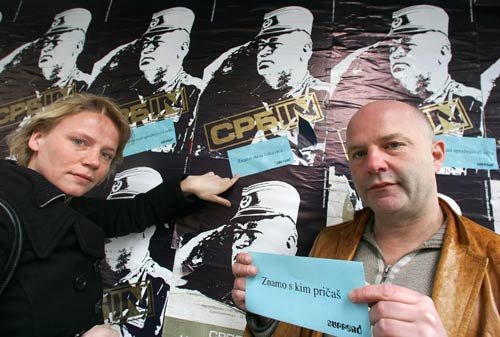
This week posters once more appeared in Belgrade with messages of support for genocide indictee Ratko Mladić, this time accompanied by claims that he is a "Serb." These ones were put up by the members of the cheeky neofascist group "Obraz." Danish artists Pia Bertelsen and Jan Egesborg (I may be misspelling their names, which I encountered in the rendering po Vuku) responded by adding a variety of slogans to the posters: "We know who you are talking to," "We know you have weak nerves," and "We know you are a coward."

2006-04-10

Signs of the times?

So the French government has responded to irresistible pressure by withdrawing its proposed law permitting labor discrimination, and it looks like Romano Prodi will be forming the next Italian government. And we finished our taxes in record time and visited our friends in quaint Portsmouth, New Hampshire, where we had some of the best pizza this side of Buenos Aires. Don't let the good times get you down, ah?

2006-04-06

Cosa ho nella testa

Since Mrs Ethnia and I have launched into our new translation hobby, nuances of meaning and ways in which they can be magnified are apparent to us more than they are usually. Which makes me wonder whether the reporter used the only way possible of rendering this. Somehow I expect the answer is yes, after all.

2006-04-05

And now the sergeant will tell us his dream

Admit that you always thought that there were unexplored connections between Slobodan Milošević and Luis Buñuel. Edin Hajdarpašić explains why.

Communication with the public

B92 is reporting that Florence Hartmann, spokesperson for the ICTY prosecutor, has been removed from her position. No confirmation or word as to why, or on the question of who might replace her.

Update: Rumor is her role will be assumed by Anton Nikiforov, up to now a diplomatic advisor at OTP.

2006-04-01

Nema te 100 godina bre

I am getting to the end of an insanely busy period, the beginning of which coincided with the Blogger meltdown in early March. Expect regular posting to resume in the next couple of days. Aside from travel, regular work-type work, and nonwork-type work, Mrs Ethnia and I have been working on a book translation which has to be done today. A part of that translation is the introductory poem, which was a pretty difficult piece of work. We are pretty well pleased with how it turned out (must work on emulating rhythm, however), though Mrs Ethnia is fonder of the poem itself than I am. For your pleasure, the original followed by our translation:
Momčilo Nastasijević
MISAO

1
Tišinom čudno
sve mi zasvetli, -
krilata pohodi me ona.
Nerođenih zora
zapoju mi petli;
sa dna iskon-mora
potonula, čujem, bruje zvona.

2
Raduj se,
svemu si spona,
pokoji u tebi svi žive.
I duša
tuzi što sklona,
i prazninom što
dani zasive,-
u pohode to sprema ti se ona.

3
I čudom,
u neprohod me spletu,
putanje isprave se krive;
i radosnica suza
orosi me kam.

4
I kroz golet me, u mahu,
dah zastruji aprila.
U samoći to
ne ostadoh sam:
tajno je kroz potaje moje, znam,
noga njena bila.

5
I nespokoji
u pokoj svi ožive.
Sa bezdan sa izvora
Poteku vode svete.
Blage od srca srcu
vesti polete.

6
Mreži to, i pauku,
zlosluto što je plete,
prisniva se svila.
Duši to,
svetli za let,
tajno izrastaju krila.

7
Tišinom čudno
sve mi zasvetli,-
krilata pohodi me ona.
Nerođenih zora
zapoju mi petli;
sa dna iskon-mora
potonula, čujem, bruje zvona.


Momčilo Nastasijević
THOUGHT

1
Silently, strangely
everything lights up for me,
winged she pursues me.
Of unborn dawns
roosters crow to me;
from the depths of ancient seas
sunken bells tolling I hear

2
Rejoice,
You bring together every thing
all the peace lives in you.
And the soul
inclined to sorrow,
with days graying
from emptiness,
awaits your attendance.

3
And miraculously,
though tangled where I cannot pass,
twisted paths straighten out;
and tears of joy
soften the stone

4.
And through the cliff, at once,
the breath of April streams.
In that loneliness
I did not remain alone:
Secretly through my hiding places, I know,
her foot has crossed.

5
And all my troubles
come alive in tranquility.
From abysses, from springs
holy waters course.
From heart to heart
the gentle message flies

6
To the web, and to the spider,
who weaves it with dread
dreams of silk appear.
To the soul,
lit up for flight,
wings sprout unknown.

7
Silently, strangely
everything lights up for me,
winged she pursues me.
Of unborn dawns
roosters crow to me;
from the depths of ancient seas
sunken bells tolling I hear

2006-03-22

Hope for conspiracy theorists

If the antibiotic thing did not work out, try this: Slobodan Milošević is alive and well and living in Illinois. However, he wants to change his name to Brad Pitt.

2006-03-18

In the event anyone should succeed in getting this page

Yes, I do know that the problems with Blogger seem to continuing. I cannot get East Ethnia to load myself, despite my powerful connections. Presumably they will be able to fix this at some point, but in the meantime I am headed off for a trip. If everything is up and running, your regular service ought to resume here on Wednesday.

2006-03-17

While you were away

Blogger seems to have been having some difficulty, with any luck whatever problem there was has been resolved.

Today has turned out to be a bad day for conspiracy theorists. An autopsy of Slobodan Milošević did not find traces of the drug about which everybody has been speculating. On the other hand, this may turn out to be just fine for conspiracy theorists. It has also been a bad day for museum directors, who can apparently be overruled on the question of what exhibit from the general interest area of necrophilia can be placed in their institutions.

For everything else around questions of burials, memorials and museumgoing, Viktor is keeping the world posted (with illustrations!). Highlights: the death announcement from the symbolic Ćurčići in Politika, and photos.

2006-03-15

Požarevac: The trouble with Harry


The Body of Evidence couldn't make it to Moscow. Belgrade doesn't want it, the government won't recognise it, and the military won't honor it. There is concern in the cemeteries that it may end up near the bodies of decent people. So the family has decided to bury it on their own property in Požarevac.

Reports of mourning aside, not all citizens are happy to rejoined by the dictator they removed. Have a look at the comments (219 of them and counting) on B92. There is talk of an "anti-burial" to coincide with the autoamnesty festival on Saturday (see the announcement reproduced on Viktor's Belgrade Blog). SPS is failing in its effort to organize a public viewing. The parties of the old regime are threatening to bring down the government if they do not get symbolic satisfaction, and SPO is being invited to bring down the government if they do. Expect some ugliness on Saturday as the "two Serbias" meet again.

Meanwhile, the American far right radio host Rush Limbaugh has made his own contribution to the flowering of conspiracy theories. Clinton killed him, por supuesto.

Illustration: Predrag Koraksić in Danas, 13 March.

2006-03-13

2006-03-12

Questions about Milošević's death

A bit of a controversy is brewing over the causes of the death of Slobodan Milošević. While it is far from rare, given a combination of preexisting conditions, stress, and unhealthy habits, that a person's health should fail, much is being made of the fact that Mr Milošević should have passed just at the time that his trial was (or, possibly, was not) nearing the end of oral presentations of evidence. So his death has given rise to a number of conspiracy theories. None of these are based on anything like reliable evidence, and some of them may be products of how the various conspiracy theorists think the trial was going.

The people who believe that the prosecution was well on the way to a conviction (most prominent among them, the prosecutor) have raised the possibility that the accused may have committed suicide. There are two versions of the story in the rumours: one is that he refused the medication he was given for high blood pressure, as suggested by the Russian physician with whom he consulted, Dr Leo Bokeria. Another is that he may have been (surreptitiously) taking another medication to counteract the effects of the blood pressure medication which was prescribed to him, which is being suggested (we do not know yet on the basis of what source) by the journalist Heikelina Verrijn Stuart. The center of the controversy is around an unconfirmed report from an anonymous source, claiming that an unspecified drug used to treat leprosy had been found in Mr Milošević's blood.

If the report of an unspecified drug is true, Mr Milošević's supporters have their own version of the story of how it got there. His legal counselor Zdenko Tomanović told reporters that Mr Milošević had written to Russian diplomats the day before his death, mentioning a mysterious drug and raising suspicions that his doctors may have been poisoning him. So in this version (promoted by people who believe that the prosecution's case had been going badly), he was killed by poison, presumably either to silence him or to avoid an acquittal.

Conspiracy theories are productive! So choose your version, was he poisoned, and if so by whom? Did he gamble with his health and lose? Did he commit suicide and invent a poisoning cover story? Was somebody else poisoning him? There is enough material for a soap opera to continue into several installments here, and as yet none of the reports of strange drugs having been found are confirmed.

There are clear advantages to the Milošević camp in continuing to level charges against the medical and prison staff engaged by ICTY, and of course it is entirely possible that some charges are valid and some are not. If it is the case that Mr Milošević was refusing medication, the consequences of this are entirely his own doing. If it turns out that somebody not on the medical staff was bringing him drugs, this complicates the story, but still hardly reflects well on the management of the ICTY detention facility.

Then there is the whole appalling symbolic framework: Mr Milošević built his political movement on the ideological trade in dead bodies from the past, now he has become a commodity in that trade. This discussion develops three years to the day after the death of Zoran Đinđić, who was indisputably murdered, we know by whom and for whom.

2006-03-11

Finally, the post-Milošević era

Just some initial thoughts on the passing of Slobodan Milošević. First, it probably does not change the political situation in Serbia much. His influence had been declining since well before he left power, and as the independent activity of the groups he created indicates (for example, the murder of Zoran Đinđić a day short of three years ago, the continuing march of SRS through the institutions), very little depended on him.

The news is probably good news for Serbia, which will be hostage to one person fewer. It is also good news for SPS, which might now have the possibility (under the condition that it restructures meaningfully) to follow the example of the other parties in the region that once held a monopoly of power, and become a functional political party.

It is bad news for ICTY, for several reasons. One is that the detention facility will find it hard to escape a reputation for ineptitude. The main reason, though, is that the Tribunal will complete its activity without having completed its most important trial. The decisions which led to a frequently interrupted trial lasting years will be questioned far into the future, and will probably be used as a negative example for future tribunals.

The fact that a verdict will not be reached in the Milošević trial is bad news for everybody.

Finally, while anybody's death is a cause for regret, what is to be regretted most about Milošević is that during his life, he was able to take so many other people down with him.

Waiting for details on Milošević death

Other agencies are beginning to report the news of the death of Milošević: BBC, AP . There are no reports yet of the causes, but B92 reports that they expect a report from ICTY in about a half hour.

No details or confirmation

B92 is reporting that Slobodan Milošević has died.

2006-03-09

The ICJ genocide trial, 3: Does the court have jurisdiction?

The outcome of the case may turn on the technical question of whether ICJ has the authority to try the charges at all. Remember that the parties to the suit (as it now stands) are two countries: Bosnia and Hercegovina is the plaintiff, and the State Union of Serbia and Montenegro is the respondent. Neither of these states existed in the form they exist now when the lawsuit was filed in 1993. Bosnia and Hercegovina in its present form, as a federal republic made up of two entities, was established by the Dayton Accords in 1995. Serbia and Montenegro came into existence with the agreement of the Constitutional Charter in 2003. The question of the authority of the court depends in large measure on whether the two presently existing states claim, or can be compelled by law to assume, successor status with the states that existed in 1993. There is a further question of whether the states that are currently parties to the suit actually represent the parties to the conflict at the time the suit was filed.

One of the strongest potential legal arguments was presented for the defence by Tibor Varady (this was a strategy that Mr Varady announced well in advance). He argued that since ICJ had declared in 2004 that it did not have jurisdiction in the suit filed by SRJ against NATO regarding the 1999 bombing campaign (SRJ charged the NATO countries with genocide, which would seem to weaken SCG advocate Stojanović's argument for a narrow application of the definition of genocide), it could not have jurisdiction in this case. What ICJ found in 2004 was that since SRJ was not a member of the United Nations at the time that it filed the suit (it was admitted to membership on 1 November 2000), it did not have standing to file a suit before ICJ. Mr Varady argues that the court should apply the same standard to all cases involving SRJ between 1992 and 2000.

There are some problems with the argument. The first is that in a separate decision in 2003, ICJ specifically excluded this argument. The second is that Article 9 of the Genocide Convention specifically names the ICJ as the venue for disputes over genocide (Why then did it decline to hear the case gainst NATO? Although formally ICJ did not rule on the merits of the case, this may have been a roundabout way of finding that it was clearly not a genocide case). It might be argued that a double standard is at work here, but if so it is a standard that argues that a state must be a party to the ICJ statute in order to initiate proceedings, but not in order to be held to the law. However, it seems as though there is enough vagueness in the rules that there may still be a window through which Mr Varady's argument might be accepted.

Then there is the question of succession: is today's state of SCG the same as the state of SRJ which was sued in 1993? Mr Stojanović argued that crimes were committed by a regime which was neither democratic nor representative, and added that it was more appropriate that individuals be tried for these crimes before ICTY and national courts than for a state to be called to respond. However, this argument runs counter to an established practice by which governments inherit the obligations of their predecessors (which is why a democratic Germany which has nothing in common with the Nazi regime continues to compensate victims of the Nazis, and a modern Turkish state finds itself repeatedly drawn into polemics over the genocide of Armenians by the Ottoman Empire).

Another question of succession has been raised obliquely by the defence, in the argument by counsel Saša Obradović. He pointed to the 24,216 victims of Serb nationality in Bosnia-Hercegovina identified by the Research and Documentation Center, and asked whether they were being represented by the plaintiff's attorneys. Mr Obradović failed to argue for the importance of this point, so I will do it for him: to the degree that he points to victims of more than one nationality, the argument calls into question whether there was a targeted "group" as required by Article 2 of the Genocide Convention, and to the degree that he points to military as well as civilian casualties in BH, the argument raises the question of whether the events can be qualified as genocide or civil war. If somebody bothers to make the argument, which is based on the multiethnicity of perpetrators and victims, it might be the strongest point that can be made against the applicability of the Genocide Convention. Though as I have argued before, this strategy amounts to denying genocide by admitting to crimes against humanity.

I am not sure that I can predict how the ICJ is likely to rule on the question of its own jurisdiction (in any case, I do not have to make a prediction -- we will find out soon enough). In a sort of enigmatic interview, presiding judge Rosalyn Higgins gave a fairly loose interpretation of how much she thinks the court is bound by precedent. My feeling is that after so many years, and given the inconsistency of the arguments offered by SCG, the judges will feel obligated to decide on the merits on the case. If so, that will mean that they cannot avoid setting a major precedent related to the legal definition of genocide.

The ICJ genocide trial, 2: Was there a policy?

There is certainly a lot to be added to the first installment, on the question of whether genocide took place, and I invite people to take up the question in the comments (for the sake of people who might be looking this up in the future, I will ask people to be sure that their comment gets posted to the topic to which it pertains). For now, I want to take up the next question, which is whether genocide, if it is shown to have occurred, was the result of policy on the part of SRJ.

In a way, the question is at least a little bit circular: the "intent" provision of the Genocide Convention is most often interpreted as meaning that there cannot be a genocide without a policy. But there are two problems that immediately come forward here:

1) Even where a policy exists, it is very rare that this policy is stated in a conventional way that allows for documentation. The documentation of the Wannsee Conference (1942), for example, while it is usually taken as evidence of the announcement by the Nazis of the "Final Solution," is in fact vague on the question of what, other than deportation, this "solution" would entail (and its report was not a published document). Even the centrality of the Wannsee Conference is disputed: Christian Gerlach, for example, argues that a recently found document is more determinative and sets an earlier date. I am not about to resolve this historians' dispute -- what I want to point out out is that the dispute indicates a problem, which is that decisions to commit genocide do not lend themselves to documentation and publicity. The Nazi case takes place in the context of a regime which was sure of its power at the time and held closely to bureaucratic form, conditions which do not apply to the states of the former Yugoslavia. Even in Rwanda, where there is plentiful evidence of intent, this evidence takes the form of media material. There are no parliamentary resolutions or (written) executive decrees. So any evidence related to the existence of a policy has to be indirect.

2) To the extent that a policy can be said to have existed, there remains the question of whose policy it was. In the strictest bureaucratic sense, Serbia and the Serb parastate in Bosnia-Hercegovina were separate entities. To further complicate the matter, many of the worst atrocities were carried out by paramilitary groups (White Eagles, Tigers, Scorpions, and other critters) which had no legal status. The core of the case presented by the BiH advocates lies in demonstrating the ways in which all of these elements were connected. These are all facts that, in the parlance, "everybody knows," but that sort of qualification does not necessarily reach the required standard of legal proof. Alain Pellet of the BiH legal team himself raised the possibility that SRJ may have been "merely" an accomplice rather than a direct participant with intent in the genocide. But he raised this possibility more or less as a null hypothesis, in the process of attempting to show that the military and police forces of RS were "totally dependent on SRJ and have to be considered as organs of SRJ." Here, too, the evidence has to be indirect: the strategy depends on showing logistical, command and financial links between SRJ institutions and perpetrators.

Demonstrating links was the central concern of BiH attorney Magda Karagianakis, who spoke of the role of the Serbian interior ministry in training, arming and commanding the RS military (VRS) and paramilitaries. One well known example was broadcast to great publicity last year: the video recording showing prisoners who had been taken by the military being executed by members of a paramiltary unit. In addition to evidence from the plaintiffs' attorneys showing that VRS was financed directly by the regime in Belgrade, there remains Slobodan Milošević's interesting complaint at the time of his initial arrest, in which he denied that he had taken money missing from the state budget for personal or party use, claiming instead:
"As for the resources spent for weapons, ammunition and other needs of the Army of Republika Srpska and of Republika Srpske Krajine, those tasks for reasons of state, as a state secret, could not be shown in the budget, which is a public document. The same applies to appropriations for the supply of security forces, and especially the special antiterrorist forces --"from needles to locomotives" -- from light weaponry and equipment to helicopters and other resources which remain in place, and which were not revealed to the public for reasons of state secrecy."
Similarly, the ongoing financial relations between the legal military and Ratko Mladić raises the issue of how close the informal contacts between institutions were, as do more recent revelations of the connections between state security and paramilitary groups. These sorts of statements and findings do not offer a high level of precision, but a lot of them cumulatively contribute to an argument that a variety of forces operated with a shared goal, and with some level of coordination.

The defence has a number of potential answers to arguments along these lines. One would be that in a war atmosphere characterised by general criminality and confusion, chains of command did not function (a similar argument is offered by Kosta Čavoški on behalf of Radovan Karadžić, but it will not help in this case -- he tries to shift blame to Milošević by way of Mladić). Another would be that the interior ministry and its forces represented rogue elements not controlled by state policy, but this argument faces the problem of finding more rogue than nonrogue elements as it develops the theory. On his first day of presentation, SCG advocate Radoslav Stojanović argued for a separation between the actions of the Milošević regime and the interests of the state and its citizens. This argument may have considerable political validity but it is not clear that it can translate to a legal argument.

My assessment would be that if ICJ finds that genocide took place, it will be hard for them not to find also that there existed a policy in which SRJ was engaged.

2006-03-08

The ICJ genocide trial, 1: Did genocide occur?

There are several competing definitions of genocide in the academic literature. The term originates with the work of the lawyer Raphael Lemkin, who had the Nazi genocide specifically in mind when he developed the concept. He intended, however, both to account for similar historical experiences of which he was aware (the Armenian genocide, for example), and to produce a concept exhaustive enough to serve as a basis for prevention (Lemkin includes in his work sections on "cultural genocide," "religious genocide" and "moral genocide," for example). His broad definition sees genocide as directed toward:
"disintegration of the political and social institutions, of culture, language, national feelings, religion, and the economic existence of national groups, and the destruction of the personal security, liberty, health, dignity, and even the lives of the individuals belonging to such groups" (R. Lemkin, "Genocide," in A.L. Hinton [ed.], Genocide: An Anthropological Reader. Oxford and Malden: Blackwell, 2002, p. 27).
One of the results of Lemkin's engagement was the passage by the United Nations of the Convention on the Prevention and Punishment of the Crime of Genocide (popularly, the "Genocide Convention") in 1948. After considerable debate, the UN General Assembly opted for a definition which would exclude the categories of "cultural," "religious" and "moral" genocide, and which concentrated on physical destruction of people instead. The UN definition also narrowed the potential categories of victims, excluding, for example, political groups. The relevant part of the definition is in Article 2:
In the present Convention, genocide means any of the following acts committed with intent to destroy, in whole or in part, a national, ethnical, racial or religious group, as such:

(a) Killing members of the group;
(b) Causing serious bodily or mental harm to members of the group;
(c) Deliberately inflicting on the group conditions of life calculated to bring about its physical destruction in whole or in part;
(d) Imposing measures intended to prevent births within the group;
(e) Forcibly transferring children of the group to another group.
The UN definition is the topic of a good deal of legitimate controversy, mostly because of what it excludes -- but it is the only legal definition that exists in international law, and so it is the one that has to be used. Large scale killings which fall outside of the definition can be treated a number of ways. Some researchers have proposed definitions like "democide" and "politicide," which might be useful analytically but are not legal terms. One legal term which may apply to serious cases outside the scope of the Genocide Convention is "crimes against humanity," which the Nuremberg Charter (1945) defined as including "murder, extermination, enslavement, deportation, and other inhumane acts committed against civilian populations." The most current definition of "crimes against humanity" is in the Rome Statute of the International Criminal Court, where Article 7 paragraph 1 enumerates:
1. For the purpose of this Statute, "crime against humanity" means any of the following acts when committed as part of a widespread or systematic attack directed against any civilian population, with knowledge of the attack:

(a) Murder;
(b) Extermination;
(c) Enslavement;
(d) Deportation or forcible transfer of population;
(e) Imprisonment or other severe deprivation of physical liberty in violation of fundamental rules of international law;
(f) Torture;
(g) Rape, sexual slavery, enforced prostitution, forced pregnancy, enforced sterilization, or any other form of sexual violence of comparable gravity;
(h) Persecution against any identifiable group or collectivity on political, racial, national, ethnic, cultural, religious, gender as defined in paragraph 3, or other grounds that are universally recognized as impermissible under international law, in connection with any act referred to in this paragraph or any crime within the jurisdiction of the Court;
(i) Enforced disappearance of persons;
(j) The crime of apartheid;
(k) Other inhumane acts of a similar character intentionally causing great suffering, or serious injury to body or to mental or physical health.
I have not included paragraphs 2 and 3, which clarify terms in paragraph 1, but you can find those yourselves by following the link. One legitimate question that might be asked could be whether the distinction between "crimes against humanity" and "genocide" is all that important, since there is considerable overlap between the two. I am inclined to think that the distinction is on the one hand symbolic, like the difference between labelling a crime "really really bad" and "really really really bad," and that on the other hand it is related to political issues, as there is a greater moral claim associated with the status of being a victim of genocide. But I have no doubt that a great number of lawyers and human rights activists will disagree with me on this point (which they are certainly welcome to do).

All of this may seem like a huge digression, but it comes down to this: no reasonable person denies that a lot of murdering was carried out in Bosnia-Hercegovina, and that a majority of the victims were from one ethnic group. What is in dispute is whether this can be legally defined as genocide, or as something else.

The debate is going to turn in large measure on interpretations of legal terms. In particular, it will turn on the question of whether there was an "intent to destroy" a group, and on how big a "part" has to be to meet the standard of "in whole or in part." The requirement of "intent" means that the plaintiffs have to show that destruction was a matter of policy, while the defendants will argue that destruction was a consequence of a particularly nasty war. Numbers or scale may not be so important: the first criminal conviction to be handed down by an international tribunal on charges of genocide (in 1998) was against a Rwandan mayor, Jean-Paul Akayesu. Convictions against national officials came later. The precedent would seem to suggest that destruction on a national or international scale, as occurred in the Nazi genocide, is not necessary in order for a finding of genocide to be made.

For an idea of why this matters, it might be useful to recall a famous example of evasion: this exchange took place between journalist Alan Elsner and State Department spokeswoman Christine Shelly during the Rwandan genocide on 10 June 1994:
Q How would you describe the events taking place in Rwanda?

MS. SHELLY: Based on the evidence we have seen from observations on the ground, we have every reason to believe that acts of genocide have occurred in Rwanda.

Q What's the difference between "acts of genocide" and "genocide?"

MS. SHELLY: As you know, there is a legal definition of this. There has been a lot of discussion about how the definition applies under the definition of "genocide" contained in the 1948 convention. If you're looking at that for your determination about genocide, clearly, not all of the killings that have taken place in Rwanda are killings to which you might apply that label.

Some of the difficulties over actually arriving at a definition of "genocide" and formulations on genocide are the reasons why -- particularly, in late May, the U.N. Human Rights Commission, with the very strong support by the United States, appointed a Special Rapporteur for Rwanda, specifically to compile the information on possible violations of human rights and on acts which constitute breaches of international humanitarian law and crimes against humanity, including acts of genocide.

His preliminary report, which is due later this month, will provide the additional information about the human rights violations -- the types, and presumably how they might be characterized -- and that is something that we have to wait for.

As to the distinctions between the words, we're trying to call. What we have seen so far, as best as we can, and based, again, on the evidence, we have every reason to believe that acts of genocide have occurred.

Q How many acts of genocide does it take to make genocide?

MS. SHELLY: Alan, that's just not a question that I'm in a position to answer.

Q Well, is it true that you have specific guidance not to use the word "genocide" in isolation but always to preface it with these words "acts of"?

MS. SHELLY: I have guidance which I try to use as best as I can. There are formulations that we are using that we are trying to be consistent of our use of. I don't have an absolute categorical prescription against something, but I have the definitions. I have phraseology which has been carefully examined and arrived at as best as we can apply to exactly the situation and the actions which have taken place.
Thomas Franck of the BiH legal team has put the argument that the events amount to genocide in terms of a thesis that the type and scale of crimes, as well as the similarity of several events to one another, are evidence that what occurred was not a set of isolated incidents but a part of a strategic plan (for which there exists indirect evidence -- more on this in the following post). It is not yet clear how SCG representatives will argue against the applicability of the Genocide Convention. So far they are off to a weak start, arguing that the numbers and descriptions in the complaint by BiH are exaggerated. If they want to confront the arguments presented by the plaintiffs so far, they will have to present a position on the questions of organization and intent.

The ICJ genocide trial: Introductory notes

There would seem to be two issues that really matter in the dispute between Bosnia-Hercegovina and Serbia and Montenegro which is currently being heard by the International Court of Justice (ICJ). These are:
1) Did genocide occur in Bosnia-Hercegovina?, and
2) If there was genocide, was it a result of policy on the part of the Federal Republic of Yugoslavia (SRJ)?
Then there is a third question which, while it is of interest primarily to lawyers of a certain type, may determine the outcome of the proceedings, which is:
3) Does the court have the authority to try the case?
Then there is a question which is not a legal one at all, but might be the one that is most interesting to people following the case, which is:
4) What would be the political consequences of a guilty verdict?
I doubt very much that I can give definitive answers to any of these four questions, but I think I can try to give a picture of some of the issues that will have to be considered along the way to an answer. First, an observation -- the issues at stake are at bottom political issues, and judicial institutions do not necessarily provide the best forum for political issues to be resolved. However, when there is a lack of will on the part of political institutions, this may be the only forum available. In that context, I feel confident in making a prediction: no matter what the outcome, very few people will be satisfied.

Having said that, let me see whether I can shed any light on the questions, one by one. I will be posting short essays related to each of the questions in a series of four posts. A word of caution: although I do own a briefcase, I am not a lawyer. Merely a talented amateur, like Emma Peel.