Whoever says crime doesn't pay needs to review the stats. A pompezni sendoff and a shiny new Czech automobile wasn't enough to smooth the path of Vladimir Lazarević to his retirement home on the North Sea. He also got a budget outlay of around a half million Euros. The government is now defending itself by saying it hasn't actually cut the check. A peek at the readers' comments section of the B92 site gives a variety of reactions, among them the delightfully phonetic "Čizs krajst."
Update: Finance minister Mladjan Dinkić is claiming that a clerical error is in question, and that the appropriation was meant to be not just for Mr Lazarević but for all of the ICTY detainees the government is paying off. Even if his claim is true, the thesis stands.
2005-07-20


Corporate identity
Eleven British soldiers have been charged under the statute (whatever that means) of the International Criminal Court (ICC) with war crimes in Iraq and are to stand trial in Britain. Sky News, which I've started watching during the London bombing inquiry because they reported rumors and speculations much more quickly than the BBC, which still often behaves as the moutpiece of Her Majesty's Government, carried the news this morning accompanied by pictures of, you guessed it, the International Criminal Tribunal for former Yugoslavia, or ICTY, also in The Hague. To complete the confusion, The Hague is also host to the International Court of Justice, or ICJ; if I remember correctly, Boris Tadić referred to the ICJ when he should have mentioned the ICTY in remarks to the press he made last week.
If the president of a country that has a lot of business with the ICTY and the ICJ can't keep them apart, what are we mere mortals to do? The least they could do is, as a matter of urgency, to move two of the three to, say, Cork and Riga, if it has to be in Europe at all. Any other suggestions?
If the president of a country that has a lot of business with the ICTY and the ICJ can't keep them apart, what are we mere mortals to do? The least they could do is, as a matter of urgency, to move two of the three to, say, Cork and Riga, if it has to be in Europe at all. Any other suggestions?
2005-07-19
Super special guest post! Maniac Shop on the Exit festival! Nowhere but East Ethnia!
Note: Thanks to Maniac Shop for the update. If anyone wants an English translation, look at the comments.
MANIAC SHOP for EAST ETHNIA
EXIT 05


Ovogodisnji EXIT je, kao uoastalom i svi prethodni, bio po svemu NAJ. Najveci broj izvodjaca, navjise bina, najvise posetilaca, najludji provod. Od 7. do 10. jula masa muzicara uveseljavala je masu ljudi koja je, usput, popila i masu piva. Sve u svemu bilo je odlicno. Niceg nije nedostajalo, pa ni kise. Bili su tu i BBC Radio 1 koji je prenosio koncerte, i MTV-ovci koji su nastavili sa snimanjem filma o festivalu. Sto ova multikulturalna humanitarna manifestacija svakako zasluzuje, buduci da vec neko vreme vazi za jedan od 4 najvaznija muzicka festivala u Evropi, barem po izjavama ovih iz BBC-a (a sta oni pa znaju). Na sajtu festivala www.exitfest.org se nalaze spiskovi svih grupa i pojedinaca koji su nastupali, a od zvucnijih imena treba pomenuti Ian Brown, Garbage, Underworld, Carl Cox, Fatboy Slim, White Stripes.


Humanitarna (ili humanisticka) crta cele stvari je ove godine trebala da bude ostvarena gestom odavanja pocasti zrtvama genocida u Srebrenici, prekidom programa na par minuta, u ponoc, 10. jula. Barem je tako bilo najavljeno od strane organizatora festivala. Ubrzo je usledila reakcija (a koga drugog) radikala, trenutno na vlasti u Novom Sadu, gradu koji omogućuje postojanje EXIT-a, uz izjavu njihovog zamenika prvog coveka Tome Nikolica da, kao, ako se to desi, sledeceg EXIT-a nece biti. Kao, nije u redu jednu takvu manifestaciju, gde se mladi druze, zabavljaju i igraju, tako bezocno zloupotrebljavati i odavanjem poste zrtvama Srebrenice ispolitizovati celu stvar!? Yea, right...davanje pomena pobijenima u ratu je politizacija. Nije pomoglo ni to sto se odustalo od prvobitne namere da se pomenu SVA stratista, na svim stranama, i izjava zamenila pesmom koju bi otpevala Eni Lenox, organizatori su ustuknuli i i stvar je propala. Radikali bi se mogli naci i sledece godine na vlasti, i tako...


Ali ako ostavimo po strani izopacene radikalske umove, ostaje porazavajuca cinjenica, koja se lako moze utvrditi posmatranjem javnog mnjenja u Srbiji, i kojom su se, verujem, vodili i organizatori festivala kada su se povukli iz konfrontacije sa pretnjama, da svest u vecine Srba nije spremna na katarzu.
Ko zna, mozda na EXIT 10 cujemo pesmu Lenoxove ili neku ljudsku rec. Ako ga bude bilo.
Written by http://maniac.blog.hr

MANIAC SHOP for EAST ETHNIA
EXIT 05
Ovogodisnji EXIT je, kao uoastalom i svi prethodni, bio po svemu NAJ. Najveci broj izvodjaca, navjise bina, najvise posetilaca, najludji provod. Od 7. do 10. jula masa muzicara uveseljavala je masu ljudi koja je, usput, popila i masu piva. Sve u svemu bilo je odlicno. Niceg nije nedostajalo, pa ni kise. Bili su tu i BBC Radio 1 koji je prenosio koncerte, i MTV-ovci koji su nastavili sa snimanjem filma o festivalu. Sto ova multikulturalna humanitarna manifestacija svakako zasluzuje, buduci da vec neko vreme vazi za jedan od 4 najvaznija muzicka festivala u Evropi, barem po izjavama ovih iz BBC-a (a sta oni pa znaju). Na sajtu festivala www.exitfest.org se nalaze spiskovi svih grupa i pojedinaca koji su nastupali, a od zvucnijih imena treba pomenuti Ian Brown, Garbage, Underworld, Carl Cox, Fatboy Slim, White Stripes.
Humanitarna (ili humanisticka) crta cele stvari je ove godine trebala da bude ostvarena gestom odavanja pocasti zrtvama genocida u Srebrenici, prekidom programa na par minuta, u ponoc, 10. jula. Barem je tako bilo najavljeno od strane organizatora festivala. Ubrzo je usledila reakcija (a koga drugog) radikala, trenutno na vlasti u Novom Sadu, gradu koji omogućuje postojanje EXIT-a, uz izjavu njihovog zamenika prvog coveka Tome Nikolica da, kao, ako se to desi, sledeceg EXIT-a nece biti. Kao, nije u redu jednu takvu manifestaciju, gde se mladi druze, zabavljaju i igraju, tako bezocno zloupotrebljavati i odavanjem poste zrtvama Srebrenice ispolitizovati celu stvar!? Yea, right...davanje pomena pobijenima u ratu je politizacija. Nije pomoglo ni to sto se odustalo od prvobitne namere da se pomenu SVA stratista, na svim stranama, i izjava zamenila pesmom koju bi otpevala Eni Lenox, organizatori su ustuknuli i i stvar je propala. Radikali bi se mogli naci i sledece godine na vlasti, i tako...
Ali ako ostavimo po strani izopacene radikalske umove, ostaje porazavajuca cinjenica, koja se lako moze utvrditi posmatranjem javnog mnjenja u Srbiji, i kojom su se, verujem, vodili i organizatori festivala kada su se povukli iz konfrontacije sa pretnjama, da svest u vecine Srba nije spremna na katarzu.
Ko zna, mozda na EXIT 10 cujemo pesmu Lenoxove ili neku ljudsku rec. Ako ga bude bilo.
Written by http://maniac.blog.hr
2005-07-18
Sentences for political murders
After a sentencing earlier this month for another another attempted murder of Vuk Drašković, today several members of the so-called «Unit for Special Operations» (JSO), together with former State Security chief Radomir Marković, were sentenced for another attempted murder of Drašković and the kidnapping and murder of Ivan Stambolić. Four members of JSO (including Milorad Ulemek) got maximum sentences of 40 years, while Radomir Marković got just 15. The JSO members were also required to return (to whom?) the money they were paid for their participation.
Slobodan Milošević and Nebojša Pavković were also named in the indictment, but spared trial because they were occupied elsewhere. This may be a logical move or may be, together with Marković's comparatively light sentence, taken as a sign that it still pays better to be a ranking member of a conspiracy than one of its employees.
Thanks to AR for the photos:

Milorad Ulemek takes a moment to wonder about the optometric services available in prison

Slobodan Milošević and Ivan Stambolić, in the days before Milošević had the power to order murders
Slobodan Milošević and Nebojša Pavković were also named in the indictment, but spared trial because they were occupied elsewhere. This may be a logical move or may be, together with Marković's comparatively light sentence, taken as a sign that it still pays better to be a ranking member of a conspiracy than one of its employees.
Thanks to AR for the photos:
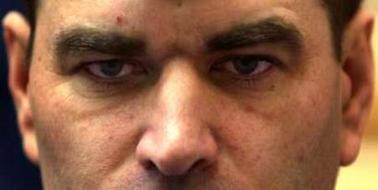
Milorad Ulemek takes a moment to wonder about the optometric services available in prison

Slobodan Milošević and Ivan Stambolić, in the days before Milošević had the power to order murders
Tracing the new quasilegal rhetoric
If it is true that the discussion in Serbia about Srebrenica—marginal and wholly instrumental participants left aside—has moved from dispute over the facts to dispute over whether the facts can be characterised as «genocide» or not, this needs to be explained. Some possible hypotheses:
1) The criminals know that they are losing both the legal and political terrain on which they have been claiming their heroism and innocence. So now they are using distance and surrogates to try to bargain over the verdict in advance.
2) In the preparation to make a public recognition of genocide as well, the familiar old faces are being trotted out for a last round of denial before their well-earned return to obscurity.
3) The issue is not about events but responsibility, namely the effort of the members of the criminal conspiracy to present their own responsibility as somebody else's, reducing the question of recognition to one of fear of consequences (On this point see the quasilegal reflections of the by no means uninterested party Ratko Marković on whether the criminal conspiracy in which he participated was a «regime» or a «state» in today's Večernje novosti.)
What makes the third possibility seem more likely is that it can be fully explained by events that are already known, and it does not require making predictions about events in the future.
1) The criminals know that they are losing both the legal and political terrain on which they have been claiming their heroism and innocence. So now they are using distance and surrogates to try to bargain over the verdict in advance.
2) In the preparation to make a public recognition of genocide as well, the familiar old faces are being trotted out for a last round of denial before their well-earned return to obscurity.
3) The issue is not about events but responsibility, namely the effort of the members of the criminal conspiracy to present their own responsibility as somebody else's, reducing the question of recognition to one of fear of consequences (On this point see the quasilegal reflections of the by no means uninterested party Ratko Marković on whether the criminal conspiracy in which he participated was a «regime» or a «state» in today's Večernje novosti.)
What makes the third possibility seem more likely is that it can be fully explained by events that are already known, and it does not require making predictions about events in the future.
2005-07-17
The beauty of blogging
The beauty of blogging is that it allows you to rant on without necessarily advancing our knowledge. Debating Holocaust deniers, for example, is such an exercise in futility since nobody serious can disagree about the key facts. That doesn't keep fools like Major General (ret.) Lewis MacKenzie -- who was nowhere near Bosnia in the summer of 1995 -- to declare that the massacre in the UN safe haven "was not a black and white event in which the Serbs were solely to blame." (He's right on that one -- I'd also blame the Dutch.) He doubts that more than a few thousand were murdered (which presumably would make it somehowe okay). He blames the Bosnian Muslims in Srebrenica for provoking the attack. He claims Naser Oric (whose name he misspells twice) was responsible for as many killed Serbs outside Srebrenica as the Bosnian Serbs were for killed Muslims inside the town. And he concludes, with admirable intellectual coherence, that the massacres couldn't possibly have been genocide because the Serbs let the kids and the women get away.
MacKenzie, of course, is a notorious revisionist who has been paid by Serb lobby groups for his fine work promoting their viewpoint. But I'm afraid that his views carry a certain weight with people on the far left who'd rather sacrifice a few thousand Muslims than allow any course of action that might result in an increase in U.S. power, or who compulsively dispute everything that is "fed" us by the "corporate" or "mainstream" media.
What I don't understand is how a fine paper like the Globe and Mail can give space to such lunatics. (By the way, it seems like you need a subscription to access the MacKenzie op-ed, but in a service to mankind another balanced news source has reproduced the piece on their website.)
MacKenzie, of course, is a notorious revisionist who has been paid by Serb lobby groups for his fine work promoting their viewpoint. But I'm afraid that his views carry a certain weight with people on the far left who'd rather sacrifice a few thousand Muslims than allow any course of action that might result in an increase in U.S. power, or who compulsively dispute everything that is "fed" us by the "corporate" or "mainstream" media.
What I don't understand is how a fine paper like the Globe and Mail can give space to such lunatics. (By the way, it seems like you need a subscription to access the MacKenzie op-ed, but in a service to mankind another balanced news source has reproduced the piece on their website.)
2005-07-12
Lesson 1 in autoamnesty
Having resigned his ministry in disgrace, Andrija Hebrang is turning to the former sociologist turned horsie spokesmodel Slaven Letica to score a few points with his country's far right. The two want to propose a declaration to be passed by the Croatian Sabor for the tenth anniversary of "operation Storm" declaring in retrospect it and everything that happened in it to have been legal. The reasoning is that the action was an "allied defense against terrorism."
Lesson 1 in autoamnesty: the amnesty should apply to charges. Hebrang and Letica are clearly influenced by their colleague Bozidar Delic, who told Hague prosecutors today that whatever he had done must have been legal because "we had the right to self defense." These kinds of statements work nicely for public opinion where the perception that ICTY defendants are being tried for having participated in war at all is popular. What was illegal in 1995 and 1999 and remains illegal now is the expulsion of civilian population: not the military action itself but its conduct.
Lesson 1 in autoamnesty: the amnesty should apply to charges. Hebrang and Letica are clearly influenced by their colleague Bozidar Delic, who told Hague prosecutors today that whatever he had done must have been legal because "we had the right to self defense." These kinds of statements work nicely for public opinion where the perception that ICTY defendants are being tried for having participated in war at all is popular. What was illegal in 1995 and 1999 and remains illegal now is the expulsion of civilian population: not the military action itself but its conduct.
Never again?
For those of you in Europe, be sure to check out Srebrenica: Never Again? by Leslie Woodhead, on tonight (12/7) at 10pm on BBC 4 and at 10:15 on Arte. For a brief blurb, check here.
2005-07-11
A word about genocide
Let's avoid falling into caricature. My little idyll with the fascists was unique. These are people who deprived of the extreme positions they take would have little else to keep them occupied. In any case, as their chants suggest, they do not exactly shy away from taking a few swigs of collective guilt (responsibility being a bit beside the point).
Their moderate wing is represented by the media that have never got out of the habit of safely endorsing them from afar. A case in point would be the tabloid most loyal to the old regime, Večernje novosti. Their approach in the past couple of weeks has been, to borrow the categories first articulated by Vojin Dimitrijević, to move from «denial of the fact» to «denial of the law.» However much they relativise (this was the paper that published the list of Serb victims last week), they are no longer openly contesting the version of events in Srebrenica which has been established by research and in open court.
Their approach now is to contest the qualification of the events as genocide. This ranges from citing politicians warning against the chimera that Serbs may be labelled as «a genocidal nation» — but enough of that, it is a category which, if it exists anywhere, does not exist in law: strictly for popular consumption. But twice in the last week they have run long interviews (both times on the top tabloid page 2) offering technical denials of genocide. First Smilja Avramov was quoted as accepting the facts but denying that it was genocide because «there was no intent.» Then today a young law professor, one Škulić, came foward with an argument that there was no genocide because only men over a certain age were murdered.
Take or leave the arguments: to my mind, they have a sophistic quality and while they might get by in a seminar room, the existing record of jurisprudence makes them untenable in a courtroom. But step back a bit, too — the strategy amounts to denying genocide by recognising crimes against humanity (of course it is not identified this way in Novosti). If all that is left is to test different legal theories against the facts, let the trials begin.
Their moderate wing is represented by the media that have never got out of the habit of safely endorsing them from afar. A case in point would be the tabloid most loyal to the old regime, Večernje novosti. Their approach in the past couple of weeks has been, to borrow the categories first articulated by Vojin Dimitrijević, to move from «denial of the fact» to «denial of the law.» However much they relativise (this was the paper that published the list of Serb victims last week), they are no longer openly contesting the version of events in Srebrenica which has been established by research and in open court.
Their approach now is to contest the qualification of the events as genocide. This ranges from citing politicians warning against the chimera that Serbs may be labelled as «a genocidal nation» — but enough of that, it is a category which, if it exists anywhere, does not exist in law: strictly for popular consumption. But twice in the last week they have run long interviews (both times on the top tabloid page 2) offering technical denials of genocide. First Smilja Avramov was quoted as accepting the facts but denying that it was genocide because «there was no intent.» Then today a young law professor, one Škulić, came foward with an argument that there was no genocide because only men over a certain age were murdered.
Take or leave the arguments: to my mind, they have a sophistic quality and while they might get by in a seminar room, the existing record of jurisprudence makes them untenable in a courtroom. But step back a bit, too — the strategy amounts to denying genocide by recognising crimes against humanity (of course it is not identified this way in Novosti). If all that is left is to test different legal theories against the facts, let the trials begin.
My fascist weekend
So you don't think the slow pace of posting has been an indication of inactivity. On Saturday I spent the afternoon with the Serbian Radical Party. They had a new film to present, called «Istina» («Truth»), meant to be their response to the onslaught of new information about crimes against humanity, war crimes and genocide in Bosnia. The event was held in the large cinema at Sava Centar, heavily advertised and an overflow crowd was assured by the lot full of buses from various provincial places bringing SRS supporters from places where their party is the only one with a local organisation to the city.
The ceremony began with speeches from the SRS leadership—a greeting sent by Vojislav Šešelj from the Hague, dramatically read by Aleksandar Vučić, the presentation of the usual scenographic bit players at right-wing events (the frail Patriarh Pavle, the diabolical Smilja Avramov, the former poets whose names nobody remembers). Then acting Radical-in-chief Tomislav Nikolić gave an outwardly conciliatory address recognising crimes and the need to punish them, but denying any uniqueness for the Serbian side. I thought that this was an interesting step forward for SRS, staking out a new position between denial and recognition which would place them in the spineless center of Serbian politics, but my friends persuaded me that this is the public face which SRS trots out every six months or so to hide the private face. Perhaps so, as they have put a good deal of effort into developing an outward surface which might resemble that of a legitimate political party.
The film itself offers little of interest. For the most part it is a new montage of propaganda clips that anybody who watched Serbian state television during the time when SRS and their allies controlled it already saw repeatedly between 1991 and 1995, and again for a period between 1998 and 2000. What new material there is has no source attribution. The film itself is not signed by an author. My own feeling was that the handpicked SRS audience was not particularly impressed either, as there was a lot of sidetalk, milling about, and complaint about the quality of production. If this is the right wing reply to the existing evidence, it may be an admission that they do not have replies.
On Sunday evening we went to the commemoration of Srebrenica victims which was organised in Belgrade by the feminist human rights group Žene u crnom, on the city's principal square. A circle of activists and supporters, mostly dressed in black, held white roses in a circle around a makeshift memorial of votive candles. Some held banners declaring «never again» in different languages, some held banners identifying them as visiting activists from other countries. There was a large and mostly disengaged police presence, in partial riot gear and doing nothing.
Around the perimeter milled a small group of spectators and a smaller group of local fascists. There were not many fascists, perhaps twenty or thirty, and several of them were faces that I recognised as regular provocateurs from previous public events. Most of them hung back away from the perimeter of the group while a few of them circulated around the perimeter shouting insults. At one point a group of them moved into the center of the circle, but were escorted out by a single police officer. At another point a group of them launched into some football-fan style chants—one of them threatening violence against human rights activist Nataša Kandić (who was there, of course), and another the increasingly familiar ominous rhyme «Nož, žica, Srebrenica» (literally it is not much—«knife, wire, Srebrenica»—but its intent is to threaten a reprise).
Then some of the fascists tossed a tear gas grenade into the center of the circle. The participants in the commemoration dispersed, the semisentient police did nothing that anybody could observe, and there was a brief moment of disruption. My wife and I ducked into the restroom of a coffee shop to wash our hands and rinse our eyes, and then everyone returned to their positions, the participants to the circle, the fascists to shout and toss things from the wings, and the police to discreetly and inactively stand at a few points between the two groups. The ceremony continued in deliberate silence, with some people coming to the center of the circle to light candles, then the participants to place their roses at the makeshift memorial (a paper sign at the top of the steps below the equestrian statue at the square). The police escorted the core activists and international visitors away, we hung back to chat with friends, and a friend bet that the memorial would remain in place five minutes. She was off by four and a half, a group of five young fascists immediately ran up the steps, ripped the memorial sign, and ran away.
My fascist weekend was less tragic than sad, a recurring meeting of incomprehension, incapacity and powerlessness. My wife and I went off to have drinks with our friends, raise a toast to our first (really!) taste of tear gas, and share our wonder. The old guard is finally in retreat, five years after kobajagi losing power. But there is no new guard, and if there were it would have a hard time finding anything to say, and if it had anything to say not many people would be willing to listen.
The ceremony began with speeches from the SRS leadership—a greeting sent by Vojislav Šešelj from the Hague, dramatically read by Aleksandar Vučić, the presentation of the usual scenographic bit players at right-wing events (the frail Patriarh Pavle, the diabolical Smilja Avramov, the former poets whose names nobody remembers). Then acting Radical-in-chief Tomislav Nikolić gave an outwardly conciliatory address recognising crimes and the need to punish them, but denying any uniqueness for the Serbian side. I thought that this was an interesting step forward for SRS, staking out a new position between denial and recognition which would place them in the spineless center of Serbian politics, but my friends persuaded me that this is the public face which SRS trots out every six months or so to hide the private face. Perhaps so, as they have put a good deal of effort into developing an outward surface which might resemble that of a legitimate political party.
The film itself offers little of interest. For the most part it is a new montage of propaganda clips that anybody who watched Serbian state television during the time when SRS and their allies controlled it already saw repeatedly between 1991 and 1995, and again for a period between 1998 and 2000. What new material there is has no source attribution. The film itself is not signed by an author. My own feeling was that the handpicked SRS audience was not particularly impressed either, as there was a lot of sidetalk, milling about, and complaint about the quality of production. If this is the right wing reply to the existing evidence, it may be an admission that they do not have replies.
On Sunday evening we went to the commemoration of Srebrenica victims which was organised in Belgrade by the feminist human rights group Žene u crnom, on the city's principal square. A circle of activists and supporters, mostly dressed in black, held white roses in a circle around a makeshift memorial of votive candles. Some held banners declaring «never again» in different languages, some held banners identifying them as visiting activists from other countries. There was a large and mostly disengaged police presence, in partial riot gear and doing nothing.
Around the perimeter milled a small group of spectators and a smaller group of local fascists. There were not many fascists, perhaps twenty or thirty, and several of them were faces that I recognised as regular provocateurs from previous public events. Most of them hung back away from the perimeter of the group while a few of them circulated around the perimeter shouting insults. At one point a group of them moved into the center of the circle, but were escorted out by a single police officer. At another point a group of them launched into some football-fan style chants—one of them threatening violence against human rights activist Nataša Kandić (who was there, of course), and another the increasingly familiar ominous rhyme «Nož, žica, Srebrenica» (literally it is not much—«knife, wire, Srebrenica»—but its intent is to threaten a reprise).
Then some of the fascists tossed a tear gas grenade into the center of the circle. The participants in the commemoration dispersed, the semisentient police did nothing that anybody could observe, and there was a brief moment of disruption. My wife and I ducked into the restroom of a coffee shop to wash our hands and rinse our eyes, and then everyone returned to their positions, the participants to the circle, the fascists to shout and toss things from the wings, and the police to discreetly and inactively stand at a few points between the two groups. The ceremony continued in deliberate silence, with some people coming to the center of the circle to light candles, then the participants to place their roses at the makeshift memorial (a paper sign at the top of the steps below the equestrian statue at the square). The police escorted the core activists and international visitors away, we hung back to chat with friends, and a friend bet that the memorial would remain in place five minutes. She was off by four and a half, a group of five young fascists immediately ran up the steps, ripped the memorial sign, and ran away.
My fascist weekend was less tragic than sad, a recurring meeting of incomprehension, incapacity and powerlessness. My wife and I went off to have drinks with our friends, raise a toast to our first (really!) taste of tear gas, and share our wonder. The old guard is finally in retreat, five years after kobajagi losing power. But there is no new guard, and if there were it would have a hard time finding anything to say, and if it had anything to say not many people would be willing to listen.
2005-07-09
"Well, nothing. They listen to music."
A dear friend whose father was an intelligence officer told me about the day in the early 1980s when he decided to cut his hair short and get an earring. His father asked about among the intelligence folk, and determined that he "was either an anarchist or a punker." About anarchists everything is more or less known, yes, but what was up with this new category of "punker"? The answer among the intelligence officers was "well, nothing. They listen to music."
These days the fifth annual Exit festival in Novi Sad is under way. It is the biggest cultural event in the city and the only festival in Serbia that consistently attracts a large crowd of visitors from around the world. The concert lineup gets better every year, and the creativity of the organisers is more than obvious. The festival originated as a way of showing a different face of Serbia in the waning agonies of the Milosevic period, and continues to mean something now that the neofascist Serbian Radical Party (SRS) has taken power in the city government of Novi Sad.
Which is where the difficulty comes up. This year the festival coincides with the anniversary of the massacre of the civilian population of Srebrenica. The organisers thought to recognise this with a minute of silence at the performance. The SRS responded by asking whether the organisers thought they might like to have another festival next year, or not. Now the minute of silence for the victims is degenerating into a flowery gesture for peace in the world.
So is it really "well, nothing. They listen to music"? Or is the SRS so persuasive that the youth follow their command? Or is it that if you scratch a young progressive, you find a Radical underneath?
These days the fifth annual Exit festival in Novi Sad is under way. It is the biggest cultural event in the city and the only festival in Serbia that consistently attracts a large crowd of visitors from around the world. The concert lineup gets better every year, and the creativity of the organisers is more than obvious. The festival originated as a way of showing a different face of Serbia in the waning agonies of the Milosevic period, and continues to mean something now that the neofascist Serbian Radical Party (SRS) has taken power in the city government of Novi Sad.
Which is where the difficulty comes up. This year the festival coincides with the anniversary of the massacre of the civilian population of Srebrenica. The organisers thought to recognise this with a minute of silence at the performance. The SRS responded by asking whether the organisers thought they might like to have another festival next year, or not. Now the minute of silence for the victims is degenerating into a flowery gesture for peace in the world.
So is it really "well, nothing. They listen to music"? Or is the SRS so persuasive that the youth follow their command? Or is it that if you scratch a young progressive, you find a Radical underneath?
2005-07-06
Srebrenica and all that
If it weren't sad it'd be funny.
On 10th anniversary of Srebrenica massacre, UN recommits to rehabilitationI'm sure the headline writer at the UN news service missed the bitter irony contained in this news dispatch -- the UN, under whose protection the 8,000 men and boys killed by Serb troops were, "recommitting" to the rehabilitation of the town, which is managed by a largely dysfunctional and corrupt bureaucracy. (I have no proof to back this accusation up, but I suspect we might see some solid evidence published soon.) Well, it wouldn't be the only irony surrounding next week's anniversary. How about this?
"Ten years after those tragic events, they continue to haunt us and serve as a reminder that such atrocities must be met with all necessary means and that there must be the political will to carry the policy through," said Mr. Tharoor [Under-Secretary-General for Public Information and Communications].You mean, like we're doing in Darfur?
2005-07-03
Musical news puzzling, sad and great
As people try to figure out whether the continued popularity of Bijelo Dugme means anything or not and the entire world mourns the passing of the great Luther Vandross, may I just note that Stevie Wonder has set to rest any doubts that he is still fantastic with his engrossing, amusing, inspiring and just darn good new single (with Prince and En Vogue), «So what the fuss.» Listen to it, and see that the fuss is about something.
Update on the Srebrenica debate
An update on the public discussion of Srebrenica in Serbia — it has definitely changed, and I am standing by my earlier assessment that denial has dropped out of the discussion as an option. But there are a couple of new directions.
First, the attacks on the most prominent human rights advocates (Nataša Kandić, Sonja Biserko, Borka Pavićević, Biljana Kovačević-Vučo: interesting that they are all women!) has moved from the tabloids to the floor of the Serbian parliament. Maybe an assessment is possible that when the debate moves from disputes over the facts to attacks on individuals, this is a sign of desperation. Probably there is also a class element to this, akin to the tendency of the American far right to habitually label people to the left of them (i.e., everyone) as «elitists.»
Second, the line of semidenial that says «this has nothing to do with Serbia» is still very much alive, and does not appear to be confined to the far right. The lines of supply and command are clear enough that it is not necessary to respond empirically. But I think that something else is at stake here. The global strategy is to say that if there were criminals, they were not from Serbia, and shift the blame onto the refugees. Something similar has been under way for a long time in Croatia, with every evil put down to «Hercegovci.» It continues a long tradition of regional stereotyping of people according to how far above sea level they live that was originally traced by Vladimir Dvorniković. What it amounts to is shifting responsibility from the people who exercised power to the people who trusted them.
Third, the old construct has reappeared which says that if there were victims from one group this justifies the creation of victims from other groups. Leading the charge is of course, Večernje novosti, which on Thursday published as a special supplement a list of names purporting to document Serb victims of war crimes from the area of Srebrenica. Let's say the document is methodologically and empirically accurate: what does this legitimate?
First, the attacks on the most prominent human rights advocates (Nataša Kandić, Sonja Biserko, Borka Pavićević, Biljana Kovačević-Vučo: interesting that they are all women!) has moved from the tabloids to the floor of the Serbian parliament. Maybe an assessment is possible that when the debate moves from disputes over the facts to attacks on individuals, this is a sign of desperation. Probably there is also a class element to this, akin to the tendency of the American far right to habitually label people to the left of them (i.e., everyone) as «elitists.»
Second, the line of semidenial that says «this has nothing to do with Serbia» is still very much alive, and does not appear to be confined to the far right. The lines of supply and command are clear enough that it is not necessary to respond empirically. But I think that something else is at stake here. The global strategy is to say that if there were criminals, they were not from Serbia, and shift the blame onto the refugees. Something similar has been under way for a long time in Croatia, with every evil put down to «Hercegovci.» It continues a long tradition of regional stereotyping of people according to how far above sea level they live that was originally traced by Vladimir Dvorniković. What it amounts to is shifting responsibility from the people who exercised power to the people who trusted them.
Third, the old construct has reappeared which says that if there were victims from one group this justifies the creation of victims from other groups. Leading the charge is of course, Večernje novosti, which on Thursday published as a special supplement a list of names purporting to document Serb victims of war crimes from the area of Srebrenica. Let's say the document is methodologically and empirically accurate: what does this legitimate?
Also, a licence to bottle Stella would be nice
I'll admit that most of my associations with Nikšić are positive: the 'ladna Trebjesa, some of the most interesting driving habits outside of Dorchester, the best Balkan beer this side of Laško (note to people who will reply to say that Slovenia is «not Balkan»: it is. And so is Italy — also only one good beer, Moretti. New Hampshire too — Smuttynose, if you were wondering). So if it turns out that the report is true that genocidaire Radovan Karadžić has moved his hiding place there, that could only interfere with everybody's enjoyment. So please yank him out of his treehouse and send him off. Then chill a nice Nikšićko pivo. Okay? Thanks.
2005-06-26
Preview: The secondary market in victims
Exclusive to the readers of this weblog, the remarks I will make tomorrow morning on "the concept of victims in transitional law" at a conference on transitional justice:
I recently had the opportunity to make a tour, together with several of my students, of several of the camps established in Europe by the Nazis in the Second World War period. Among these was the one which is certainly best known of the lot, Auschwitz. But that sentence is in itself misleading. Let me tell you why.
What people commonly refer to as "Auschwitz" is in fact three camps. Monowitz was a labor camp, the smallest of the three. Auschwitz itself was a prison camp principally for Polish political prisoners, though there were certainly other types of prisoners and prisoners of other nationalities there. People were killed in Auschwitz, but it was not organized around the purpose of killing. The camp that most people think of when they hear the name Auschwitz, by far the largest one in the complex, the one with the massive expanse of barracks, with the famous railway platform, and with the gas chambers and crematoria, is Birkenau.
Aside from a sculpture complex, there is little in terms of historical commemoration at the death camp, Birkenau. The museum, library, multimedia centres (and, yes, the snack bars) are at Auschwitz, which is visited by far more people than the other sites. More than that: all of the items from Birkenau which have become iconic, and with which the people in the audience here are probably familiar – the room full of human hair, the large piles of shoes and eyeglasses – are on display at Auschwitz, that is to say that the decision was made to move them from Birkenau to Auschwitz for the purpose of display.
It is not my role to second-guess the decisions of the historians and curators, who I am sure made none of these decisions rashly or without consultation. But I can tell you that many of my students were outraged, and saw the placement of exhibits as an effort to eclipse the massive scale of evil at one camp and claim it for the other one where the prisoners had a different origin and where their experience, while not be minimized in any way, was qualitatively different from the experience of the people who "produced," however involuntarily, the exhibits in question. It would not be unfair to say that at least some of them thought that the museum represented an effort by Polish nationalists to lay claim to non-Polish victimhood.
I cannot take a position on the question of whether any currently living person, or any collective, can claim moral ownership over a pair of eyeglasses stolen from another person who was killed years ago. The prospect that I might put myself in a position where I could address that question is more than a little bit horrifying to me. But I can say that I think that I observed in that controversy among my students a pattern that applies here as well, as much as people shy away from comparisons between the two sets of historical events: the existence of a secondary market in victimhood, which operates through political capital and has no capacity to bring any benefit to victims.
What is a victim? To borrow a bit of Marxist terminology, the role of perpetrators is confined to the primitive accumulation of victims. It is only in the secondary markets that the surplus value of victimhood is extracted and transformed into political and symbolic capital. As in Marxist economic theory, this value does nothing for the people who actually produce it, only for the people who trade in it.
One way to illustrate this might be, in the spirit of Ambrose Bierce (who in his Devil's Dictionary defines "justice" as " A commodity which is a more or less adulterated condition the State sells to the citizen as a reward for his allegiance, taxes and personal service"), to suggest a set of possible definitions. First, a set indicating some of the ways in which advantages can be extracted from victimhood:
Definition A1: a by product of the illicit trade in corpses by politicians mining the past to gain advantage in the present.
Definition A2: a strategy by which another person's humiliation and suffering are converted into political capital by a second actor, to be spent for dubious goals by a third.
Definition A3: an attribution by which an individual assumes a monumental character, limiting all incoming forms of address to the narrow spectrum which ranges from sympathetic silence to meek apology.
Next, a set of definitions suggesting that the recipients of the advantages of victimhood are rarely the victims themselves:
Definition B1: damaged human goods, fit to be respected from a distance but deemed to be too lacking in objectivity to participate in serious discussion.
Definition B2: the recipient of rights such as witness protection and the privilege of inviting recognition at public events, such as memorials and the (rare) sentencing of perpetrators.
Definition B3: a figure admired at a distance by speculators, emulated by nobody.
If any of these definitions are descriptive, they may tell us something about the value of victimhood. Specifically, while there is no value in being a victim, there is tremendous potential value in being able to make property claims with regard to another person's victim status. Conflicts over such questions as commemoration and memorialisation generally have to do with the symbolic machinery by which documentary evidence is mobilized to support these property claims.
I think it is this secondary symbolic market in victimhood that explains the lack of political consensus around the evidence that everybody has seen by now of the murder of civilians in Bosnia and Hercegovina. There is no longer any serious controversy regarding the facts of the Srebrenica case, even in Serbia where denial has been a cottage industry, and in Serbia even among those political forces which have a material interest in denial. Where there is controversy is with regard to the interpretation of events that offered and the implied context into which the cases fit.
A few years ago, Vojin Dimitrijevic set out two strategies by which responsibility is avoided. The first is "denial of the fact": that is the strategy at work when the connections between paramilitaries such as the "Scorpions" and the organizations that supplied and commanded them are negated. The second is "denial of the law": that is the strategy at work when concrete acts are attributed the war environment, which then takes on a false character as an unearthly environment in which everything is permitted and all distinctions (like the distinction between soldiers and civilians) are lost.
I would suggest a third category, to be labeled "denial of the context": this is what we see mostly at work now, and it operates through the competitive bidding process on victimhood. If the Serbian president goes to pay his respects to Srebrenica, is he also required to go to go to another place where a different lobby makes property claims to the victims? Whatever answer you give, it represents an attempt to intervene in the relative position of values on the market of fetishised victim commodities. The criticism being leveled now (in the Serbian parliament, for example) which seeks to equate the campaign for a condemnation of crimes with an "anti-Serbian campaign" represents a recognition that, for various reasons, the market value of Serbian victims is low.
It may be that there are other victim merchants who have better property claims, but the dilemma remains the same. On the one hand, our education and values make it difficult for us to accept a position according which victims are entitled to anything other than recognition, acknowledgement and respect. At the same time, it is often clear that victims are not the beneficiaries of efforts to provide the kinds of responses that appear to us to be necessary. This is a problem of marginal interest to law, but ought to concern people interested in the politics of societies faced by these problems deeply.
I recently had the opportunity to make a tour, together with several of my students, of several of the camps established in Europe by the Nazis in the Second World War period. Among these was the one which is certainly best known of the lot, Auschwitz. But that sentence is in itself misleading. Let me tell you why.
What people commonly refer to as "Auschwitz" is in fact three camps. Monowitz was a labor camp, the smallest of the three. Auschwitz itself was a prison camp principally for Polish political prisoners, though there were certainly other types of prisoners and prisoners of other nationalities there. People were killed in Auschwitz, but it was not organized around the purpose of killing. The camp that most people think of when they hear the name Auschwitz, by far the largest one in the complex, the one with the massive expanse of barracks, with the famous railway platform, and with the gas chambers and crematoria, is Birkenau.
Aside from a sculpture complex, there is little in terms of historical commemoration at the death camp, Birkenau. The museum, library, multimedia centres (and, yes, the snack bars) are at Auschwitz, which is visited by far more people than the other sites. More than that: all of the items from Birkenau which have become iconic, and with which the people in the audience here are probably familiar – the room full of human hair, the large piles of shoes and eyeglasses – are on display at Auschwitz, that is to say that the decision was made to move them from Birkenau to Auschwitz for the purpose of display.
It is not my role to second-guess the decisions of the historians and curators, who I am sure made none of these decisions rashly or without consultation. But I can tell you that many of my students were outraged, and saw the placement of exhibits as an effort to eclipse the massive scale of evil at one camp and claim it for the other one where the prisoners had a different origin and where their experience, while not be minimized in any way, was qualitatively different from the experience of the people who "produced," however involuntarily, the exhibits in question. It would not be unfair to say that at least some of them thought that the museum represented an effort by Polish nationalists to lay claim to non-Polish victimhood.
I cannot take a position on the question of whether any currently living person, or any collective, can claim moral ownership over a pair of eyeglasses stolen from another person who was killed years ago. The prospect that I might put myself in a position where I could address that question is more than a little bit horrifying to me. But I can say that I think that I observed in that controversy among my students a pattern that applies here as well, as much as people shy away from comparisons between the two sets of historical events: the existence of a secondary market in victimhood, which operates through political capital and has no capacity to bring any benefit to victims.
What is a victim? To borrow a bit of Marxist terminology, the role of perpetrators is confined to the primitive accumulation of victims. It is only in the secondary markets that the surplus value of victimhood is extracted and transformed into political and symbolic capital. As in Marxist economic theory, this value does nothing for the people who actually produce it, only for the people who trade in it.
One way to illustrate this might be, in the spirit of Ambrose Bierce (who in his Devil's Dictionary defines "justice" as " A commodity which is a more or less adulterated condition the State sells to the citizen as a reward for his allegiance, taxes and personal service"), to suggest a set of possible definitions. First, a set indicating some of the ways in which advantages can be extracted from victimhood:
Definition A1: a by product of the illicit trade in corpses by politicians mining the past to gain advantage in the present.
Definition A2: a strategy by which another person's humiliation and suffering are converted into political capital by a second actor, to be spent for dubious goals by a third.
Definition A3: an attribution by which an individual assumes a monumental character, limiting all incoming forms of address to the narrow spectrum which ranges from sympathetic silence to meek apology.
Next, a set of definitions suggesting that the recipients of the advantages of victimhood are rarely the victims themselves:
Definition B1: damaged human goods, fit to be respected from a distance but deemed to be too lacking in objectivity to participate in serious discussion.
Definition B2: the recipient of rights such as witness protection and the privilege of inviting recognition at public events, such as memorials and the (rare) sentencing of perpetrators.
Definition B3: a figure admired at a distance by speculators, emulated by nobody.
If any of these definitions are descriptive, they may tell us something about the value of victimhood. Specifically, while there is no value in being a victim, there is tremendous potential value in being able to make property claims with regard to another person's victim status. Conflicts over such questions as commemoration and memorialisation generally have to do with the symbolic machinery by which documentary evidence is mobilized to support these property claims.
I think it is this secondary symbolic market in victimhood that explains the lack of political consensus around the evidence that everybody has seen by now of the murder of civilians in Bosnia and Hercegovina. There is no longer any serious controversy regarding the facts of the Srebrenica case, even in Serbia where denial has been a cottage industry, and in Serbia even among those political forces which have a material interest in denial. Where there is controversy is with regard to the interpretation of events that offered and the implied context into which the cases fit.
A few years ago, Vojin Dimitrijevic set out two strategies by which responsibility is avoided. The first is "denial of the fact": that is the strategy at work when the connections between paramilitaries such as the "Scorpions" and the organizations that supplied and commanded them are negated. The second is "denial of the law": that is the strategy at work when concrete acts are attributed the war environment, which then takes on a false character as an unearthly environment in which everything is permitted and all distinctions (like the distinction between soldiers and civilians) are lost.
I would suggest a third category, to be labeled "denial of the context": this is what we see mostly at work now, and it operates through the competitive bidding process on victimhood. If the Serbian president goes to pay his respects to Srebrenica, is he also required to go to go to another place where a different lobby makes property claims to the victims? Whatever answer you give, it represents an attempt to intervene in the relative position of values on the market of fetishised victim commodities. The criticism being leveled now (in the Serbian parliament, for example) which seeks to equate the campaign for a condemnation of crimes with an "anti-Serbian campaign" represents a recognition that, for various reasons, the market value of Serbian victims is low.
It may be that there are other victim merchants who have better property claims, but the dilemma remains the same. On the one hand, our education and values make it difficult for us to accept a position according which victims are entitled to anything other than recognition, acknowledgement and respect. At the same time, it is often clear that victims are not the beneficiaries of efforts to provide the kinds of responses that appear to us to be necessary. This is a problem of marginal interest to law, but ought to concern people interested in the politics of societies faced by these problems deeply.
Predictions of "light" blogging
Were it not for the quotation marks, I'd enter the heading in the understatement of the week contest because I'm pretty sure I won't blog at all until next weekend. I'll be in Dublin on business and have every intention of leaving my PowerBook at home.
2005-06-24
Playing "where's Ratko?" again
So the domestic media have quieted down a bit on the wait for the arrest of Ratko Mladić. But international media have moved in to fill the gap. First the Sunday Times reported on ongoing negotiations for Mladić's surrender, now the International Herald Tribune has joined in (see, of course, B92 for the full story). It does not help that the government is denying everything, since they would have to deny it whether it is true or not. But as outward signs that something is happening, look at the arrest of 11 Srebrenica suspects in RS and the revival of claims by right-wing parties about an "anti-Serbian campaign" led by NGOs. Signs from outside can be misleading, of course. The last time I saw large numbers of riot police on the streets, I had already begun speculating by the time I overheard three of them complaining to each other about what a waste it was to bring them out for a sports match.
Shock and huh
It's been slow blogging for me this week as I have been preparing texts for other people. One of them is now out, a piece for TOL on what appear to be the effects of the "Scorpions video" (not to be confused the video for the mediocre old heavy metal tune "Rock me like a hurricane," and no, there will be no bitterly pointing out from me that it is possible to distinguish between things that rock and things that blow). The others may be a while out, but it is all a part of the effort to use my short time here as intensively as possible.
2005-06-22
Headline of the day
Dutch troops still traumatized by BosniaPoor things! It must have been really hard on them to abandon the people of Srebrenica and leave them at the mercy of General Mladic and his associates. My heart goes out to them.
THE HAGUE, Netherlands | June 22, 2005 5:11:47 PM IST
Forty percent of Dutch soldiers who served in Srebrenica during the Bosnian war needed psychological help after the massacre, reports Radio Netherlands.
Subscribe to:
Posts (Atom)
